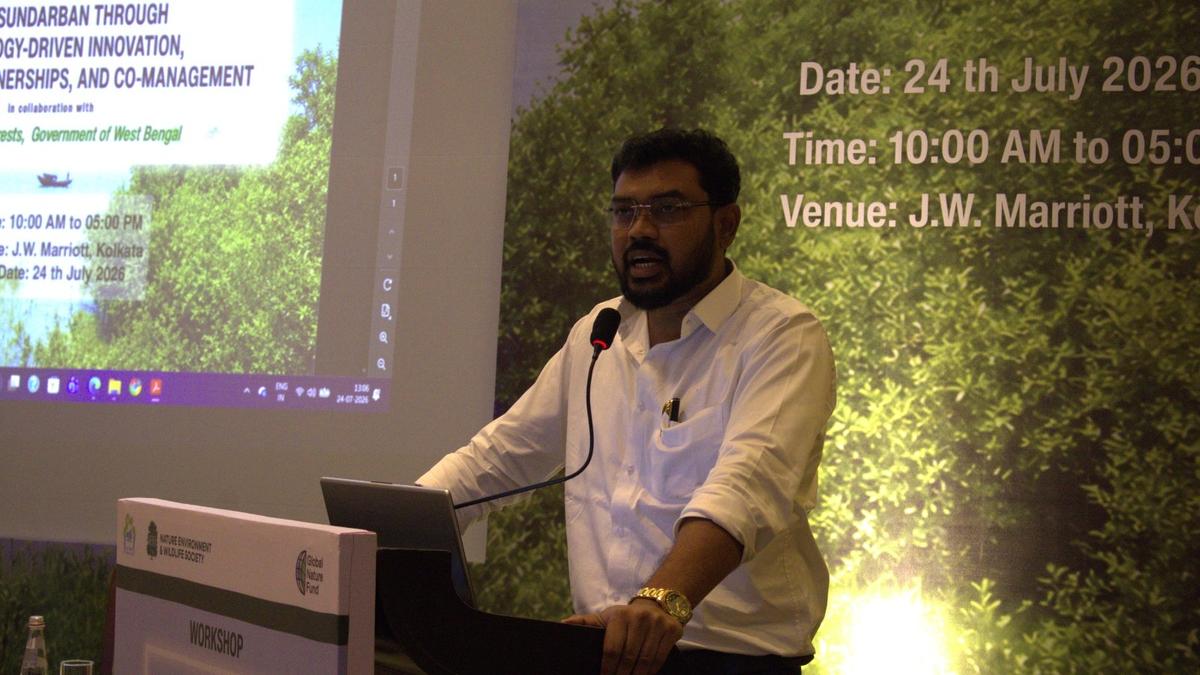
West Bengal Environment and Forest Minister Manoj Kumar Oraon speaking at a workshop organised by the Nature Environment and Wildlife Society (NEWS) in collaboration with the State Forest Department. | Photo Credit: Special Arrangement In the Sundarbans, hundreds of acres of mangrove forests have been lost to encroachments, including the construction of shallow fish ponds. West Bengal Environment and Forest Minister Manoj Kumar Oraon, who recently visited an island where over 100 hectares of mangroves have been encroached on, said on Friday that such areas would be restored.“In one of the islands with green mangrove cover till a few years ago, I saw that the entire island has been turned into fisheries. There are hundreds of such examples,” Mr. Oraon said, referring to Kripakhali in the Sundarbans.The Minister said when one travels along the water bodies and creeks of the Sundarbans, from the outside it appears that there is a dense mangrove forest, but inside the forest, the mangrove cover has been cleared and the land has been encroached upon.Mr. Oraon made the remarks at a workshop titled ‘Strengthening Mangrove Governance in the Indian Sundarbans through Technology Driven Innovation, Knowledge Partnership and Co-management’. It was organised by the Nature Environment and Wildlife Society (NEWS) in collaboration with the State Forest Department.A report prepared by NEWS highlighted that over 600 hectares of mangrove forest have been encroached upon for the construction of bheries (shallow fish ponds) at 10 locations. The representatives of NEWS said the mangroves encroached upon could be much higher as the estimates have been made at only 10 sites.‘Set up authority’Speaking at the workshop, Pradeep Vyas, president of NEWS, called for the setting up of a mangrove management and conservation authority in the State.Dr. Vyas, a former forest official who has served in the Sundarbans for over a decade, also called for promoting the saltwater crocodiles in the area, saying the species can have a lot of tourism potential.West Bengal, particularly the Sundarbans, holds the largest share of mangrove cover in India, accounting for 42.45% of the national total with approximately 2,119.16 sq. km.Rajendra Jakher, Chief Conservator of Forests and Field Director of the Sundarban Tiger Reserve, in his address at the workshop said the number of saltwater crocodiles is between 234 and 264. The Sundarbans is the only mangrove forest in the world which is home to tigers, with a population of about 100 tigers.Emphasising that the Sundarbans are a fragile ecosystem, where all factors are not within the control of local authorities, he said factors in control of the Forest Department are being managed well.Ajanta Dey, joint secretary and programme director of NEWS, said there is no magic wand for restoration and conservation of the Sundarbans, and something that works in one area may not work in another. Ms. Dey, who called for an incremental learning approach for the Sundarbans, also pointed out that there are not enough tidal gauges in the Sundarbans and that such equipment is necessary to have scientific data for management of the ecosystem.One of the success stories of NEWS has been developing a mangrove-linked aquaculture project lauded as a model for sustainable livelihoods. In October 2025, a model of Sustainable Aquaculture in Mangrove Ecosystems by NEWS in West Bengal’s Sundarbans was conferred Global Technical Recognition by the Food and Agriculture Organization of the United Nations.The Sundarbans, a fragile ecosystem which is home to millions of people, is characterised by complex hydro-geomorphological processes, and has experienced a series of extreme climatic events, including cyclones such as Phailin, Bulbul, Amphan and Yash. Published - July 25, 2026 01:56 am IST
West Bengal Minister vows to restore mangroves lost to encroachments in Sundarbans
Full Article
Original Source
Read the full article at Thehindu →KhanList aggregates and links to publicly available news content. We do not host full articles from third-party sources. Always verify important information with original sources.