
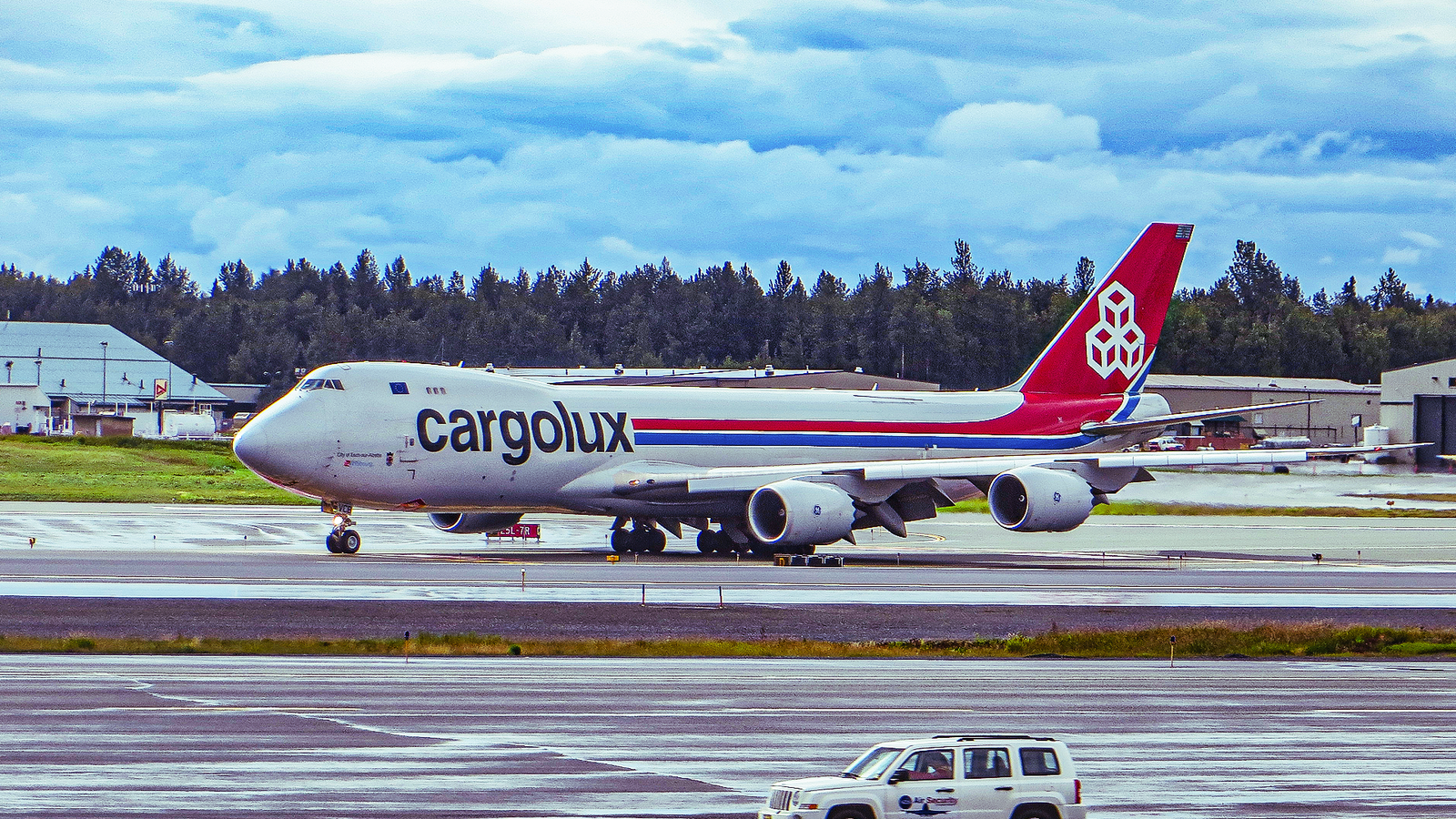
Published Oct 31, 2026, 8:00 PM EDT Journalist - Steven has a varied background in communications, and it was this passion for writing combined with his in-depth knowledge of the aviation industry that led him to Simple Flying. A keen linguist, he also has experience in translation and interpreting. Based in Palma, Spain The Boeing 747-8F remains one of the most capable cargo aircraft in commercial aviation, combining enormous payload capacity with the range required to connect major freight markets. Among the aircraft still operating, Cargolux's LX-VCB holds a special place in aviation history as the first 747-8F delivered by Boeing. Tracking its movements between October 19 and 25 reveals how a single aircraft supports a global logistics network spanning Asia, the Middle East, North America, and Europe. Using the Simple Flying Flight Tracker, the aircraft's movements can be followed leg by leg, revealing a demanding schedule of long-haul flights and intermediate stops. The week also coincided with a serious landing gear incident involving sister aircraft LX-VCF, which prompted inspections across the 747-8F fleet. Together, these developments highlight the complexity of international air freight and the continuing importance of Boeing's largest production freighter. From Miami To Astana: The Week Begins Credit: Phung Quang Minh | Shutterstock LX-VCB began its tracked week on October 19, operating Cargolux Flight CV342 from Miami International Airport (MIA) to Luxembourg Airport (LUX). It departed at 7:21 am UTC and arrived at 3:26 pm UTC, completing the transatlantic journey in eight hours and five minutes. That evening, it departed again, demonstrating how quickly a dedicated freighter can return to service after a long flight. Its next assignment was CV9001, which left Luxembourg at 7:49 pm UTC for Astana Nursultan Nazarbayev International Airport (NQZ) in Kazakhstan. The aircraft arrived at 02:05 UTC on October 20 after six hours and 16 minutes, connecting Europe with Central Asia. LX-VCB did not remain in Astana for long. Flight CV9001 continued to Taipei Taoyuan International Airport (TPE), departing at 5:37 am UTC and arriving at 12:38 pm UTC after seven hours and one minute. Retaining the flight number across successive legs illustrates how cargo services can operate as connected journeys rather than isolated city pairs. Later that day, LX-VCB departed Taipei for Singapore Changi Airport (SIN) as CV9022, arriving at 7:17 pm UTC after four hours in the air. Within two days, the aircraft had crossed several major cargo markets, demonstrating the international reach of the Boeing 747-8F and its ability to transport substantial freight volumes between regions. A Diversion In Muscat Before The Return To Asia Credit: JetKat | Shutterstock On October 21, LX-VCB departed Singapore at 9:43 pm UTC on CV9022, a service bound for Luxembourg that diverted to Muscat International Airport (MCT) in Oman. It arrived at 04:06 UTC after six hours and 22 minutes. The tracking data establishes the diversion but does not establish its cause, making speculation about the circumstances inappropriate without confirmation from Cargolux. Credit: Simple Flying Flight Tracker The aircraft subsequently continued from Muscat to Luxembourg, operating as CLX1G rather than retaining the CV9022 flight number. It departed at 5:57 am UTC and arrived at 1:21 pm UTC, completing the journey in seven hours and 24 minutes. The changed designation illustrates how operational adjustments can affect the flight numbers recorded for individual segments. After returning to Luxembourg, LX-VCB departed at 7:17 pm UTC on CV4793, bound for Hong Kong International Airport (HKG). It arrived at 7:06 am UTC on October 22 after an 11-hour-and-49-minute flight. The schedule carried it from Singapore through Muscat and Luxembourg before sending it back east, reflecting the interconnected nature of international cargo operations. Cargolux's network is built around Luxembourg, with dedicated freighters connecting markets across multiple continents. The Muscat stop remains a documented part of LX-VCB's movements, but its reason remains unconfirmed - tracking data reveals where the aircraft went, not necessarily why its original plan changed. Hong Kong, Anchorage, Dallas & Miami Credit: Sergey Kustov | Shutterstock The next sequence began on October 22, when LX-VCB departed Hong Kong at 9:41 am UTC on CV287. It arrived at Ted Stevens Anchorage International Airport (ANC) at 6:23 pm UTC after eight hours and 43 minutes. Positioned between Asia and North America, Anchorage is a natural stopping point for cargo aircraft crossing the North Pacific. LX-VCB departed Anchorage at 7:44 pm UTC, continuing on the same CV287 service to Dallas/Fort Worth International Airport (DFW). It arrived at 1:30 am UTC on October 23 after five hours and 46 minutes. Keeping the same flight number across both segments shows that the aircraft was following a broader sequence of cargo destinations rather than simply connecting two endpoints. From Dallas/Fort Worth, the aircraft continued to Miami, departing at 4:49 am UTC and arriving at 6:57 am UTC. The domestic leg lasted two hours and eight minutes. Three consecutive destinations under CV287 connected Hong Kong with Anchorage, Dallas/Fort Worth, and Miami, illustrating how a freighter can serve several markets during one extended operation. LX-VCB then departed Miami for Luxembourg at 9:20 am UTC on October 23, arriving at 5:19 pm UTC after seven hours and 59 minutes, completing the loop. Why Cargo Aircraft Fly Loops Credit: Phuong D. Nguyen | Shutterstock Passenger airlines often organize schedules around recognizable return journeys, while dedicated freighters frequently operate more complicated patterns because freight demand varies by destination, shipment type, and time of day. An aircraft may deliver part of its load at one airport, collect additional cargo elsewhere, and continue to another destination before returning home. The CV287 sequence demonstrates this principle. Rather than flying directly from Hong Kong to Luxembourg, LX-VCB crossed the Pacific to Anchorage, continued to Dallas/Fort Worth and Miami, and eventually returned to Luxembourg. The flight number remained associated with successive legs, illustrating how one scheduled service can encompass several stages of a wider cargo operation. Anchorage is particularly important because its location provides convenient access between North America and Asia. Operators can use the airport as a transfer point, a technical stop, or a destination within a multileg service, depending on their schedules and operational requirements. Its geography helps explain its recurring presence in international freighter movements. The Simple Flying Flight Tracker makes these patterns easier to understand by presenting individual flights within the context of a complete itinerary, allowing readers to follow an aircraft across several destinations rather than viewing each arrival in isolation. LX-VCB's schedule demonstrates how tracking data can reveal the structure of freight operations as well as document individual flights. The Luxembourg Landing Gear Incident Credit: Minh K Tran | Shutterstock October 23 brought a significant development for Cargolux when sister aircraft LX-VCF suffered a landing gear collapse in Luxembourg. The incident prompted fleet-wide inspections of the Boeing 747-8F aircraft, drawing attention to the operational challenges of maintaining a large freighter fleet while supporting a busy international schedule. LX-VCB was also in Luxembourg that day, having arrived from Miami at 5:19 pm UTC. It departed again for Hong Kong at 9:22 pm UTC on CV4755, arriving at 8:30 am UTC on October 24 after 11 hours and eight minutes. Its subsequent movements provide a chronological record, although tracking data cannot establish which inspections were conducted on the aircraft. An incident involving one aircraft can have implications for an entire fleet. Operators may need to assess other aircraft, coordinate technical checks, and determine whether scheduled flights can proceed as planned. These measures can place additional demands on maintenance teams and operational planners, especially when aircraft are moving continuously between international cargo markets. The available itinerary must nevertheless be distinguished from confirmed technical information. LX-VCB's presence in Luxembourg on the day of the incident does not establish that it was directly involved or experienced a related problem. The First Boeing 747-8F & The Future Of Air Freight Credit: Markus Mainka l Shutterstock LX-VCB occupies a special place in Boeing 747 history. Built in 2010 and delivered to Cargolux on October 12, 2011, it was the first 747-8F delivered by Boeing. Named City of Esch-sur-Alzette, the aircraft marked an important milestone for a family whose payload capacity and long-range performance made it a cornerstone of international cargo operations. The Boeing 747-8F developed the strengths of earlier 747 freighters with a longer fuselage and updated technology, while retaining the distinctive nose-loading capability that allows operators to accommodate certain oversized shipments. Boeing ended 747 production in 2023, delivering the final aircraft to Atlas Air, but existing freighters continue to support important routes worldwide. Cargolux remains a significant operator of the type. Newer-generation aircraft will eventually change its operations, but the 747-8F remains valuable for its capacity, range, and established infrastructure. LX-VCB's schedule demonstrates how an aircraft delivered more than a decade ago can continue serving a global network. Ranking Airline Boeing 747-8F 1 UPS Airlines 30 2 Atlas Air 15 3 Cathay Pacific 14 4 Cargolux 14 5 Nippon Cargo Airlines 8 The latest data from ch-aviation shows that UPS Airlines is currently the largest operator of the Boeing 747-8F, as detailed in the table above. The outlook for dedicated cargo aviation also points toward continued demand. Airliner World reported an Airbus forecast projecting 46% growth in the global freighter fleet by 2045. This reflects expectations for expanding freight requirements and aircraft replacement needs. The European manufacturer is tapping into this market with its freighter version of the popular Airbus A350 aircraft. Although future growth will depend on economic conditions and trade patterns, LX-VCB's movements illustrate the role large freighters continue to play in connecting manufacturing centers, distribution hubs, and consumer markets.
We Tracked The World's First Boeing 747-8 Freighter For A Week: Here's Where It Went
Full Article
Original Source
Read the full article at Simpleflying →KhanList aggregates and links to publicly available news content. We do not host full articles from third-party sources. Always verify important information with original sources.