
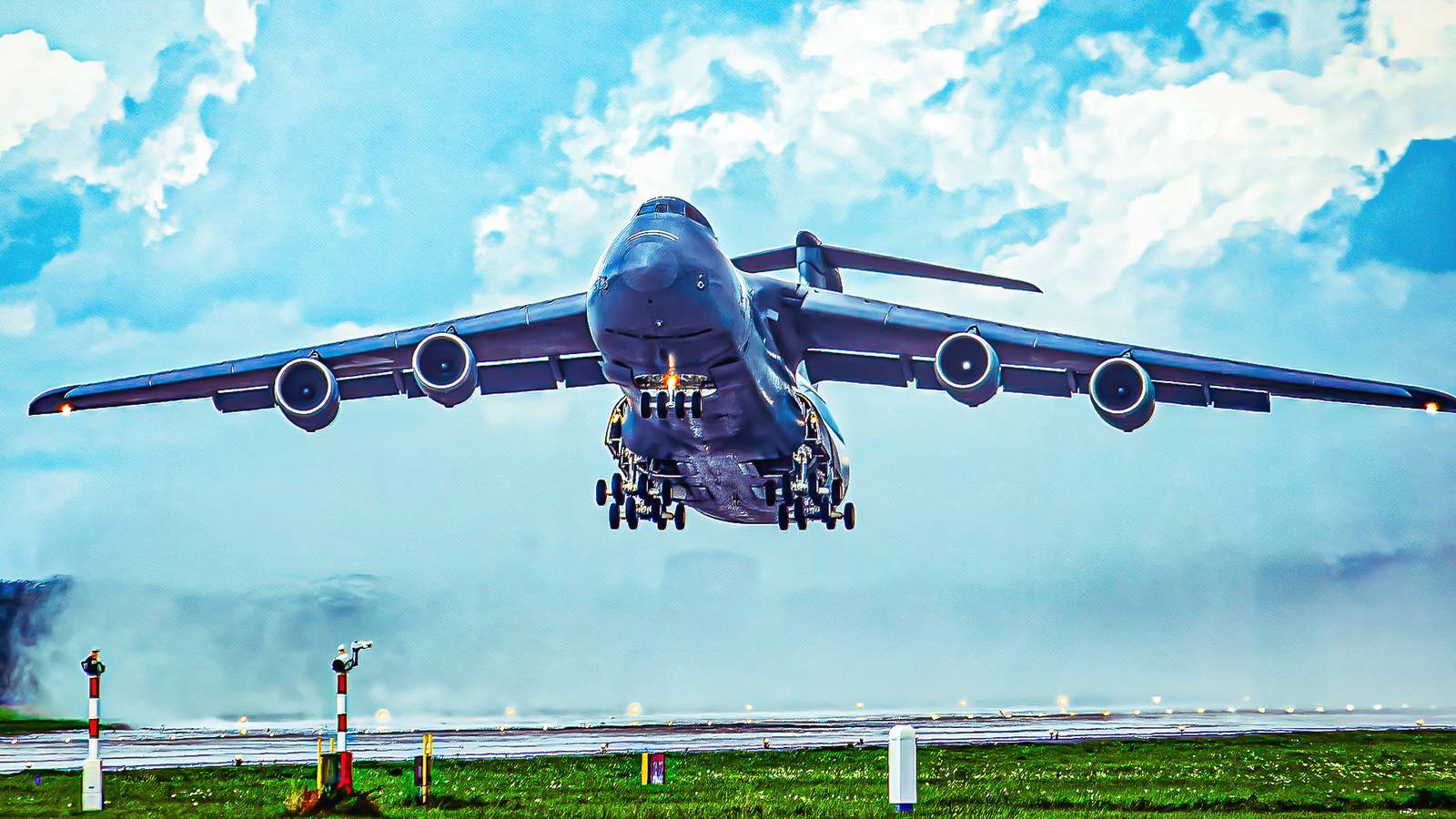
Credit: Adomas Daunoravicius | Shutterstock Published Oct 31, 2026, 6:00 PM EDT Passionate about promoting aviation, the beauty of flight and the science behind it, Antonio is an avid reader of aviation magazines and books, and he loves visiting airshows all over the world, taking photos and writing about airplanes and helicopters as well. He is currently based in Palermo, Sicily. Sign in to your Simple Flying account The Lockheed C-5M Super Galaxy can take off weighing 840,000 lb (381,024 kg), yet the United States Air Force's standard crew consists of just seven people. In January 2020, however, one aircraft left Dover Air Force Base (DOV) with twelve crew members and spent fifteen days away. The difference is more than a matter of numbers: it raises a question about what it takes to operate one of the world's largest military transport aircraft. So why did that flight need five additional people? The answer involves the C-5M's crew structure, the demands of a long-distance mission, and decisions made before the aircraft even leaves the ground. Understanding the difference also helps explain why the Air Force has retained a larger crew for the Galaxy than for the smaller C-17 Globemaster III. The Seven Standard Positions Credit: US Air Force According to the Air Mobility Command fact sheet, the C-5M’s standard crew is a pilot, a co-pilot, two flight engineers and three loadmasters. Airman Magazine independently lists the same breakdown, and Air & Space Forces Magazine agrees. The pilots fly the aircraft, while the other five handle systems monitoring and cargo operations. Their responsibilities help explain why the C-5M needs a larger crew than some newer military transports. The aircraft they operate is anything but ordinary. As reported by the same fact sheet, the cargo compartment runs 143 feet, 9 inches (43.8 meters) long, 19 feet (5.79 meters) wide, and 13 feet, 6 inches (4.11 meters) high, with 36 pallet positions and a maximum payload of 281,001 lb (127,460 kg). Four engines, each rated at 51,250 pounds (228 kN)of thrust, push it along at 518 miles per hour (833.5 km/h). Aerial refueling can extend the aircraft's range, although crew endurance remains a limiting factor on long missions. Even without refueling, a C-5M carrying 281,001 lb can fly 2,150 nautical miles (3,982 km), unload, and continue another 500 nautical miles (926 km) to a second base. That kind of operation requires coordination between the flight crew and the loadmasters. Right now, the Air Force owns 52 of these aircraft, spread across four bases, and each one needs the same seven roles filled. Three of the seven crew members are loadmasters, making them the largest group in the standard crew. So what do three loadmasters actually do once the engines are running? What C-5 Galaxy Loadmasters Do In Flight Credit: US Air Force The loadmasters' responsibilities begin before takeoff and continue throughout the mission. According to a Joint Base San Antonio-Lackland (JBSA) training profile, loadmasters handle loading and offloading, pre-flight and post-flight checks of aircraft systems, weight-and-balance calculations, airdrops, and the decision about how much cargo and how many passengers go where. On a C-5M, that job is physical and mathematical at the same time. The C-5M's design gives loadmasters several ways to handle oversized cargo. Its nose can swing upward while the rear ramp is lowered, allowing loading operations at both ends of the aircraft. Full-width drive-on ramps also accommodate double rows of vehicles, according to Air Mobility Command. Air & Space Forces Magazine lists loads such as two M1 Abrams tanks, six Boeing AH-64 Apache helicopters or seven MRAP vehicles. The landing gear can even kneel, lowering the floor so tall cargo is easier to roll aboard. Every one of those loads has to be placed so the aircraft stays balanced, which is why the schoolhouse starts with math. An instructor there put it bluntly: fail that portion and you are out. Position Seats Main job Pilot and co-pilot 2 Flying the aircraft Flight engineers 2 Monitoring aircraft systems Loadmasters 3 Loading, securing, weight and balance Total 7 With the cargo secured, the other two non-pilot positions in the standard crew become the focus: the flight engineers. Their role has largely disappeared from modern airline cockpits, but the C-5M still relies on them to monitor the aircraft's systems. Why The C-5 Galaxy Still Needs Two Flight Engineers Credit: US Air Force The C-5's cockpit reflects the era in which the aircraft was designed. When the Galaxy was developed in the 1960s, large aircraft commonly carried dedicated flight engineers to monitor systems and assist the pilots. As Simple Flying explains, the Galaxy was conceived in the 1960s, long before glass cockpits existed, and its mission did not justify digital avionics until much later in its service life. The same JBSA profile says flight engineers handle preflight, through-flight, and post-flight inspections away from home station, and work out engine fuel consumption from airspeed and atmospheric data. Modernization has changed what flight engineers work with, but it has not eliminated the role. Airman Magazine notes that upgrades brought flat-panel displays, new navigation and safety equipment, and a new autopilot. Air Mobility Command also says a diagnostic system now records data from more than 7,000 test points. The flight engineers remain responsible for monitoring the aircraft's systems, while further flight deck display upgrades are still in development, according to Air & Space Forces Magazine. We will see exactly how the flight engineer earns that seat, on a mission that went wrong, in a moment. The C-17’s fact sheet shows just 3 crew members. Its smaller crew reduces manpower requirements, risk exposure and long-term costs. The C-5M's standard crew is more than twice as large, but a January 2020 mission departed with twelve people on board. If three people can run a big airlifter, why did one C-5M mission launch with twelve? Why A C-5 Galaxy Flew With 12 Crew Members In 2020 Credit: Department of Defense Seven is the standard crew complement, not a limit on how many people can be assigned to a mission. As reported by Air Mobility Command, the REACH 190 left Dover on January 13, 2020, counted twelve crew members: an aircraft commander and two more pilots, two flight engineers, six loadmasters, and a flying crew chief from the 436th Aircraft Maintenance Squadron. The account does not explain the staffing choice, but it does show what a crowded flight deck can absorb. In the preflight briefing, aircraft commander Capt. Geoffrey Howard stressed communication and crew resource management across the three crew positions, a theme that would matter within days. And it had a lot to absorb. The crew spent four and a half days at Barksdale Air Force Base (BAD), Louisiana, before an unscheduled return to Dover to fix an inoperative weather radar. Then, climbing through 18,000 feet (5,486 meters), a pressure-door warning lit up the pilot, co-pilot, and flight engineer displays. Flight engineer Tech. Sgt. Alexander Barnes confirmed cabin pressure was stable, and the crew ran the checklist that called for descending below 10,000 feet (3,048 meters). The pressure-door warning was not the only problem the crew had to manage. A passenger on the troop deck then suffered a seizure. Loadmaster Sgt. Joshua Cutrer helped the passenger while keeping the aircraft commander informed, and recommended a diversion. At 770,000 lb (349,266 kg), the Super Galaxy needed a long runway, and Memphis, with more than 11,000 feet (3,353 meters) of it, was about fifteen minutes away. Howard declared an in-flight emergency, air traffic control supplied immediate vectors, and the passenger walked off the aircraft under his own power. Two and a half hours later, the crew flew on to Dover. Twelve people made that look routine. Could the Air Force simply add people whenever a mission demands it? C-5 Galaxy Crew Training Takes More Than One Year The JBSA profile says flight engineers and loadmasters need about 18 months of training to graduate, while pilots, who must already have earned their wings, can face up to two years. When it was written in 2018, the formal training unit could teach roughly 250 C-5M students a year, and it trained every aircrew, active duty included. A chief flight engineer there recalled seeing grown men cry when they could not complete the course. Those training requirements make it difficult to replace experienced crew members quickly. Training is only part of the challenge. The work itself can involve long hours and demanding conditions. The same loadmaster instructor described hurricane relief flights in 2017 as nonstop, with cargo checks lasting until landing. The environment is punishing too: as reported by Simple Flying, the noise near a C-5 at full power can approach or exceed 120 decibels. Air Mobility Command says the move to CF6 engines made the fleet quieter and compliant with FAA Stage 4 noise standards. Quieter, however, does not mean easier on the people inside. The Air Force must also consider how long the existing fleet can remain in service. A low mission-capable rate and ongoing maintenance demands raise questions about the future of the aircraft and the crews trained to operate it. What C-5 Retirement Means For Its Crew Credit: US Air Force The C-5M's future remains uncertain, despite plans to keep the aircraft in service for decades to come. As reported by Air & Space Forces Magazine, Gen. Kenneth Wilsbach told lawmakers on April 30, 2026, that the C-5 had a 37 % mission-capable rate, down from 49 % in fiscal 2024. Air Force Secretary Troy Meink said the C-5s were extended through 2040, and that the Galaxies would be replaced before the C-17s. Wilsbach added that the 2027 budget request includes $24.7 billion for aircraft sustainment, and he called the mobility force sustaining rather than declining. The longer-term outlook is not entirely clear, however. Simple Flying reports that the Air Force plans to keep the C-5M flying until 2050 despite low readiness, rising costs, and maintenance delays. Lawmakers have also pressed on the Next Generation Airlifter, intended to replace both the C-5 and the C-17. Air Mobility Command’s interim leader at the time, Lt. Gen. Rebecca Sonkiss, put the stakes simply: “there is no other aircraft that can do what the C-5 does.” The C-5M's eventual replacement will have to meet the Air Force's heavy-lift requirements, but it may not need to replicate every feature of the existing aircraft. The C-17 already demonstrates how a smaller crew can operate a large transport, while the C-5's mission and payload requirements demand a different approach. As the Next Generation Airlifter takes shape, its crew requirements will be one indication of how the Air Force intends to move its heaviest equipment in the years ahead.
How Many Crew Members Does It Take To Fly A C-5 Galaxy?
Full Article
Original Source
Read the full article at Simpleflying →KhanList aggregates and links to publicly available news content. We do not host full articles from third-party sources. Always verify important information with original sources.