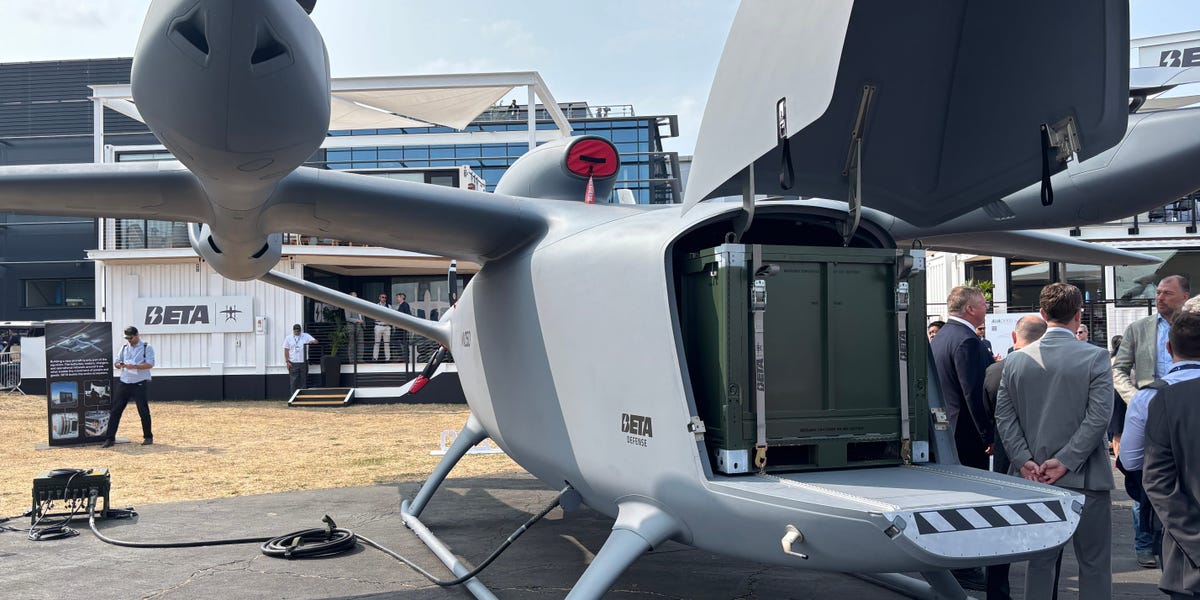
Cargo is loaded into the nose of the MV250. Pete Syme/Business Insider Uncrewed aircraft are becoming more important to militaries, and defense departments are increasingly looking to air-taxi companies for help.Beta Technologies unveiled the MV250, an autonomous hybrid-electric cargo aircraft, at the Farnborough Airshow in July. Business Insider was there to see why the company believes it could be a valuable tool for the future battlefield.Beta initially focused on civil electric aircraft. But as militaries seek new ways to move supplies amid increasingly autonomous warfare, Beta has adapted its technology for a new customer.The MV250 can take off and land vertically, fly without a pilot aboard, and carry up to a ton of cargo into dangerous areas.Here's what it's like, and why it matters. Beta Technologies is one of several firms building air taxis — electric aircraft that can take off and land vertically. Beta's Alia-250 eVTOL during a test flight in 2023. Tiffany Hagler-Geard/Bloomberg via Getty Images These eVTOLs operate like helicopters but make very little noise. So, they wouldn't annoy residents when flying over cities.Beta is also building an electric aircraft that takes off and lands conventionally, known as a CTOL.Earlier this year, Beta deployed its all-electric ALIA CTOL aircraft during NATO Exercise Aurora 26 in Sweden. It then adapted that technology into a military aircraft, the MV250. A side view of the MV250 on display at Farnborough. Pete Syme/Business Insider It is a hybrid-electric aircraft that can take off vertically and fly autonomously."Why do we all want autonomy? I'm a pilot. No pilot wants to see their job go away," said Gen. Jim McConville, a former chief of staff of the US Army and a Beta board member."But what we want to do is give commanders the ability to go into situations at extremely high risk."For example, in Ukraine, aerial drones and ground robots are increasingly being used for logistics missions that have become too dangerous for soldiers.Ukrainian officials have said that they want machines to eventually handle 100% of battlefield logistics amid a broader push to replace humans with robotics wherever possible. Instead of carrying pilots or passengers, it can transport up to a ton of cargo. The MV250 has a much longer range when not carrying cargo. Taylor Rains/Business Insider The MV250's nose opens to reveal a cargo bay capable of carrying up to 2,000 pounds of equipment, medical supplies, munitions, or other critical cargo.Beta says it can take that payload to destinations within a 250-nautical-mile tactical radius, roughly 288 miles, and return to base. Beta says hybrid-electric power means it can fly faster and farther than a helicopter. Beta has traditionally focused on all-electric aircraft. Taylor Rains/Business Insider A turbogenerator developed with GE Aerospace produces electricity for the MV250's motors.As well as the 1,300-nautical-mile repositioning range — when it isn't carrying a payload — Beta says it can generate power on the ground for equipment such as radar, antennas, and other vehicles. Beta says its bonded-composite fuselage could speed up production. Quicker manufacturing times could be ideal for militaries. Taylor Rains/Business Insider The MV250's fuselage is bonded together rather than held with conventional fasteners."That allows us to make this in a panini press, basically," Clark said. "You can make it inexpensively and meet the demands of the military."Beta says manufacturing cycle times could be measured in hours rather than months.It has also designed the aircraft without gearboxes, hydraulics, or articulating rotors, systems that can add maintenance demands.During earlier military exercises with Beta's all-electric aircraft, Clark said the company sent one maintainer and one pilot — and "the maintainer was bored." Beta thinks military demand could develop faster than the air-taxi market. Kyle Clark, Beta's CEO and founder. Taylor Rains/Business Insider Beta developed the technology behind the MV250 for civilian electric aircraft, but Clark said defense customers may adopt vertical-lift technology sooner."Near-term defense, I think, will take a pace in front of civil in vertical lift, and then civil will overtake that," he said. Defense dominated this year's Farnborough Airshow as governments are growing more concerned about security. Airshow attendees watching an F-35A fighter jet during the flying display. Andrew Matthews/PA Images via Getty Images Defense companies made up about half of the roughly 1,600 exhibitors at this year's airshow, up from the roughly 40% share they usually represent. The event drew over 140,000 visitors, a 41% increase on the last edition in 2024.The shift reflects a scramble to rearm as wars have reshaped military priorities, including the need for cheaper drones, autonomous systems, and new ways to move supplies.NATO allies have also committed to raising defense and security-related spending to 5% of GDP by 2035, after President Donald Trump pressed them to spend more. Read next Pete Syme is an aviation reporter for Business Insider, based in London.He writes about all things related to the industry, such as flight diversions, aviation safety, airline updates, travel tips, plane tours, and aviation leaders.Pete has appeared on BBC News to discuss a Heathrow Airport closure and on Sky News to talk about Boeing.Before joining Business Insider in 2022, he graduated with an MA in Newspaper Journalism from City, University of London. While getting his BA in English from the University of Exeter, he was the award-winning deputy editor of the student newspaper, Exeposé.You can get in touch by emailing psyme@businessinsider.com or via Signal @syme.99. Aviation
We saw Beta Technologies' autonomous aircraft for the battlefield. Meet the MV250.
Full Article
Original Source
Read the full article at Businessinsider →KhanList aggregates and links to publicly available news content. We do not host full articles from third-party sources. Always verify important information with original sources.