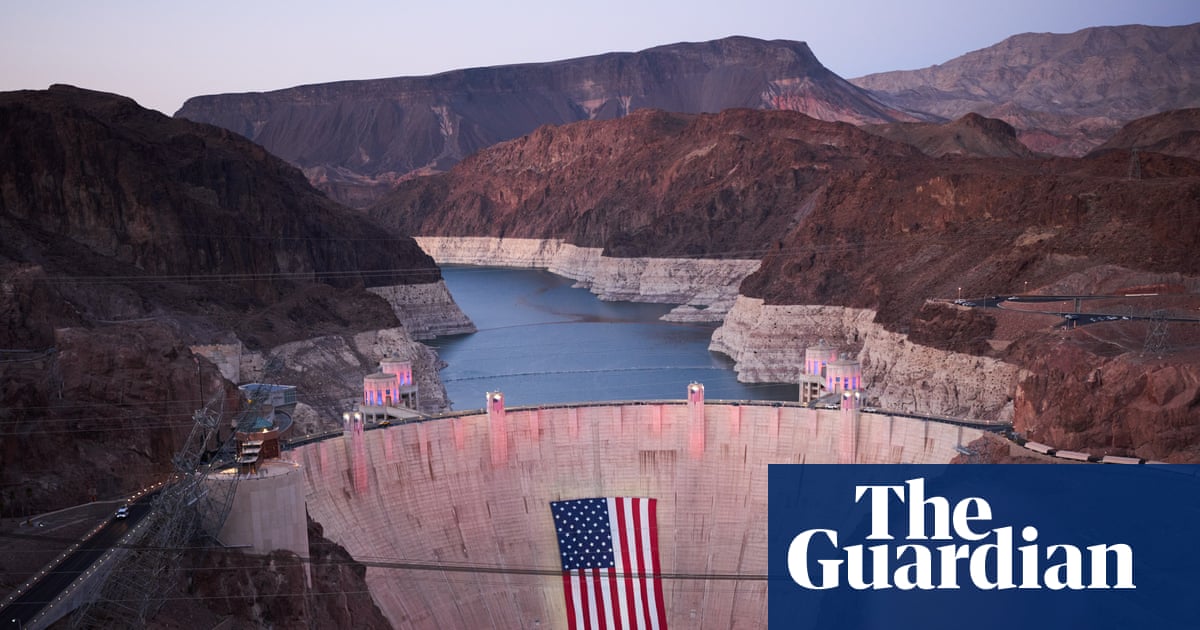
The US government released its anxiously awaited plan for how to manage the Colorado river crisis on Friday, outlining cuts in water supplied to California, Arizona and Nevada.The proposal from the US Bureau of Reclamation spares Colorado, Utah, New Mexico and Wyoming from facing mandatory cuts, for now. But it is a temporary fix as the states that rely on the river continue to fight over a long-term management plan for the dwindling resource that supplies huge swaths of the western US.The proposal is the federal government’s answer to a years-long stalemate between the seven states responsible for forming a plan on how to distribute the deep cuts needed to pull the system back from the brink. It comes just months before the framework that currently governs the essential and imperiled waterway is set to expire.The western US is running out of water. What happens next? – Stateside with Kai and Carter“This framework provides the flexibility to respond to changing hydrologic conditions while preserving the opportunity for the Basin States to continue working toward durable, consensus-based solutions,” said Doug Burgum, the US interior secretary, in a press release.Under the 10-year plan, the Lower Basin states could face deep cuts of up to 3m acre-feet (3.7bn kiloliters) a year – up to 40% of their collective total – “subject to hydrology”, according to the press release by the Department of the Interior. That’s about enough water annually to serve more than 25 million people.The plan would also allow annual releases of between 5m and 12m acre-feet from Lake Powell, the basin’s second-largest reservoir. Under the 10-year federal framework, water management decisions will be made every two years.The federal government is expected to release a record of decision in the coming week that will detail operations under the plan in the short term, but it is likely they will closely follow a proposal issued by the lower basin states earlier this year that would shave 3.2m acre-feet from their combined total over 2027 and 2028.Governing the enormous and essential river system has always been deeply challenging. The federal government has limited jurisdiction over water policies and agreements between states. A century-old compact that initially divided up the river gave rights to more water than there is in the system. With the river’s decline, the gap has only widened.The combined levels of the two largest reservoirs on the river, Lake Powell and Lake Mead, have already reached record lows and it’s exceedingly unlikely that the system will bounce back, even if there is a wet winter.An overlook near the Wahweap Marina on Lake Powell in July 2026. The reservoir is nearing a record low level. Photograph: John Locher/APThe Bureau of Reclamation has the power to manage operations of the dams at the two central reservoirs, which provide hydroelectric power and supply the flows from the upper states to the lower, which is largely why, experts say, the cuts were directed at the lower basin states.The river and its tributaries are the lifeblood for the American west, supplying bustling cities such as Las Vegas, Phoenix and Los Angeles, as well as agricultural centers. Roughly 40 million people in seven states, two countries and dozens of tribes rely on the river, which also irrigates 5.5m acres of farmland.The Colorado has been overdrawn for more than a century, as demand continues to outpace supply. The climate crisis is also taking an increasingly large share. Snowmelt that feeds the river is evaporating more quickly, and thirsty soils and plants soak up more water. Flows in the Colorado are down 20% over the last century and precipitation has shrunk by about 7%.Snaking across 1,450 miles (2,300km) from the Rocky Mountains into Mexico, the sprawling basin fuels an estimated $1.4tn in economic activity and is also home to scores of birds, fish, plants and animals, its diverse ecosystems providing critical habitat for more than 150 threatened or endangered species.The ecosystems on the banks of the river have already paid a heavy price. Fourteen native fish species are endangered or threatened. The once-lush wetlands in Mexico’s river delta have been dry for decades and the once mighty river slows to just a trickle as it crosses the US-Mexico border.
Water cuts loom as US unveils long-awaited response to Colorado river crisis
Full Article
Original Source
Read the full article at Theguardian →KhanList aggregates and links to publicly available news content. We do not host full articles from third-party sources. Always verify important information with original sources.