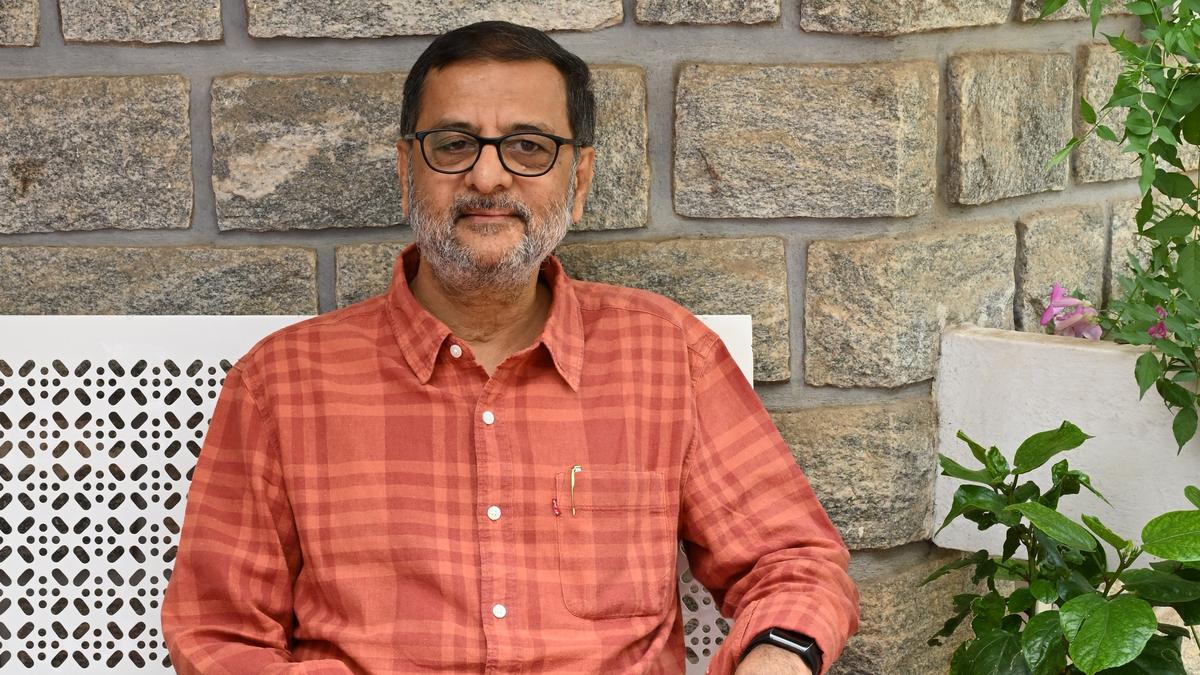
What happens when you cradle a seed of an idea and nurture it for almost 20 years? For novelist and playwright Vivek Shanbhag, it led to the founding of Hyphen, a literary journal to celebrate India’s multilingual heritage with an exclusive focus on translations from Indian languages into English. “I grew up reading translations from other languages, whether it was Malayalam or Russian. But I have always felt that while Indians have so much access to writers from outside the country, there is little access to writers from our own neighbouring States. It was this desire to read writers from other Indian languages that led to Hyphen. We named it six years ago when we started Bahuvachana Prakashana, our publication house, but no one noticed it then,” says Shanbhag. Now, in the wake of global attention on Indian literature following the International Booker Prize wins for Tomb of Sand by Geetanjali Shree and Daisy Rockwell in 2022, and Heart Lamp by Banu Mushtaq and Deepa Bhasti in 2025, the moment seems opportune for a venture such as Hyphen to bridge the gap in India’s translation landscape. What is Hyphen?With Deepa Ganesh as Editor-in-Chief, Hyphen is launching on July 26 with three components: a literary journal in English, in print and digital formats; a publishing wing; an online space for translation resources, a curated bookshop, fellowships and mentorship programmes, seminars, book clubs, and publisher forums. It will also be printed and circulated in the United States and the United Kingdom. An initiative of Bahuvachana Trust, of which Shanbhag is the founding trustee, Hyphen is supported by an advisory board comprising distinguished writers, translators and literary figures, including Geetanjali Shree, Perumal Murugan, Namita Gokhale, KR Meera, Christopher Merrill, Hansda Sowvendra Shekhar and Sudhir Sitapati. The name, Hyphen, is borrowed from a line by famous scholar and translator AK Ramanujan, says Shanbhag. “Ramanujan once described himself as the hyphen in ‘Indo-American’. So, this is a tribute of sorts to him. I also feel that the hyphen signifies the connecting of two disparate things,” he explains. A world of languagesIt is the diverse nature of a journal that makes it an efficient and enticing way to introduce Indian writing to readers around the world, he feels. “While a book will expose you only to one writer, a journal can have 20 writers. In a linguistically diverse country such as India, a literary journal can offer people a taste of what these writers are, pique their curiosity and help them pursue it further,” says Shanbhag, who is no stranger to running a journal. He brings to Hyphen insights from his seven-year run as the editor of Desha Kaala, a Kannada literary magazine, coupled with his experience working in the corporate world. What makes it even more personal is the wider readership Shanbhag has enjoyed with the English translations of his popular and much-loved Kannada novels, Ghachar Ghochar and Sakina’s Kiss. “It is one thing to run a small magazine such as Desha Kaala, and another to run Hyphen. But the experiences have been useful during this tough journey of structuring, establishing and building the initiative over the past year,” he adds. While the inaugural issue is curated, Hyphen has plans to open up the journal for submissions at a later stage. Every issue of the journal, will also spotlight one literary tradition to help people be anchored in that language, starting with Marathi. “Marathi has great writers who are open to experimentation. The performing arts of the region as well as social movements, have also had an impact on the way literature is perceived. The attempt is to give a glimpse into what Marathi writers, critics, and playwrights are thinking.”Translation, the sole focusAcross its three branches, translation remains the singular focus of Hyphen, and Shanbhag acknowledges the challenges that come with it. “For any literary journal, the challenge is to get good stories and writing. When I was running Desha Kaala, I had a section called Desha Bhashe, where I brought a piece of writing from other Indian languages that was not available in Kannada to inspire our writers. I soon realised, it is one thing to know a few people or writings from a language and a whole other ball game to select a piece for translation. I feel that is a challenge Hyphen will have to contend with.”In what could give an added boost to these literary endeavours, Hyphen and Bahuvachana Trust are also attempting to understand the way young India reads through an ambitious initiative called Hyphen Connects. As part of the pilot programme, activities, discussions and day-long sessions have been held at 18 universities across Bengaluru, Shivamogga, Tumakuru, Channarayapatna, Udupi, Mysuru, and Dharwad in Karnataka. “We will be announcing several contests for students soon, with Hyphen subscriptions as the prize. We hope such engagement will open young minds to literature from all parts of India,” Shanbhag says. Students of Vidyashilpa University in Bengaluru during an activity organised as part of Hyphen Connects, a student outreach programme. | Photo Credit: Special arrangement A means to reconnectHyphen’s long-term vision towards building a pan-India translation initiative includes workshops, mentorship programmes and fellowships for emerging translators. “In the last 20-25 years, there is a significant difference in the quality of translations largely owing to English medium education. English is the first language for many young people, but they are also interested in reading or working on translations as a means to reconnect with their mother tongues,” he says, citing their experience with Hyphen Connects. For Shanbhag, Hyphen represents the joy of sharing. “India has always had a strong tradition of literary journals. It’s run by a small group of people with a few thousand subscribers. But there is a lot of joy in doing things where people share your passion. That is Hyphen, on a slightly bigger scale.” Hyphen will be launched at BIC, Domlur, 11 am on July 26. A single issue of the 272-page journal is priced at ₹799, while an annual subscription, comprising two issues, is available at ₹1,299. More details on the Hyphen website.
Vivek Shanbhag on ‘Hyphen’, and bridging the gap in India’s translation landscape
Full Article
Original Source
Read the full article at Thehindu →KhanList aggregates and links to publicly available news content. We do not host full articles from third-party sources. Always verify important information with original sources.