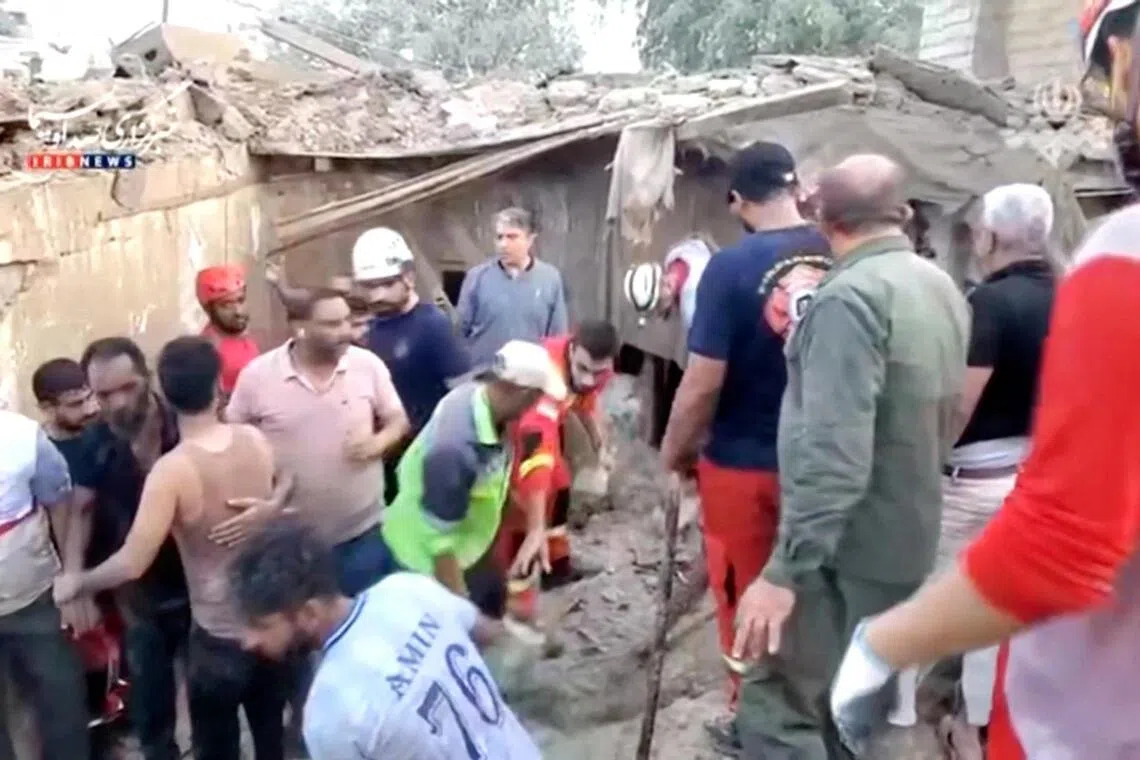
WASHINGTON – The United States struck a family home on Iran’s Qeshm island overnight on July 30 with a large-scale bomb, according to an analysis of videos, photos and satellite imagery by weapons experts and The New York Times.Iranian officials said the strike killed a husband and wife and their two-year-old son. The couple’s two other children were pulled from the rubble alive, they said.The size of the crater and munition fragments appear to show the weapon used was a 2,000-pound bomb called a Mark-84, one of the largest conventional bombs used by the US military.The location and time of the strikes are consistent with where and when the US was operating. The evidence raises questions about what the US was targeting and why such a large munition was used.The strike hit a densely populated neighbourhood on the island, which sits in the Strait of Hormuz in southern Iran, and appears to have been part of a flurry of attacks the US said it launched to retaliate against earlier strikes by Iran on a base used by US forces in Jordan.The Times found no indication of a military site near the family’s home or any reports of military casualties from the strike, which the Iranian authorities typically announce.Roughly 20 neighbouring households were displaced by the strike, Iranian officials said, and footage shows debris and damaged vehicles over 60m away. Additional strikes destroyed two warehouses outside the city in the same wave of attacks, according to the visual analysis.US Central Command (CENTCOM), which announced it struck targets in southern Iran early on July 30, said it was looking into the reports of civilian casualties but did not respond to questions about the intended target, the munition used or what precautions had been taken to protect civilians.“We are aware of the reports and looking into them,” said Captain Tim Hawkins, a CENTCOM spokesman. “The US military never targets civilians.”The Times corroborated details in bystander and news footage with satellite imagery to pinpoint the location of the strike and determine the size of the crater.The strike, which occurred in the Chah-Tangu neighbourhood of Qeshm City, an area of tightly clustered homes, also destroyed several structures, leaving a crater at least 9m wide.“The large crater and structure damage is consistent with a Mark-84 2,000-pound bomb, which can be equipped with JDAM guidance kits,” said Trevor Ball, a former US Army explosive ordnance disposal technician and an analyst at Armament Research Services, referring to kits that convert unguided bombs into GPS-guided munitions.Photos published by the Iranian media, he said, showed parts of these guidance kits, though the Times could not confirm where the fragments were recovered.Frederic Gras, a French munitions consultant who reviewed the same imagery, also said the crater dimensions matched an air-dropped Mark-84 2,000-pound bomb.He said the bomb appeared to have detonated below the surface rather than on impact, and that the sandy ground absorbed part of the blast, directing the force downward, which limited damage in the surrounding area.Gras also identified the metal remnant as the tail section of a JDAM guidance kit.Weapons of this size are typically used for “buildings, rail yards and lines of communication”, according to a US Army office that manages ammunition for the Pentagon. Experts say they can cause serious harm to civilians when used in heavily populated areas.Though it remains unclear who or what the intended target in the strike may have been, international humanitarian law requires combatants to weigh the expected harm to civilians against the military advantage of a strike.“The attacking force must take all feasible precautions to minimise civilian harm, including in its selection of munitions, times of attack and, whenever circumstances allow, by issuing effective advance warnings,” said Tom Dannenbaum, a professor of law at Stanford University.The choice of a 2,000-pound munition in a densely populated area, he added, “is very difficult to reconcile with” that obligation.Ahmad Nafisi, a deputy governor of Hormozgan province, cited by Fars News, a semi-official Iranian news agency, identified the dead as Zahra Jafari; her husband, Qeysar Jafari, a taxi driver; and their son, Sina.In a video report from Mehr News, another semi-official Iranian news agency, a clock on a wall inside one of the ruined houses had stopped just before 3.40am local time, minutes after CENTCOM said it started striking Iran that night.The Jafaris’ two surviving children, Mohammad Reza and Mehdi, remained hospitalised but were in stable condition, Iranian officials said. NYTIMESThis article originally appeared in The New York Times.
Visuals suggest US dropped 2,000-pound bomb on home in Iran, killing 3
Full Article
Original Source
Read the full article at Straitstimes →KhanList aggregates and links to publicly available news content. We do not host full articles from third-party sources. Always verify important information with original sources.