
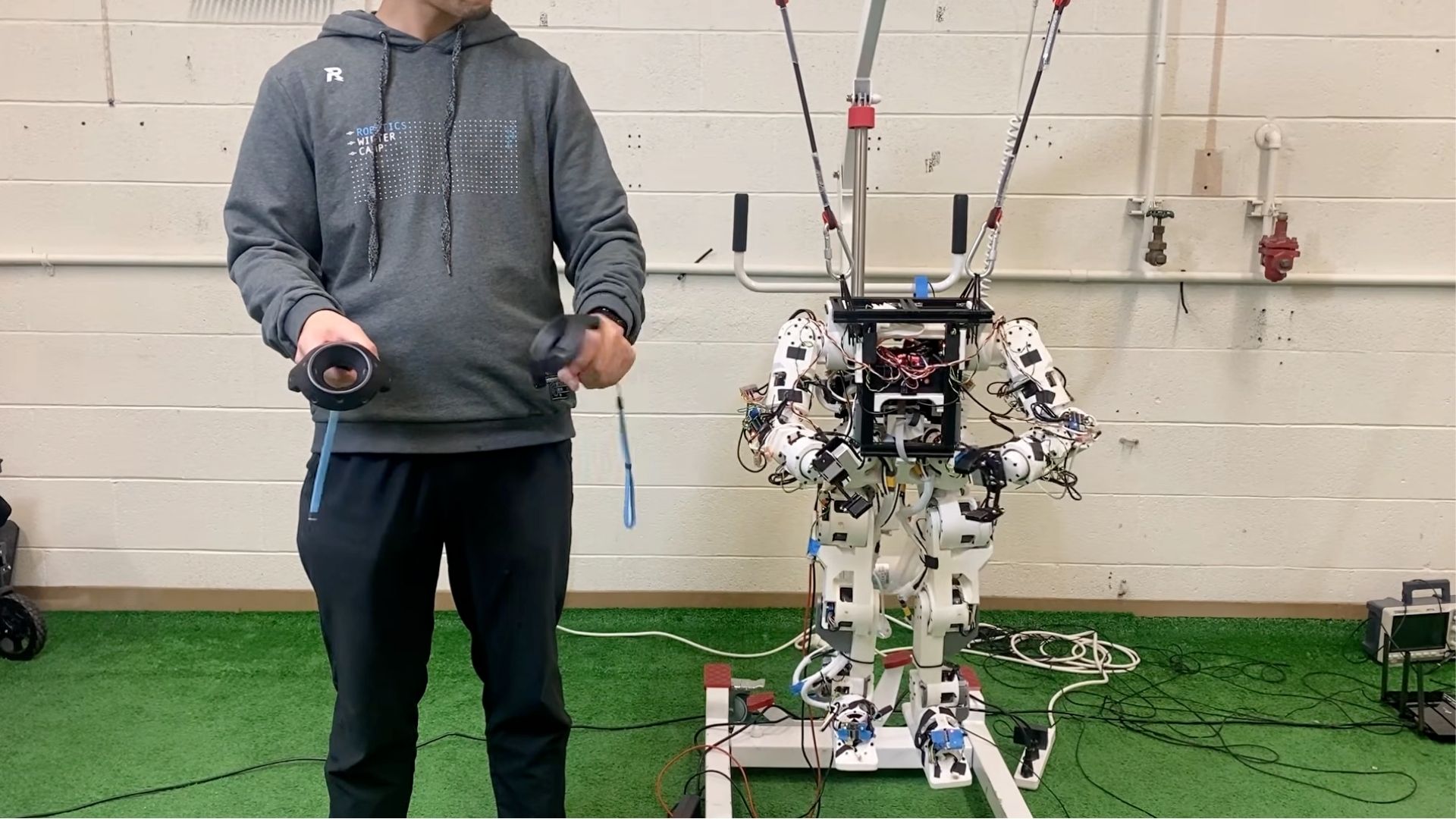
Researchers have developed a low-cost humanoid robot designed to make robotic hardware more accessible to enthusiasts, researchers, and developers. Called the Berkeley Humanoid Lite, the open-source platform uses 3D-printed components to reduce the cost and complexity of building a humanoid robot. Rather than being offered as a finished commercial product, the system is intended as a customizable reference design that users can build, modify, and experiment with. The project also provides resources for recreating the robot and exploring its capabilities, including demonstrations of remote operation, potentially giving more people a practical entry point into humanoid robotics research and development. Low-cost humanoid The Berkeley Humanoid Lite is an open-source humanoid robot designed to make building and experimenting with humanoid machines more affordable. Developed by researchers at the University of California, Berkeley, it uses 3D-printed parts and commonly available components instead of expensive custom hardware. The 0.8-meter-tall robot weighs about 35 pounds (16 kilograms) and uses modular actuators to drive its arms and legs. According to the researchers, the complete hardware can be built for less than $5,000 using US market prices. At the heart of the robot are custom actuators that convert electrical power into movement at the joints. Each actuator combines a brushless DC motor with a 3D-printed cycloidal gearbox and a position encoder. The gearbox reduces the motor’s high-speed rotation while increasing the torque available at the joint, allowing the robot to move its limbs. Two actuator sizes are used to drive different parts of the robot. The actuator housing, gears, and shafts can be made using a standard desktop FDM 3D printer. The researchers use PLA plastic and designed every printed part to fit within a 200-by-200-by-200-millimeter build volume. The cycloidal gearbox helps address some of the weaknesses of 3D-printed plastic. Its design spreads loads across multiple gear teeth, while screws and embedded brass supports add strength and improve torque transfer. According to the team, the actuators also rely on readily available electronics. The larger 6512 actuator combines a BLDC drone motor, motor driver, magnetic position encoder, bearings, and printed parts, with a listed cost of about $188 in the US. The smaller 5010 actuator costs about $136. The complete robot uses 10 of the larger actuators and 12 smaller ones, making them a major part of its overall cost. Robot goes modular The Berkeley team tested the actuators for efficiency, durability, and consistency. The gearbox achieved about 90 percent mechanical efficiency under most operating conditions, although performance dropped at high torque and speed because of heat. In a 60-hour endurance test, efficiency remained relatively stable, while backlash increased gradually as the printed components experienced wear. Tests on six actuators made using two different 3D printers also showed consistent performance, with torque-tracking error remaining within 0.5 Nm.The modular actuators allow the robot to be reconfigured for different applications. Since each unit is self-contained and requires only power and CAN communication, researchers can change limb lengths and joint arrangements. The same hardware can be adapted into bipedal, quadruped, centaur-like, or mobile-base configurations, while longer limb structures can be used to create an adult-sized version. For control, the robot uses an Intel N95 mini PC and an onboard motion sensor. A reinforcement-learning controller trained in simulation was transferred directly to the physical robot, allowing it to walk while following user-specified velocity commands. The robot can also be teleoperated using SteamVR controllers, enabling tasks such as writing, moving objects, packing boxes, and solving a Rubik’s Cube.The researchers acknowledge that the long-term effects of heat on the 3D-printed structure need further study. Even so, the Berkeley Humanoid Lite shows how printed gearboxes, inexpensive motors and off-the-shelf electronics can be combined to create a functional and customizable humanoid research platform. Get the latest in engineering, tech, space & science - delivered daily to your inbox.Jijo is an automotive and business journalist based in India. Armed with a BA in History (Honors) from St. Stephen's College, Delhi University, and a PG diploma in Journalism from the Indian Institute of Mass Communication, Delhi, he has worked for news agencies, national newspapers, and automotive magazines. In his spare time, he likes to go off-roading, engage in political discourse, travel, and teach languages.
Video: 3D-printed Berkeley Humanoid Lite opens a cheaper route to building robots
Full Article
Original Source
Read the full article at Interestingengineering →KhanList aggregates and links to publicly available news content. We do not host full articles from third-party sources. Always verify important information with original sources.