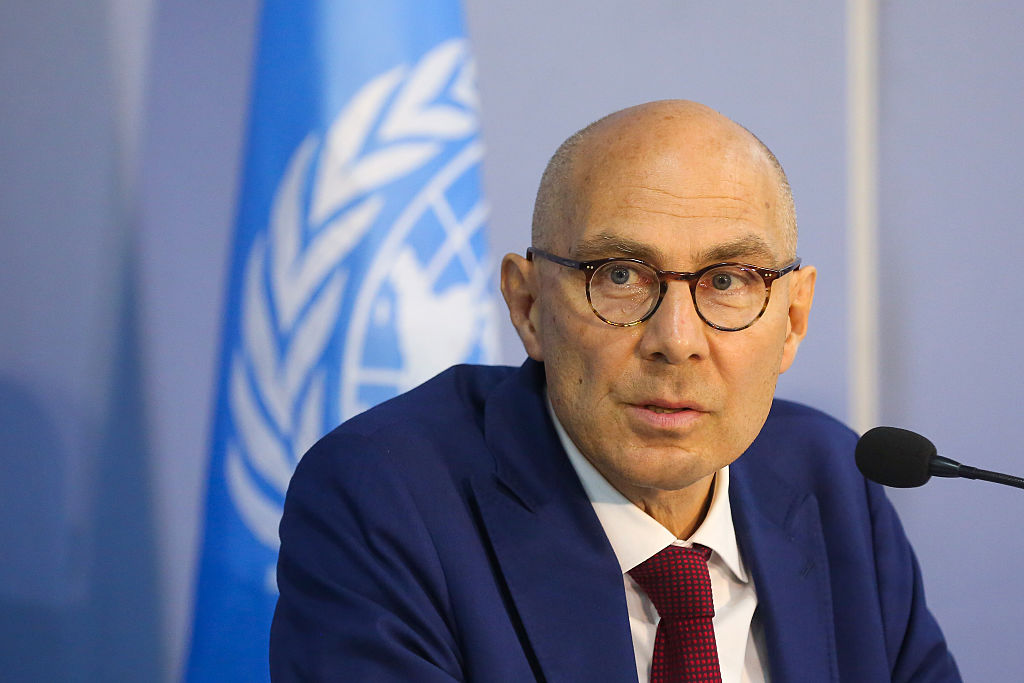
Interviewed by the left-leaning Guardian newspaper shortly after his appointment as United Nations High Commissioner for Human Rights in 2022, Volker Turk effusively praised the UN’s Universal Declaration of Human Rights. The declaration, he said, “is underpinned by fundamental human values that cut across the whole world: all continents, all religions, all faith groups, all belief systems, all culture.” With outgoing UN Secretary General Antonio Guterres now proposing a second four-year term for Turk, an Austrian lawyer, his record at the helm of the United Nations Human Rights Council (UNHRC) is being subjected to scrutiny. Despite his stated belief in the universal nature of human rights, Turk has focused excessively on alleged human rights offenses by Israel and criticized Western democracies, including the United States, largely ignoring China and remaining silent on other key abusers, among them Cuba, Qatar, and North Korea. Turk’s Fixation With Israel Turk’s first term at the helm of the UN’s Office of the High Commissioner for Human Rights dovetailed with the period that followed the October 7, 2023, Hamas atrocities in Israel. Turk was more outspoken in condemning the mass slaughter and abductions of that day, including by acknowledging the “reports of torture and sexual violence inflicted by Hamas and other Palestinian armed groups” that were denied by other UN officials such as Francesa Albanese, the special rapporteur for what the UN refers to as the “Occupied Palestinian Territories,” and Reem Alsalem, the special rapporteur for the prevention of violence against women and girls. However, as the Geneva-based monitoring organization UN Watch pointed out, Turk issued 58 statements condemning Israel’s response in the two years that followed the atrocities, a number that dwarfed his public interventions on other human rights crises. Over time, moreover, Turk’s rhetoric towards Israel notably hardened. Perhaps stung by an August 2025 letter signed by over 1,000 UN employees criticizing his reluctance to repeat the libel that Israel’s war against Hamas constituted a “genocide,” Turk attempted to meet them halfway, subsequently attacking the “open use of genocidal rhetoric and the disgraceful dehumanization of Palestinians by senior Israeli officials.” A further statement in February asserted that “intensified attacks, the methodical destruction of entire neighborhoods and the denial of humanitarian assistance appeared to aim at a permanent demographic shift in Gaza,” adding that Israel’s policies “may constitute a genocide.” Such comments help to legitimize the false claim that Israel seeks to eliminate the Palestinian population in Gaza, as opposed to safeguarding its own security to avoid another October 7-style attack. Attacks on U.S. Contrast With Mild Tone Toward China Turk has also condemned key members of the Western Alliance, including the United States and the United Kingdom, on more occasions than he has authoritarian states. The five statements issued by him on the United States took aim at domestic policies. A May 2025 statement on the deportation of non-U.S. nationals protested that “the demeaning rhetoric used against migrants has also been profoundly disturbing.” In a June 2025 address, Turk accused “government officials” of “vilifying transgender and non-binary people, while restricting their rights.” By contrast, Turk has sounded far more conciliatory toward China, emphasizing the need for engagement with Beijing. Turk has remained silent on other critical issues such as Qatar’s abuse of migrant workers and North Korea’s maintenance of a network of concentration camps, while passively accepting the election of serial human rights abusers, including China, Cuba, and Iran, to the UN Human Rights Council. U.S. Must Oppose Renewal of Turk for a Second Term Turk’s stance towards Israel is a prominent example of the structural discrimination faced by the Jewish state in UN bodies, while his barbs at the United States suggest that he regards democratic countries that adhere to the rule of law as comparable to authoritarian states. The United States and its allies should strongly oppose Guterres’s effort to shoehorn in Turk for another term. That decision should be left for Guterres’s successor, who should be encouraged to select a candidate who will more faithfully reflect the imperatives of the Universal Declaration on Human Rights. Ben Cohen is the director of rapid response at the Foundation for Defense of Democracies (FDD). For more analysis from Ben and FDD, please subscribe HERE. Follow FDD on X @FDD. FDD is a Washington, DC-based, nonpartisan research institute focusing on national security and foreign policy.
U.S. Must Oppose Outgoing UN Secretary General’s Efforts To Renew Human Rights Commissioner
Full Article
Original Source
Read the full article at Fdd →KhanList aggregates and links to publicly available news content. We do not host full articles from third-party sources. Always verify important information with original sources.