
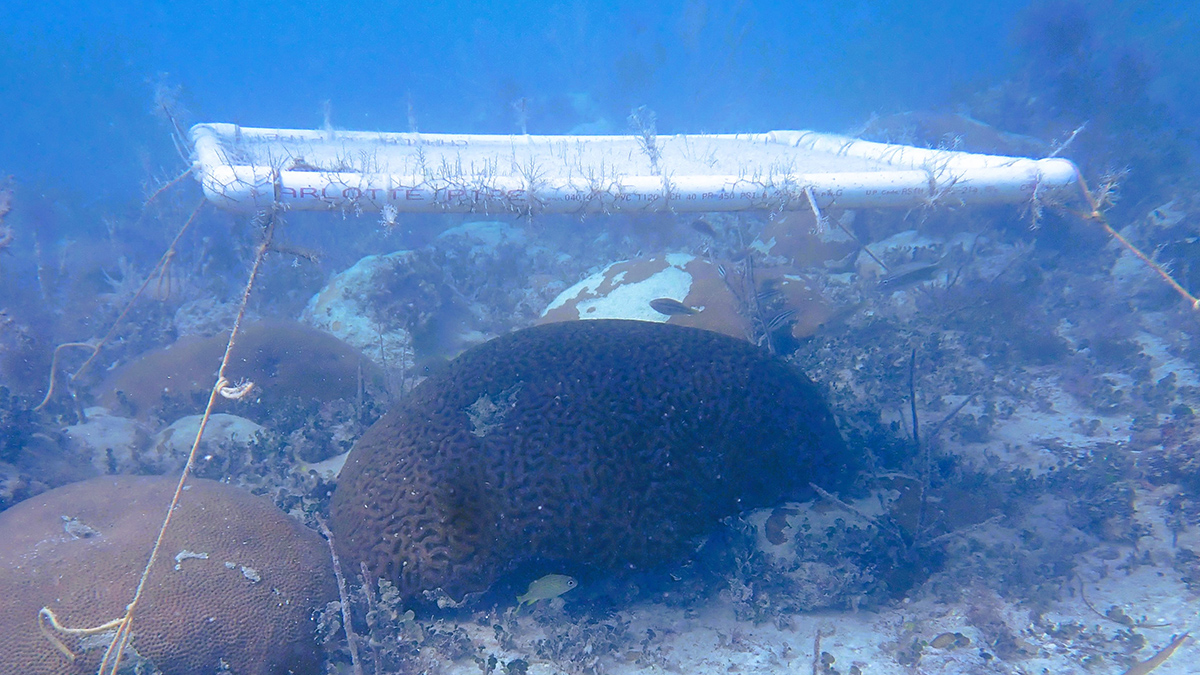
Want updates from a trusted source about how scientists are protecting marine life? Preference Eos in your searches! As the climate warms, corals around the world are facing increasingly frequent marine heat waves that lead to widespread coral bleaching. Scientists are racing to protect the world’s reefs with a variety of interventions, such as supplementing reefs with replanted corals, boosting coral immune systems with beneficial microorganisms, and deploying underwater shades to protect them from the Sun’s rays. A new study published in Frontiers in Marine Science adds to evidence that this shading strategy can prevent—and sometimes reverse—bleaching for two Atlantic coral species. Though scientists have deployed similar shades over Pacific corals, research on shading has been limited in the Atlantic Ocean. The strategy could aid coral restoration and preservation efforts by protecting particularly vulnerable corals in the Caribbean and beyond during marine heat waves. Shady Science Corals are animals that get up to 90% of their nutritional needs from so-called symbionts: single-celled photosynthetic algae that live within coral cells. The density of the algae and the amount of chlorophyll they contain determine how light or dark a coral is. When a coral is bleached and its symbionts are gone, “the coral is slowly starving,” said Karen Neely, a marine biologist at Nova Southeastern University in Florida and an author of the new study. In 2023, one of the Caribbean’s worst marine heat waves led to a widespread bleaching event. In the aftermath, Neely and the research team wanted to see whether shading could help protect coral species in the Atlantic as it has elsewhere in the world. “As soon as those shades went on, those corals all recovered.” The team assembled 20 shades made of polyvinyl chloride (PVC) pipe, foam, and agricultural shade cloth. They set the shades over communities of two Atlantic brain coral species, Pseudodiploria clivosa and Colpophyllia natans, at Newfound Harbor, a protected reef in the Florida Keys. The shades remained in place between August and November 2024. During that time, the researchers monitored the corals’ color and sampled the symbiont community. Researchers measured the extent of bleaching by matching the color of the coral to colors on the Coral Health Chart, a tool created by a research nonprofit at the University of Queensland in Australia. They compared their findings with measurements taken from nearby corals that had not been shaded. During the study, sea surface temperatures at Newfound Harbor breached the Florida Keys’ bleaching threshold of 30.5°C (86.9°F) for at least 61 days—conditions at which corals start to become stressed. In 2024, the reef faced the second-highest cumulative heat stress on record, according to NOAA. Karen Neely (left) and Kathryn Toth work on a shade off the coast of Florida. Credit: Arelys Chaparro Shaded corals showed less bleaching overall, and some even recovered from bleaching that had occurred earlier in the season—showing that interventions can still help after a bleaching event has already started. “We weren’t able to get the shades out until the corals had already started paling in color, and so we weren’t sure if this was going to be too late to have any sort of impact,” Neely said. “But what we found was that as soon as those shades went on, those corals all recovered.” Mark Warner, a marine ecological physiologist at the University of Delaware who was not involved in the new study, said the results weren’t surprising and that scientists have observed that cloudy days and large storms can mitigate bleaching events. An Algae Enigma The research team had also expected the species composition of algal cells within a coral to change depending on whether the corals were shaded or not. However, the species of symbionts and the rate at which the amount of symbionts changed were roughly the same across all corals, shaded and unshaded. Neely said this result could be because all the symbionts were already heat tolerant following the 2023 marine heat wave, which may have wiped out symbiont species that weren’t. “They were already as heat tolerant as they could be,” she said. Still, the fact that both the paler, unshaded corals and darker, shaded corals had similar algal densities could mean the corals weren’t bleaching in the traditional sense, in which algae leave their coral hosts, Warner said. “Even their control corals, which paled as the temperature was rising…really weren’t losing their symbiotic algae any faster than the treatment corals.” It’s possible that the algae within the unshaded corals were acclimating to high amounts of sunlight by decreasing their amount of chlorophyll, Warner said, which would have changed the pigment of the coral rather than the amount of algae. However, he noted, the research team was limited by their sampling—permitting restrictions meant the team could sample only the algal community present at the edges of corals, rather than the tops, which would have faced the Sun. Proof of Protection Researchers hope the study provides environmental managers with evidence that shading can work for Atlantic coral species. Neely hopes that the study provides environmental managers with evidence that shading can work for Atlantic coral species. “Something being trialed in another part of the world might not make managers as comfortable as something that’s been trialed here on our own reefs and with our own species and shown to be successful,” she said. “That opens up the doors for managers who might want to think about wider implementation.” “One thing that surprised us was how easy it was [for the shades] to be effective,” Neely said. The research team had anticipated that they’d need to clean the shades regularly or that the equipment might not be durable enough. But the shades stayed relatively clean and low-maintenance. Plus, the shading strategy is about 10 times cheaper than the cost of replacing a dead coral, the authors wrote. Neely emphasized that the shades are a small-scale solution best for protecting high-priority corals, such as particularly large, rare, or beloved specimens—“corals that managers decide we just can’t afford to lose.” Neely said that next, she’d like to study how shading affects the long-term health of corals. Even if corals don’t die from bleaching, the slow starvation that bleaching causes can make corals more susceptible to disease and less able to reproduce. Shading coral could preserve its strength for disease resistance and reproduction, she said. —Grace van Deelen (@gvd.bsky.social), Staff Writer Citation: van Deelen, G. (2026), Underwater umbrellas reduce—and reverse—coral bleaching in the Caribbean, Eos, 107, https://doi.org/10.1029/2026EO260316. Published on 2 October 2026. Text © 2026. AGU. CC BY-NC-ND 3.0Except where otherwise noted, images are subject to copyright. Any reuse without express permission from the copyright owner is prohibited.
Underwater Umbrellas Reduce—and Reverse—Coral Bleaching in the Caribbean
Full Article
Original Source
Read the full article at Eos →KhanList aggregates and links to publicly available news content. We do not host full articles from third-party sources. Always verify important information with original sources.