
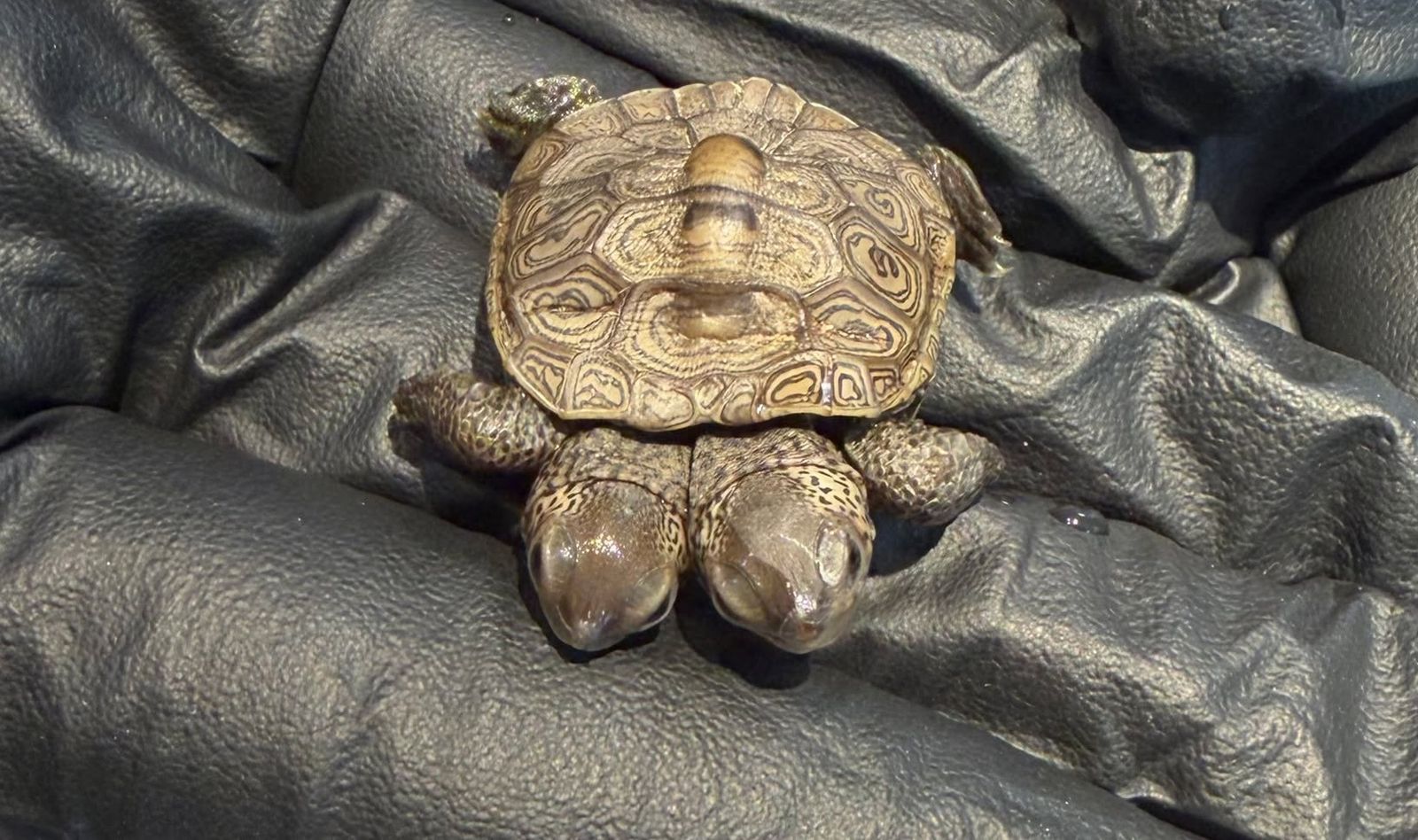
The tiny diamondback terrapin was brought to a wildlife center on September 17. At the time, the creature weighed about as much as a nickel September 29, 2026 9:33 a.m. The rare two-headed turtle was found at a proteted nesting site. New England Wildlife Center When a tiny diamondback terrapin emerged from its egg on Cape Cod this summer, it had everything a turtle hatchling should have: four legs, a patterned shell and a short tail. Except instead of one head, this creature had two. The rare turtle with double noggins was discovered earlier this month at a protected nesting site by volunteers with the Mass Audubon Wellfleet Bay Wildlife Sanctuary. On September 17, they brought the unusual reptile to the Cape Wildlife Center in Barnstable, Massachusetts, where veterinarians have been closely monitoring it ever since. The creature was born with a rare congenital condition known as bicephaly, which occurs “when an embryo goes to split—like it would for twins or something—but doesn’t separate fully,” Zak Mertz, CEO of the New England Wildlife Centers, which includes the Cape Wildlife Center, tells Popular Science’s Margherita Bassi. “And because of that, each case might have a slightly different orientation; they might have more or less overlapping anatomy.” The diminutive hatchling came in weighing just 5.2 grams, or about as much as a nickel. Veterinarians won’t be able to determine its sex until it gets a little older. But in the meantime, the creature is behaving normally—swimming, eating and even showing off its dual disposition. “The left head has the bigger personality,” Mertz tells the Cape Cod Times’ Heather McCarron. Robyn Rohm, lead veterinary technician at the Cape Wildlife Center, agrees, adding that the left head was “biting the day he came in.” Veterinarians say they need to wait until the turtle gets a bit older to determine its sex. New England Wildlife Center Bicephalic animals are rare—but not totally unheard of. This is the third two-headed diamondback terrapin to receive care at the Cape Wildlife Center in the last six years alone. And Mass Audubon Wellfleet Bay Wildlife Sanctuary has seen five on Cape Cod since the early 2000s, reports the Cape Cod Times. “While we’ve encountered this unusual condition before, every case gives us another opportunity to learn more about these fascinating animals’ anatomy and physiology,” the center wrote in a social media post. The turtle weighed about as much as a nickel when it arrived at the wildlife center. New England Wildlife Center Much about the turtle remains a mystery. Once it gets a little bigger, veterinarians will be able to use imaging techniques like CT scans and X-rays to “see” through its shell and learn more about its inner workings. “We’re looking forward to learning everything we can about these two young turtles,” Mertz tells WBZ-TV’s Neal Riley. For now, the fate of the two-headed creature remains unclear. If veterinarians determine that it is strong and healthy enough to survive on its own, it could eventually be returned to the wild. If not, it will likely find a permanent home in captivity, per the Cape Cod Times. Did you know? Bicephalic snake In 2016, a woman living near Waco, Texas, spotted a baby snake with two heads in her backyard. She donated the two-headed Western rat snake to the Cameron Park Zoo, where it has lived ever since. Diamondback terrapins make their homes in the brackish waters of salt marshes and estuaries along the northeastern United States and Gulf Coast. These aquatic turtles are named for the distinctive, diamond-shaped concentric rings covering their shells, which help them blend in with their murky surroundings. The turtles are considered mid-size; males have a maximum shell length of about 5.5 inches, while females’ shells can grow to roughly 11 inches long. In the wild, they eat a mainly carnivorous diet, using their strong mouths to chow down on snails, crabs, mussels, clams, fish, worms and insects. At the wildlife center in Massachusetts, however, the two-headed turtle is fattening up on a “delicious mix” of chopped fish, bloodworms, brine shrimp and vitamin pellets, Rohm tells the Cape Cod Times. The species’ federal listing status is under review, but the subspecies found in Massachusetts is considered threatened in the state. Threats to the turtles’ survival include sea level rise and storms caused by climate change, coastal development and urbanization, vehicle strikes and accidental entanglement in fishing and crabbing gear. You Might Also Like Get the latest stories in your inbox every weekday. More about: Animals Baby Animals Biology Nature Reptiles Turtles Weird Animals Wildlife
Two Heads Are Better Than One: Rare, Double-Headed Turtle Hatchling Discovered on Cape Cod
Full Article
Original Source
Read the full article at Smithsonianmag →KhanList aggregates and links to publicly available news content. We do not host full articles from third-party sources. Always verify important information with original sources.