
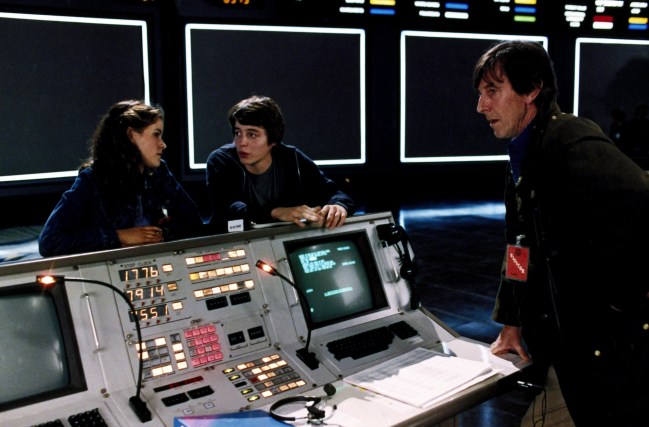
On Friday nights, IndieWire After Dark honors fringe cinema in the streaming age with midnight movies from any moment in film history. First, the BAIT: a weird genre pick, and why we’re exploring its specific niche right now. Then, the BITE: a spoiler-filled answer to the all-important question, “Is this old cult film actually worth recommending?” The Bait: Shall We Play a Game with No Winners? Ten days ago, an artificial intelligence researcher quit his job at Anthropic and promptly warned the world that the tech Silicon Valley is racing to build could kill everyone by the end of the decade. The internet’s response ranged from terror to annoyance with most laypeople asking the same thing: “OK, but how?” Released in 1983, John Badham’s “WarGames” is not about generative AI as we currently know it — and considering the movie’s massive awards and box office success, it’s barely fringe enough to qualify for IndieWire’s cult film column. Still, this increasingly eerie repertory pick is phenomenally made science fiction and not to be missed by anyone who thinks the tale of a Cold War-era supercomputer demonstrating a shockingly plausible doomsday might be for them. ‘WarGames’ (1983)©MGM/courtesy Everett / Everett Collection Matthew Broderick stars as David Lightman: a bright but bored Seattle teen-turned-cyber criminal. He’s just technically skilled enough to change his digital report card from home, but bullying his way through a telephone tree in pursuit of an unreleased video game, David notices far too late that his brute-force hacking approach has tapped into a massive defense system at NORAD. As the film explores all too well, noble winners aren’t the same as cheap opportunists — and soon, David learns his illegal enterprising has put the entire planet at risk. More and more humans seem to be getting genuinely fooled by AI these days, and that makes the fictional hero and his disastrous decision to ask the killer machine in “WarGames” for a round of “GLOBAL THERMONUCLEAR WAR” at least slightly more sympathetic. That said, the smart-ass programming prodigy also chooses to play the Soviet side of the encounter, making a very loaded sociopolitical call he’s just going to have to own as the battle continues. With a fleet of menacing pixels appearing to show enemy missiles moving in on the U.S., the philosophy behind the development of the highly advanced WOPR (that’s “War Operation Plan Response”) snaps into focus behind Broderick and his co-star, “Breakfast Club” icon Ally Sheedy. Yes, the “Ferris Bueller” actor had a particular knack for playing rebels who flouted the rules in the ‘80s, and David’s flippant appeal is central to the effort’s overall tone and comedic appeal. But before Lawrence Lasker and Walter F. Parkes were nominated for Best Original Screenplay at the Oscars, their work debuted at Cannes — sparking fierce debate among attendees about the psychology of obedience in the military. WARGAMES, Dabney Coleman (center), 1983, (c)MGM/courtesy Everett Collection©MGM/Courtesy Everett Collectio It’s hard to imagine how that crowd would have reacted if a time-traveler had told them “WarGames” was only the beginning of sci-fi efforts getting scarily close to predicting real life. Ronald Reagan certainly took it seriously. The 40th President screened the movie at Camp David during its opening weekend and, days later, recounted its plot during a closed-door meeting with members of Congress. Reagan asked Joint Chiefs Chairman Gen. John Vessey Jr. whether a teenager could actually break into the nation’s computer defense system. A week later, Vessey came back and reportedly said, “Mr. President, the problem is much worse than you think.” The scope of the problem is easier to appreciate when you consider the sheer force with which “WarGames” sells its hypothetical nightmare on screen. William A. Fraker’s cinematography is spectacular, and Arthur B. Rubinstein’s score swings between arcade levity and pure existential dread. The film’s extraordinary product was matched with its ensemble, which also includes John Wood, Dabney Coleman, Barry Corbin, Maury Chaykin, Eddie Deezen, and John Spencer. Futurist art is often credited with predicting what eventually happens in real life, but the artists imagining those horrors have at least one fundamental thing in common with the engineers building AI infrastructure: Both treat the impossible as inevitable, bypassing the question of “if” to insist on “when.” —Alison Foreman The Bite: We Have Always Lived in the Torment Nexus Man, when Ali picks ‘em, she knows how to pick ‘em. I would never in a million years have thought to watch “WarGames” today, but it was kind of the perfect thing to watch today — instead of looking at my WIRED newsletter full of articles about how an AI End, of some description, is nigh. In fact, unlike the ambient apocalyptic dread of simply existing on the Internet in 2026, in a lot of ways, this movie is a quintessential example of the kinds of ‘80s films that are fully in my blind spot; I’ll talk to you about Ernst Lubitsch deep cuts from the ‘20s for the length of a filibuster, but I don’t know that I’ve seen enough John Hughes movies to really weigh in on how well Matthew Broderick and Ally Sheedy are cosplaying John Hughes protagonists. (Well! It seems like!) ‘WarGames’ (1983)©MGM/Courtesy Everett Collection So what sticks out to me about “WarGames” is really just the details and the resonances. 10/10 would watch a cut of this film that is just Broderick’s cringe parents, buttering raw corn with white bread and stumbling from one suburban blur of a day to the next. And for me, this has been a good and bracing reminder that 1980s Gen X counter-culture truly wasn’t commodified culture in the way that my Hot Topic-warped teen brain sometimes understood it to be, growing up in the aughts. The gentle fun being made of the normies here isn’t particularly subversive, but it does highlight the silliness and superficiality of the world Broderick has fled for the thrill of being, to use more modern terminology, a l33t h4x0r. Here, that’s part of an interesting tension between the dangerous and exciting world of computer hacking (and those bastions of sin: video game arcades!) and the quote-unquote ordinary This American Life setting, which is oh-so judgmental of the former. Both make more sense than the rigid (unsustainable, one might say) pall of constant military emergency in which all the characters inside NORAD live. Yes, the comp-sci guys that Broderick goes to talk to about potentially finding a backdoor into the systems for these games he wants to play are coded as losers, autistic, or both. But even in that scene, they’re handled with a certain amount of empathy and compassion that I could see getting cut from a film a couple of decades down the line. It’s kinda sweet that Maury Chaykin tells Eddie Deezen this is a moment where he’s being rude, actually, and we cut to our girl Ally Sheedy smiling, but not mocking. The amount of — not particularly deep, but credible — work that “WarGames” does with broad, stock characters is really something and I don’t quite know where to lay the credit for it. I certainly want to give it to my White House Chief of Staff Leo McGarry aka John Spencer, playing an air force captain in charge of launching nuclear retaliation strikes right in the film’s cold open. But critically speaking, I can’t be if it’s the script or it’s the top-notch casting or it’s the film’s kinda simple curiosity. ‘WarGames’ (1983)©MGM/Courtesy Everett Collection “WarGames” does not overcomplicate all the computer stuff but keeps the thriller focused on the problem of the digital age that has only gotten worse: How do we develop (or rediscover) enough empathy to avoid the kinds of zero sum games, like war, that we always, always lose. The reason to play a nice game of chess instead, likewise, is always each other. What I appreciate most about “WarGames” is that, for as powerful a wargaming supercomputer as “Joshua” is, it will never be a hyperintelligent computer that blows us off the face of the planet; not by itself, at least. Nor will computers be our gateway into world peace, a tech utopia, or immortality, as the current crop of feckless AI oligarch charlatans crow that they might be. Each turn of this film hinges on a choice that a human being makes, and those choices matter far past what each of those humans can see — certainly past trying to pull a girl by changing her biology grade over a landline. This is, of course, a double-edged sword if you completely automate the nuclear missile silos (I, for one, am kinda sad they no longer need floppy disks). But the sword does have two edges. It’s only when we cede our agency in the name of efficiency or expanded capacity that we create the despair and the lack of empathy needed for things to go really, really wrong. Efficiency for whom? Expanded capacity for what? Who benefits? If it’s not a human being who could use some extra time to learn how to swim, then maybe a machine designed to think about the end of the world nonstop isn’t a useful tool to have. Maybe it needs to be taught to play something different. “WarGames” feels kinda naive and hopeful, looking at it from 2026, sure. But all the movie is doing is pointing out that we can still make choices, even at the brink. —Sarah Shachat Read more installments of After Dark, IndieWire’s midnight movie club: This September, ‘Remember Me’: The Robert Pattinson Film That Sounds Made Up Try 1991’s ‘New Jack City,’ the Gangster Classic That Became a Westwood Flashpoint 1935 Sci-Fi Western Film Serial ‘The Phantom Empire’ Still Feels Like the Future Ralph Bakshi’s ‘The Lord of the Rings’ Remains the Best Spiritual Sequel Ever Made You Won’t Stop Quoting Steven Seagal Once You See 1996’s ‘The Glimmer Man’
Trying to Picture Doomsday? 1983’s ‘WarGames’ Already Showed Us One Way AI Could End the World
Full Article
Original Source
Read the full article at Indiewire →KhanList aggregates and links to publicly available news content. We do not host full articles from third-party sources. Always verify important information with original sources.