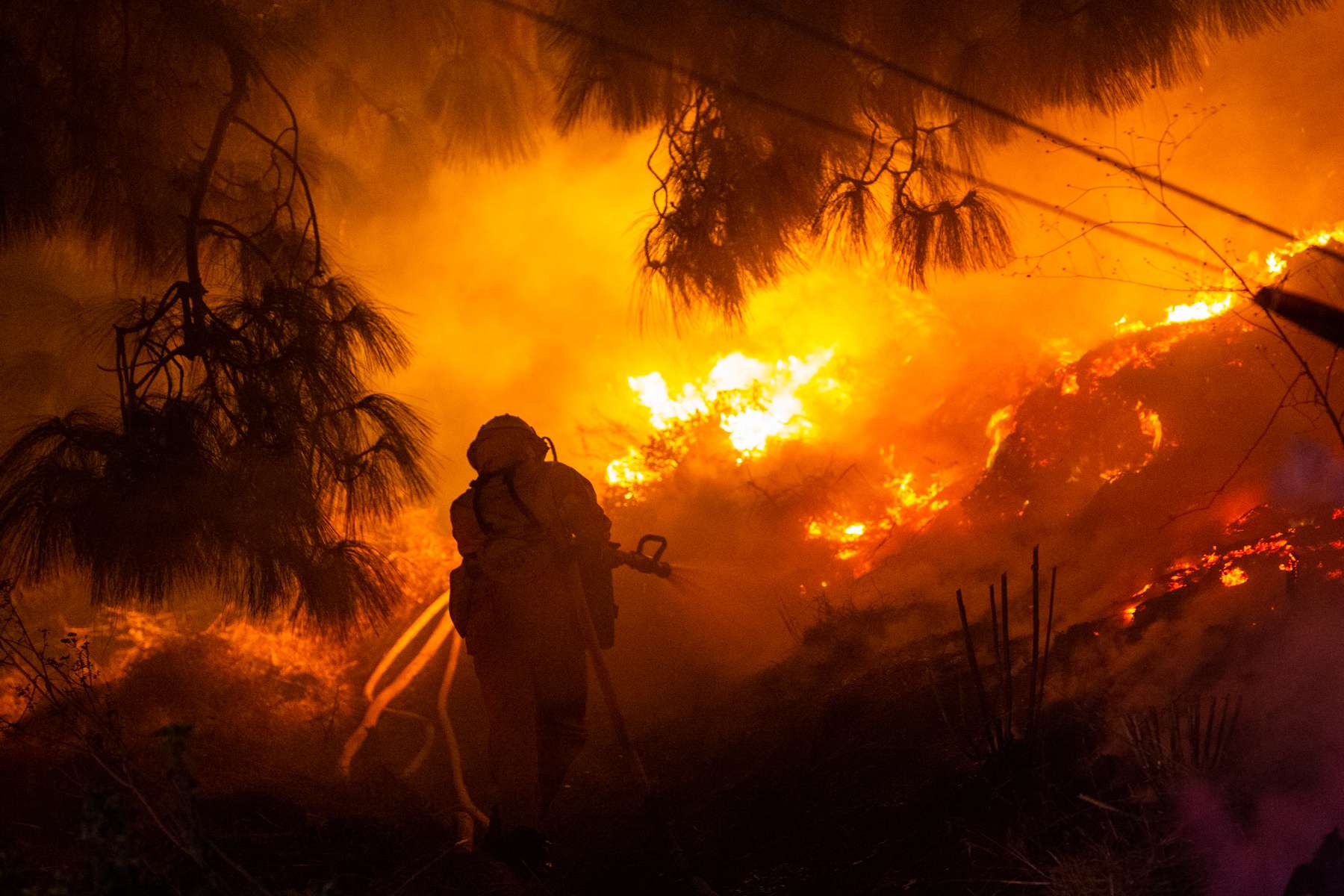
Will Lester/ZUMA Press/Newscom Much of the eastern United States has recently been affected by smoke originating from massive wildfires in Canada. It's a genuine problem. But Trump's threat to impose new tariffs on Canadian goods in response won't make the situation any better. If implemented, it would damage both the US and Canadian economies, and further poison relations between the two countries. And it has no chance of actually alleviating the wildfire problem. Furthermore, no law authorizes the president to impose tariffs in response to natural disasters like this one. Trump claims the tariffs are justified because "[w]e are holding Canada responsible for the fact that they are not properly maintaining their Forests, and Brush therein, and the United States is being unnecessarily invaded by filthy, polluted, and unhealthy air." But, in reality, the fires are caused by a combination of lightning, weather patterns, and global warming. They cannot be fixed by improvement "forest management." I suppose one can argue Canada is partly responsible for the fires because they contribute to global warming. But the same is true of the US, and on a much larger scale (because we have a much larger population and economy). In any event, higher tariffs aren't likely to somehow lead Canada to prevent the wildfires. What new tariffs would do is increase prices for American consumers, and reduce the productivity of the many US industries that rely on Canadian imports as inputs in their production process. For example, a December 2025 study by the US Chamber of Commerce documents the great harm caused by Trump's earlier tariffs on Canadian aluminum. Similarly, tariffs on Canadian lumber increase the cost of housing construction, thereby further exacerbating our housing crisis. The two countries' economies are highly integrated, and there are many sectors where we mutually benefit by purchasing goods that the other country can produce at higher quality and lower prices. New tariffs will also, of course, cause pain and suffering in Canada. But that is both bad in itself, and likely to further damage the US. It's better for us to have a prosperous and growing neighbor than the opposite. Among other things, a wealthier Canada is likely to purchase more US exports, produce more goods and services we might want to buy, and generate better investment opportunities. In addition, a new wave of tariffs would further poison relations with Canada, which have already been seriously damaged by Trump's previous tariffs and his repeated threats to annex Canada and make it the 51st state. Gratuitously alienating our neighbor and vital ally isn't "Making American Great Again." It's making us weaker and more isolated at a time when we need to work with allies to counter adversaries like Russia and China. I know many people in Canada, including a good many conservatives and libertarians traditionally highly sympathetic to the US. Thanks to Trump and his policies, many of them are now deeply alienated from us, or at least highly suspicious. And it's not just a my admittedly unrepresentative acquaintances who feel that way. Polls of Canadian opinion confirm a massive growth in anger and distrust of the United States. Americans underestimate the dangers of ruining this relationship at our peril. We don't want to replace a friendly and accommodating neighbor with a hostile one. Finally, it's worth noting that Trump does not have the legal authority to impose tariffs in response to wildfires. Under the Constitution, tariffs are a congressional power, not an executive one. The Supreme Court forcefully reaffirmed that principle when it invalidated Trump's IEEPA tariffs (in a case I helped litigate). And there is no statute authorizing the president to impose tariffs in response to wildfires or other similar natural disasters in a neighboring country. Trump is currently planning to reimpose something like the IEEPA regime using Section 301 tariffs. That plan is itself illegal for reasons Peter Harrell and I have outlined in various writings (see here and here). In any event, as Peter details, Section 301 can only be used in response to "unjustifiable" or "unreasonable or discriminatory" trade practices by foreign governments. Wildfires are pretty obviously not a trade practice. The same goes for Trump's efforts to impose massive new tariffs using Section 122 of the Trade Act of 1974 (recently struck down by the US Court of International Trade). Section 122 can only be used to counter "balance of payment deficits" and related problems. Wildfires pretty obviously don't qualify. Nor is there any other statute that provides for tariffs in such situations. Perhaps Administration lawyers will yet develop some novel legal theory to try to justify the imposition of tariffs here. But, if they do and Trump acts on it, hopefully courts will reject it. Ultimately, this situation is yet another reminder that we should not give one man a blank check to impose tariffs whenever he feels like it. Allowing that undermines the constitutional separation of powers, causes great economic harm, damages our relations with allies, and menaces the rule of law.
Trump's Pernicious Threat to Impose Tariffs on Canada in Response to Wildfires
Full Article
📰 Original Source
Read full article at Reason →KhanList aggregates and links to publicly available news content. We do not host full articles from third-party sources. Always verify important information with original sources.