
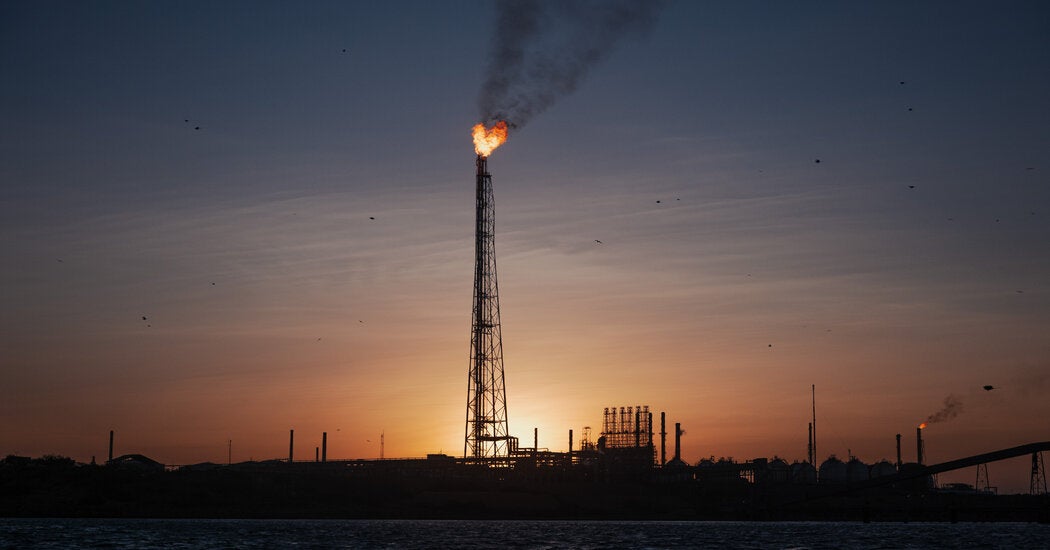
Venezuelans Saw Oil as Their Birthright. Now Trump Is Claiming It.Long-held beliefs in Venezuela about sovereign control over oil are fraying as the U.S. lays claim to the country’s oil reserves.Sunrise over the Cardón Refinery in Punta Cardón, Venezuela. Oil has shaped Venezuela to an extent rare outside the Middle East, becoming a defining feature of the country’s social fabric.Credit...Adriana Loureiro Fernandez for The New York TimesVenezuelans Saw Oil as Their Birthright. Now Trump Is Claiming It.Long-held beliefs in Venezuela about sovereign control over oil are fraying as the U.S. lays claim to the country’s oil reserves.Sunrise over the Cardón Refinery in Punta Cardón, Venezuela. Oil has shaped Venezuela to an extent rare outside the Middle East, becoming a defining feature of the country’s social fabric.Credit...Adriana Loureiro Fernandez for The New York TimesSimon Romero and Isayen HerreraSimon Romero is a former Caracas bureau chief who has covered energy politics across Latin America. Isayen Herrera reports on Venezuela for The New York Times.Like generations before him, Leonardo Silva grew up steeped in beliefs about the extraordinarily abundant resource that made Venezuela special. All the oil under their feet was theirs, they felt. Virtually free gasoline was a birthright. To be born atop this bounty was like winning the lottery.Mr. Silva, 38, said his generation viewed oil as a cornerstone of the country’s national identity, when a booming economy allowed Venezuela to occupy a privileged tier in the global order. His children, he said, have a far less rosy view.“To them oil isn’t important, it’s secondary,” said Mr. Silva, who works at a foundation in Caracas helping people with disabilities. “They don’t have that culture of us being a rich country. They just know that if you don’t work, you don’t eat.”Oil has shaped Venezuela to an extent that is rare outside the Middle East for more than a century, becoming a defining feature of the social fabric like baseball, beauty pageants or the veneration of the liberation hero Simón Bolívar.But now the U.S. government is taking control of a huge portion of Venezuela’s oil. And, pressed by economic need, long-held nationalist convictions about oil, starting with the need for sovereign control, are giving way to a more complex web of perspectives.The ways in which Venezuelans are re-evaluating oil, and by extension their reliance on it, are the result of immense upheaval over the last decade. Oil production plummeted because of mismanagement, political purges, corruption and sanctions.ImageWorkers for Venezuela’s state-owned oil company, Petróleos de Venezuela, outside its headquarters in Caracas last year. Venezuelans are re-evaluating their relationship with oil, and by extension their reliance on it. Credit...Adriana Loureiro Fernandez for The New York TimesThe cratering of an economy overwhelmingly dependent on oil led to a financial crash marked by widespread deprivation and the exodus of millions of Venezuelans up and down the Americas.The Trump administration then toppled Venezuela’s leader at the start of the year, took control of oil exports and went even further, forming a partnership with a scandal-plagued Venezuelan oil magnate that would enable the U.S. government to control a huge portion of Venezuela’s reserves.Delcy Rodríguez, the interim president, has expressed full-throated support for the plan, a sweeping shift for a leader steeped in Chavismo, the political movement that made uncontested dominance over oil one of its tenets.Ms. Rodríguez has little wriggle room with the Trump administration essentially dictating how she can operate. At the same time, some Venezuelans are so desperate for the economy to improve that they say ceding control over the oil industry is a small price to pay.“Closing these deals is super urgent,” said María Ines Figueroa, 56, referring to the Trump administration’s takeover of Venezuelan oil reserves as well as other U.S. ventures under consideration.Ms. Figueroa, a retired public-school teacher in Caracas, said inflation had recently eroded her pension to less than $1 a month. She now teaches at a private school where she earns $120 a month.Her hope, she said, was that a revival of the oil industry would create a trickle down that reached into households like her own. “I’m no expert, but I think this could work,” Ms. Figueroa said.ImageWorkers in Punto Fijo, where an oil company had posted job openings for the first time in years. Some Venezuelans have welcomed U.S. dominance over Venezuela’s oil industry.Credit...Adriana Loureiro Fernandez for The New York TimesOther Venezuelans are openly welcoming U.S. dominance over Venezuela’s oil, reflecting how opposing voices, including on the right, are becoming more bold after three decades of leftist rule marked by economic devastation and repression of dissent.“I don’t care about the oil,” Maria Elisa Smith, a right-wing polemicist known for her racist vitriol, said recently on social media. “Oil never gave me anything good, just a miserable, socialist country.”Still, sharp indignation bubbled up after President Trump announced the deal in August that gave the United States access to 65 billion barrels of Venezuelan oil, then repeatedly boasted about it.Many across the ideological spectrum were angry, from opposition leaders to prominent figures of Chavismo, the movement that has controlled Venezuelan politics for three decades.Luis Britto García, a playwright who has written widely about oil’s importance in Venezuela, said Trump’s deal laid bare the “unlimited pillage” Venezuela was experiencing as the Trump administration exerted tight financial control over oil revenues.Long before Venezuela’s economy crashed, oil had ceased to be merely a geological resource or an export statistic, evolving into a prism through which Venezuelans contemplated their own society or compared it to others.Some credited oil for creating modern Venezuela: Its reserves rank among the world’s largest, and since the first gushers were found, oil gave Venezuela an income neighboring countries envied.Others saw oil as cursing Venezuela with corruption, dependency and dysfunction, citing how authoritarian and democratic leaders alike wielded the revenues to advance their own ambitions at the nation’s expense.For decades until Venezuela’s economy collapsed, motorists viewed practically free gasoline as an entitlement, spawning a car culture of 1970s-style gas hogs and fuel-devouring SUV’s that can make the oversized vehicles filling Texas’s roads seem quaint.Even today, oil permeates everything from rap lyrics to the memes Venezuelans share on their phones. Writers have wrestled with Venezuela’s entanglement with oil so much that there’s an entire literary tradition devoted to it.ImageA statue of a hand holding a drilling rig near Venezuela’s state oil company. “Oil penetrates every fiber of national life,” in Venezuela, said Cósimo Mandrillo, the director of a state-owned publishing house, Credit...Adriana Loureiro Fernandez for The New York TimesOil even shapes the Spanish that Venezuelans speak: “Este hombre trabaja más que un balancín,” is just one popular expression, a nod to an industry once considered a steppingstone to a better life.It can be translated as “This man works more than a pump jack,” referring to the iconic machinery functioning nonstop to pull crude oil from subterranean wells.Cósimo Mandrillo, the director of Monte Ávila, a state-owned publishing house, said that despite shifting political winds as the United States takes greater control of the country’s resources, Venezuelans maintain a connection to oil so intimate that it “borders on the subconscious.”“Oil penetrates every fiber of national life,” Mr. Mandrillo said. “It is so deeply absorbed in the collective psyche that we navigate its presence almost by instinct.”Hugo Chávez, who ruled Venezuela from 1999 until his death in 2013, seized on this visceral connection like few rulers before him. Constantly clashing with the United States, he made state control over oil the centerpiece of his socialist-inspired Bolivarian revolution.At home, he used oil revenues to ease poverty and consolidate power. Projecting power abroad, Mr. Chávez propped up Cuba, built international coalitions to defy U.S. influence and launched Telesur, a pan-Latin American television network.Nicolás Maduro, Mr. Chávez’s successor, doubled down on the approach. Even as the economy unraveled, he framed oil not as a commodity on a balance sheet but as the fuel for consolidating his authoritarian rule.In a bid to circumvent U.S. sanctions, Mr. Maduro launched his own cryptocurrency called the Petro, claiming each token was backed by a barrel of oil. But the crypto scheme collapsed in connection to a corruption scandal at the national oil company.Even before Mr. Maduro was overthrown by U.S. forces in January, the ways in which Venezuelans viewed oil had begun to change, largely because of economic desperation after production plunged.ImageA staircase in Caracas depicts the late president Hugo Chávez, whose state control over oil Mr. Maduro sought to preserve.Credit...Alejandro Cegarra for The New York TimesIt was not until 2020, under the cover of acute fuel shortages and the Covid-19 pandemic, that Mr. Maduro effectively ended the era of universal, nearly free gasoline, introducing a dollarized rate at most gas stations.Until then, Chavismo had recast the Caracazo, the massive riots in 1989 sparked by a jump in fuel prices, as one of its spiritual catalysts. As a result, highly subsidized gasoline became an untouchable third rail of Venezuelan politics.Standard gasoline in Venezuela for most motorists costs about $1.89 a gallon (still far less than the prevailing prices in the United States and many other nations), alongside a tightly restricted, subsidized and cheaper tier linked to a social rationing program.In an energy-rich country where electricity shortages are a part of life in many cities, such rationing routinely produces the surreal sight of long lines of motorists waiting to fill up.The dysfunction plaguing much of the economy comes as Mr. Trump is unsparingly direct about using his chokehold on Venezuela’s government to extract one deal after another.As Venezuela emerges as essentially a vassal state of a pre-eminent superpower, Margarita López Maya, a historian, said it was not surprising some Venezuelans were prepared to accept U.S. control over the country’s oil, if only because they saw no other option.“Chavismo,” she said, “has reduced us to a state of global humiliation, kneeling before the United States.”ImageMotorcyclists waiting for gasoline in Caracas in 2020. Rationing routinely produces long lines of motorists waiting to fill up.Credit...Adriana Loureiro Fernandez for The New York TimesSimon Romero is a Times correspondent covering Mexico, Central America and the Caribbean. He is based in Mexico City.Related ContentAdvertisementSKIP ADVERTISEMENT
Trump’s Oil Grab in Venezuela Is Testing the Country’s National Identity
Full Article
Original Source
Read the full article at Nytimes →KhanList aggregates and links to publicly available news content. We do not host full articles from third-party sources. Always verify important information with original sources.