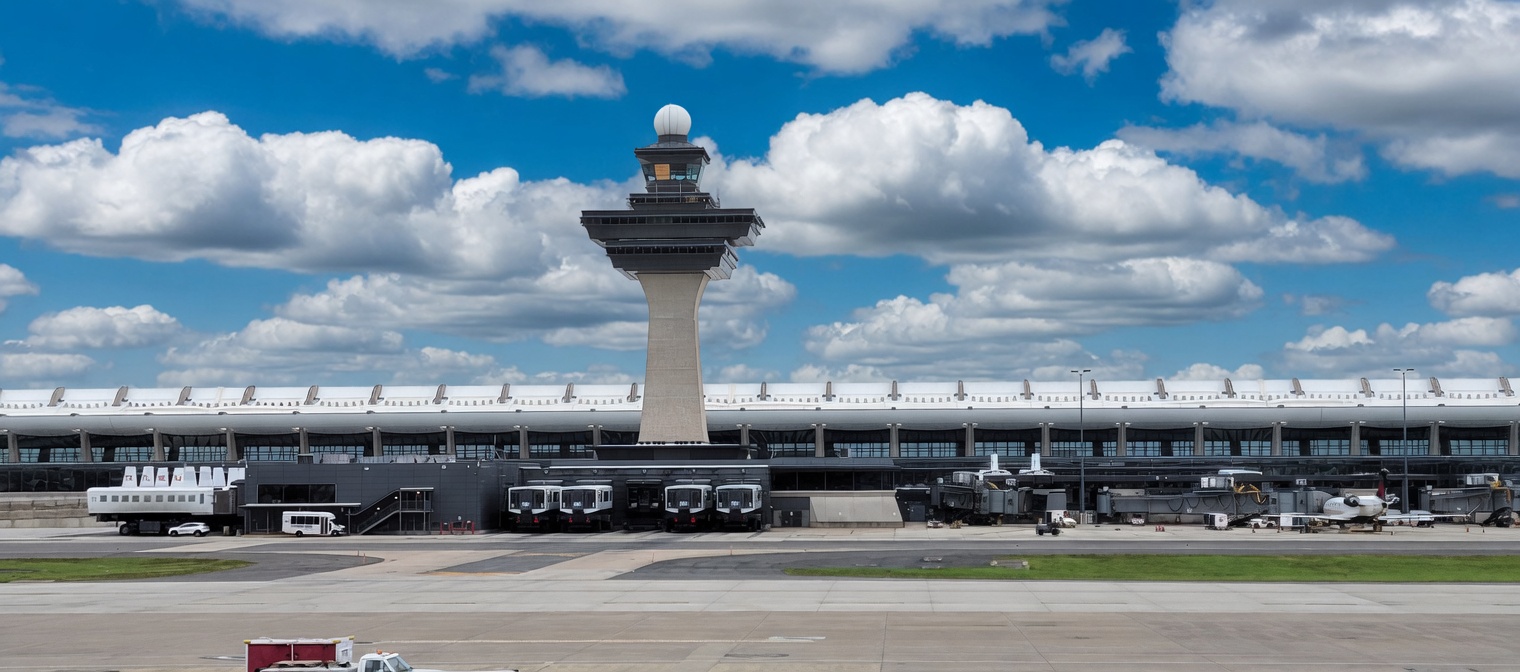
President Trump is expected to announce his plan for a $22.5 billion reconstruction of Washington Dulles airport. The proposal would preserve Eero Saarinen’s iconic main terminal while replacing most of the airport behind it: new concourses, new gates, new baggage and security facilities, parking closer to the terminal and set up the underground AeroTrain system so that stations match the actual terminals passengers fly from. After more than six decades, regular use of the airport’s mobile lounges and Plane Mates would end. President Trump has been personally designing the project. But the problem is, the federal government hasn’t appropriated money for this and if the airport spends it then costs for the airlines will be too high to operate. The President Has Been Engaged In Design Work The President was a real estate developer. His motorcade detoured through the airport in October. At a December Cabinet meeting he called the Saarinen terminal a “great building” attached to a bad airport, and the Transportation Department subsequently issued a request for ideas. Companies presented concepts, Trump asked several of them to produce substantial three-dimensional tabletop models. Those models were repeatedly hauled to the White House as the president requested revisions to address his view that: parking was too far from the terminal. mobile lounges were “crazy.” (one proposal kept the mobile lounges but renamed name ‘Direct Jet Transport’ or DJT) the train system did not take passengers where they actually needed to go. baggage handling and passenger circulation were poor new construction needed to respect Saarinen’s original terminal. Trump rejected a wavy roof on the main terminal and a bridge tall enough for aircraft to pass beneath it as well as a second main terminal at the far end of the airport. United opposed letting BlackRock finance, build and operate it in exchange for control over airport revenues. United CEO Scott Kirby met with Trump. His airline had donated $1 million to Trump’s inauguration, Kirby was nearly alone in travel in publicly supporting the President’s tariffs, and vocally blamed Democrats for last year’s government shutdown. Kirby asked the President to bless a merger between United and American Airlines. What The President’s Dulles Plan Would Build The final concept resembles the airport authority’s long-term plan, with accelerated completion in the mid-2030s. The main Saarinen terminal would remain, with its interior gutted, built and extended 300 feet in each direction. Ticketing, security, concessions, lounges, baggage facilities and international arrival processing would all be reconfigured. Parking would move closer to the terminal. Dulles would be reorganized into four linear concourses: The current A and B complex would be rebuilt and redesignated as Concourse A, connected directly to the main terminal after security. The temporary C/D concourse, built in 1985, would finally be demolished. A new Concourse B would include approximately 33 United regional gates. The 14-gate Concourse E now under construction would be expanded and renamed Concourse C, primarily handling United international flights. A new Concourse D would handle non-United domestic service. New underground moving walkways and a U-shaped AeroTrain route would connect the terminal with the concourses. The airport’s current $160 million overhaul of mobile lounges would be halted. The first piece for $4.5 to $5 billion for 2.5 – 3 million square feet of consutrction is already in early process. That covers the main terminal work, new gates, expanded security and reconstruction of the A/B concourse. The airport authority plans construction late next year and completion by 2034. But that’s only the start: $2.3 billion to replace temporary C/D concourse with a new United regional concourse. $4 billion to complete the larger concourse incorporating the new Concourse E. $3.7 billion for the eastern portion of the new non-United domestic concourse. $3.75 billion for the AeroTrain extension and underground passenger tunnel. How On Earth Does This Get Paid For? The President can’t commit $22 billion that congress hasn’t appropriated. The airport authority can issue bonds, if the market thinks it can pay them back. But the airport costs a project of this size would imply would put real pressure on United’s operations, and would make any low cost carrier service uneconomical. Trump also can’t make the airport authority sign onto this. He appoints only three members of the seventeen member board. Already, the Metropolitan Washington Airport Authority had $4.7 billion of Aviation Enterprise revenue bonds outstanding. The current plan would add $21.8 billion more. Rough back of the envelope, $22 billion additional debt over 30 years 5% interest Annual $1.4 billion interest expense Which is more than the airport authority’s entire 2025 revenue from both Dulles and National airports (out of which it needs to pay airport operating costs). The actual debt would be issued in stages. There could be longer maturities. But this isn’t an airport that can handle $22 billion additional debt. United Has Been Railing Against Costly Projects Like This For Decades The current Washington Dulles C/D concourse was built as a temporary facility in 1985. Congress and the Transportation Department wouldn’t fund the permanent midfield concourse. United has been the main tenant and 20 years ago even considered eliminating Washington Dulles as a hub. It wasn’t generating enough revenue. The airport was too expensive. Former United CEO Jeff Smisek described the airport’s finances as a “terrible competitive burden.” Kirby warned that a new concourse could not be allowed to destroy the economics of their operation, noting Pittsburgh’s beautiful terminal which preceded US Airways dropping it as a hub. To entice United to stay, the airport authority moved $295.4 million of Reagan National’s revenue to Dulles between 2015 and 2024. The state of Virginia kicked in an additional $50 million subsidy. The airport authority sold land to lower airline costs at Dulles, too. The Airport Authority Says United Signs Off On Borrowing The Money It’s more than a little weird when the airport authority’s CEO says that “The airlines have concurred” on bond financing for this project. They can’t proceed without United’s signoff. We just don’t know exactly what United actually agreed to. What federal subsidy is paired with this? And where is that money coming from? What commitments have been made to cap United’s costs? Or is this somehow a play that Kirby worries about it later, works to please Trump and if airport costs balloon he figures that just protects United against low fare competition at Dulles forever? And what does “concurrence” actually mean, the first $4 billion tranche or the whole project? $90 Airport Costs Won’t Work With $99 Fares A May airline briefing put Washington Dulles cost per enplanement at $90.64 in 2035 under this program. That’s the airline’s average airport cost divided by departing passengers. The actual Dulles cost per enplanement was $9.56 in 2025. The 2026 budget is $12.77Moving to anything close to $90 is literally insane. There are no viable $99 tickets when the cost per passenger is $90. There are no low fare routes, and no low fare carriers. Kirby himself made this argument about New York, that a low cost airline (like Frontier or previously Spirit) earning an average fare of $58 cannot absorb $52 of airport cost before paying for fuel, labor and planes: “It just doesn’t work.” As Kirby likes to say, ‘because he can do math.’ We’re Building The Wrong Things, At The Wrong Speed The Washington region has grown out towards the exurb since Dulles was first built. But it’s still 50 minutes out from downtown. To save money, the metro that was built to the airport doesn’t actually reach the airport itself. It stops before the terminal itself. You enter the headhouse and you’re still nowhere near your gates, a sprawling walk and train ride still awaits you. Air travel is meant to take you someplace quickly. Getting to, through, and out of Washington Dulles is misery. We’re building ever larger airports that add journey time and hassle. Beautiful buildings and high end retail aren’t making travel better. The Empire State Building took thirteen and a half months to construct. This is being talked about for a decade from now, before inevitable delays. We take too long to build things – even things we shouldn’t be building. Somewhere we lot the plot completely. Topics on this page
Trump Helped Design A $22 Billion Washington Dulles Rebuild — Now He’s Set To Announce A Plan That Could Break The Airport
Full Article
Original Source
Read the full article at Viewfromthewing →KhanList aggregates and links to publicly available news content. We do not host full articles from third-party sources. Always verify important information with original sources.