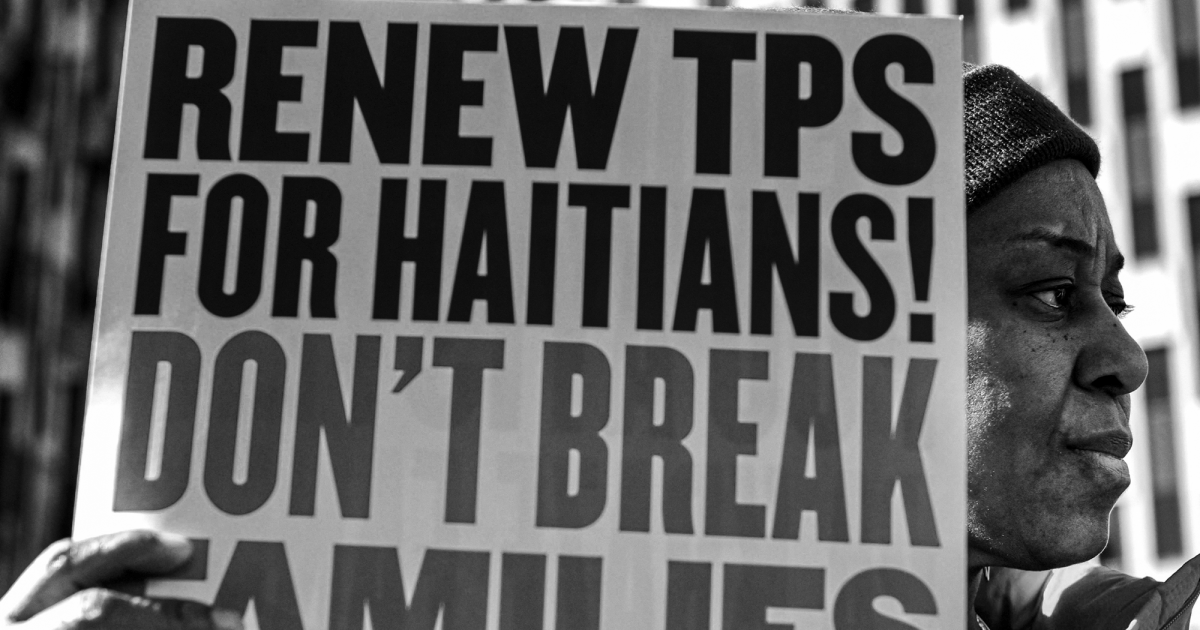
Timothy A. Clary/AFP/Getty Get your news from a source that’s not owned and controlled by oligarchs. Sign up for the free Mother Jones Daily. Since the US Supreme Court gave the Trump administration the green light to end the Temporary Protected Status designation for Haitians, immigrant rights groups, local government officials, and lawmakers—Republicans and Democrats alike—have been rallying for an extension of the program. They’ve yet to succeed. A bill to preserve the program until 2029 was rejected Wednesday in the Senate. Another measure, the American Dream and Promise Act, which would provide a pathway to legal status for TPS holders and many other immigrants, is likely to face the same fate. Scheduled to expire on July 24, as a result of an appeals court order, TPS protections for Haitians are now in place until at least July 27, the Miami Herald reported. The end of TPS would mean that about 350,000 Haitians—roughly the population of New Orleans or Orlando—would be added to the ever-growing pool of immigrants at risk of deportation. I spoke to immigration policy experts this week to understand how quickly the US government could target this community once they are stripped of their legal status. They all told me the process would be slow and would face many logistical hurdles. The likely scenario is that for the Haitian community, some may be deported, others may find another pathway to legal status, and many will remain undocumented within the US. “It’s not like the minute TPS ends, the government can simply go out, arrest people and have them on a plane 24 hours later.” “It’s not like the minute TPS ends, the government can simply go out, arrest people and have them on a plane 24 hours later,” said Aaron Reichlin-Melnick, a senior fellow at the American Immigration Council. “The vast majority of people with TPS are not currently in any sort of removal process…The US government has to find them, arrest them, take them into custody, process them, then determine whether they are subject to detention or not.” Complicating matters for the Trump administration is their deportation operations capacity. In the last fiscal year ending July 11, ICE carried out about 350,000 removals. “That would mean the entire system would have to stop everything else it was doing and focus entirely on the Haitian population if they wanted to deport them in a year,” Reichlin-Melnick added. “I don’t think they’re going to do that. They have other priorities. They have other people they’re going to be after.” Another challenge is the limited air travel available to Haiti, which has been ravaged in recent years by gang violence. Flights have all but stopped to the airport in the capital of Port-au-Prince after some US planes were struck by gunfire. Since December 2023, there has been a monthly deportation flight to Haiti that lands at the Cap-Haïtien airport on the northern coast, according to Human Rights First, which tracks ICE flights. In recent days, Haitian officials have been told by the Trump administration that they should expect two weekly flights carrying a total of 250 people, the Herald reported. “The conditions to be able to deport people to Haiti are so complicated and logistically difficult within themselves that it’s very unlikely that they’ll be able to do this quickly,” said Ariel G. Ruiz Soto, a senior policy analyst at the Migration Policy Institute. Even though Haitians would be joining the millions of other immigrants who are on ICE’s radar, the fact that TPS holders have been sharing their contact information with the US government for years would make them easier targets, John Sandweg, a former ICE director under President Obama, told me this week. TPS holders are required to report to the government for background screenings every few years. “The lowest public safety threats are the most vulnerable,” Sandweg said. “I guarantee it is easier for ICE to target those people than somebody who just crossed the border two years ago, but didn’t get apprehended.” Meanwhile, Haitians here under TPS brace for whatever is to come. As I reported earlier this week, many Haitians are consulting with attorneys to assess their legal options. Others plan to continue to report to their jobs until their work permits expire. “TPS holders don’t know what’s next for them,” Sui Chung, the executive director of the Miami-based legal nonprofit Americans for Immigrant Justice, told me. “It is such a sense of terror and disbelief that they could be returned to a country that is so completely in chaos and so very dangerous.”
Trump Ended TPS Overnight. Deporting 350,000 Haitians Is a Different Story.
Full Article
Original Source
Read the full article at Motherjones →KhanList aggregates and links to publicly available news content. We do not host full articles from third-party sources. Always verify important information with original sources.