
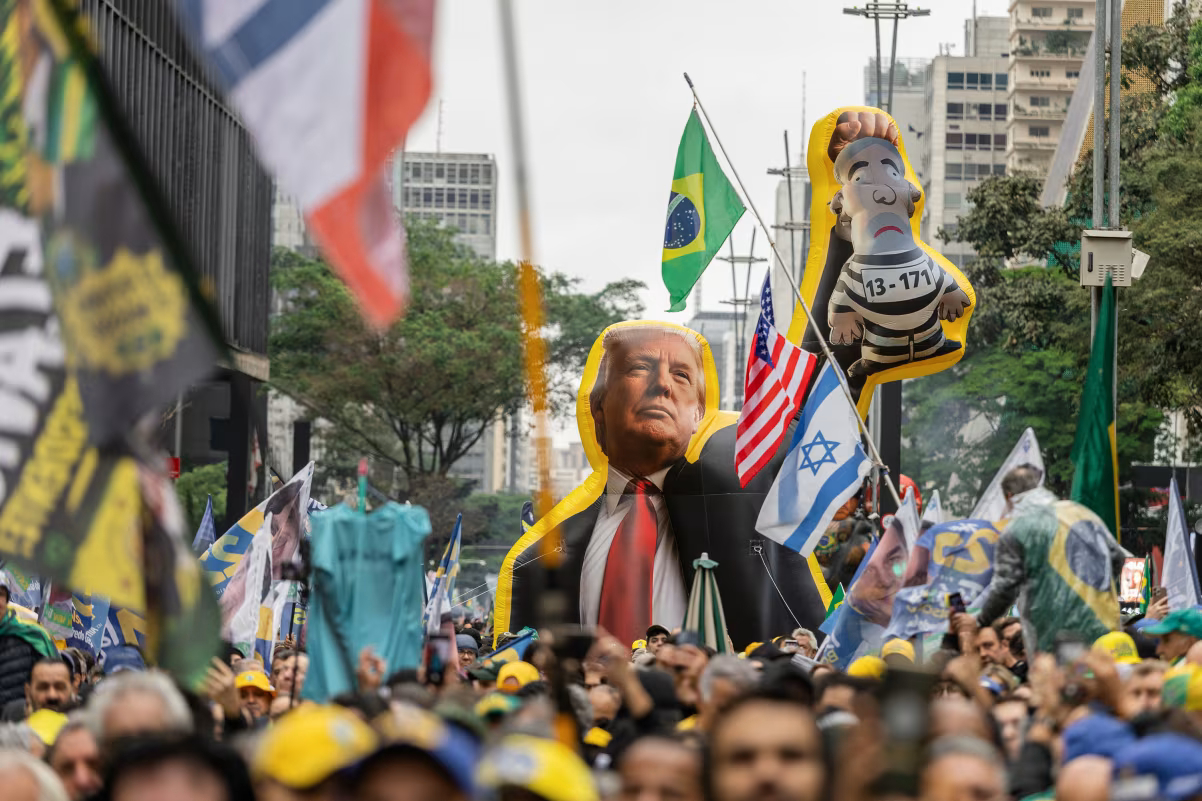
Millions of Brazilians will vote in a general election on Sunday that will choose the country’s president against a backdrop of corruption scandals, deep political polarization and growing voter fatigue, with two familiar political camps once again dominating the race. Among the frontrunners are the country’s leftist President Luiz Inácio Lula da Silva and right-wing Senator Flávio Bolsonaro, son of imprisoned former President Jair Bolsonaro, who are championing different paths for Brazil. “It’s two competing visions of what the country should look like and what Latin America should look like,” Brian Winter, editor-in-chief of Americas Quarterly and vice president of policy at Americas Society/Council of the Americas, told CNN. Voting is compulsory for most adults in the world’s fifth largest country, and turnout is typically among the highest in the Americas. The choice facing Brazilians extends well beyond domestic politics and could reshape how Brazil positions itself on the global stage. The vote would determine whether the region’s largest country tilts toward a growing conservative bloc aligned with US President Donald Trump or continues Lula’s pursuit of a multipolar foreign policy. Lula, 80, is seeking a fourth and likely last term. He governed Brazil from 2003 to 2010 and returned to the presidency in 2023 after a remarkable political comeback: Lula spent 580 days in prison on corruption convictions that Brazil’s Supreme Court later annulled in 2021, restoring his political rights, before he defeated then-president Jair Bolsonaro in the 2022 election. Lula is neck and neck with Flávio, who is trying to carry forward the political movement built around his father. Jair Bolsonaro, now under humanitarian house arrest for health reasons, is barred from running and is serving a 27-year sentence after being convicted of attempting a coup to overturn his 2022 election loss. Four other presidential hopefuls trail behind Lula and the younger Bolsanaro in the polls. They include centrist psychiatrist and best-selling author Augusto Cury; right-wing former Goiás governor Ronaldo Caiado; Renan Santos, a right-wing founder of the Movimento Brasil Livre now running under the Missão party; and Romeu Zema, the economically liberal, right-leaning former governor of the state of Minas Gerais. If no candidate wins more than half of valid votes on Sunday, the two with the most votes advance to an October 25 runoff. Lula has continued to champion multilateralism while distancing the country from the United States. That shift is visible in Brazil’s official trade data. China has been Brazil’s biggest export market since 2009, but its lead has widened sharply since Trump came to power. Lula’s relationship with Trump soured as Brazil became caught up in the US president’s tariff agenda and US policy toward organized crime in Latin America — friction that has given Lula another platform to run on: Brazil’s sovereignty. The first flashpoint came in summer of 2025, when Trump announced tariffs on many Brazilian goods, while explicitly citing what his administration called the politically motivated prosecution of Jair Bolsonaro. The tariffs were later rolled back in November. The former Brazilian president’s other son, Eduardo Bolsonaro, who moved to the US and lobbied the Trump administration on his father’s behalf, initially claimed credit for the pressure — a boast that later backfired on Flávio’s campaign as the tariffs hurt Brazilian businesses. Trade tensions returned this summer when Trump imposed fresh tariffs on certain Brazilian goods, still in effect today. Lula rejected the measures and threatened to retaliate against the US — a move he said later in September, in an interview with CNN’s Christiane Amanpour, he would hold off on while negotiations with Washington continued. The ongoing spat with the US has resonated with swing voters who lean right and embrace nationalist ideals. “Some have joked that the most effective campaigner for Lula has been Donald Trump,” Winter said. “The tariffs and the other efforts to interfere in Brazil’s politics have, for the most part, backfired and helped Lula.” Lula brought that argument onto the world stage at the United Nations General Assembly in September. “Brazil is nobody’s backyard,” he said, while accusing “some Brazilian politicians” of aligning themselves with foreign interests at odds with the country’s own — remarks widely seen as aimed at Flávio Bolsonaro. That divide extends to other foreign relations: Two days after Lula’s UN speech, Brazilian diplomats joined representatives of several countries in walking out as Israel’s Prime Minister Benjamin Netanyahu began his address, amid Lula’s sharpening criticism of Israel’s conduct in Gaza. Flávio Bolsonaro has taken a markedly different approach, cultivating ties with Netanyahu, Trump and other leaders Lula has clashed with. When Flávio launched his campaign in July, Netanyahu appeared by video to endorse him, as reported by CNN Brasil. In May, Flávio met Trump in the Oval Office to discuss organized crime, tariffs and critical minerals, then Vance and Rubio the next day. Argentine President Javier Milei, a libertarian and longtime Bolsonaro-family ally, traveled to Brazil in July to back Flávio’s campaign. He called Lula a “convict” and the government “thieving socialists,” prompting Brazil to recall its ambassador to Buenos Aires. This comes as Latin America’s broader political map has moved right following closely fought elections: Right-wing firebrand Abelardo de la Espriella narrowly won Colombia’s presidential election in June, and Keiko Fujimori won Peru’s runoff weeks later by roughly a tenth of a percentage point. “A Flávio Bolsonaro victory would cement this move to the right that we’ve seen in so much of Latin America over the last two years,” Winter said, noting that many of the region’s right-leaning governments are aligned with Trump on security and drug policy. That alignment intersects with voters’ most immediate concern: crime. “Security and crime have been the main issues that have led the Latin American right to win 13 of the last 16 presidential elections in Latin America,” Winter said, noting that robberies, extortion and cellphone theft still shape how Brazilians experience insecurity even as homicide rates have fallen over the past decade. Much like his father, Flávio has made a tougher approach to crime central to his campaign, advocating for the designation of major criminal factions as terrorist organizations, new federal prisons and lowering the age of criminal responsibility to 16. “The family’s brand has been successful above all because they’re seen as intolerant of crime,” Winter said, pointing to Jair Bolsonaro’s signature finger-gun pose. During his May trip to Washington, Flávio urged the Trump administration to classify Brazil’s two most powerful criminal organizations as terrorist groups; the US announced days later that the designation would take effect that June. Lula’s government opposed the move, warning that applying a terrorism framework to Brazilian criminal groups could become a pretext for foreign intervention. Affordability and an uneasy electorate Brazilians are also grappling with a slowing economy and persistent affordability issues. Headline indicators show low unemployment and moderating inflation, yet perceptions of household finances remain far less upbeat. “The economy is OK, but people feel like their salary doesn’t go as far,” Winter said. “They feel like their standard of living has declined, even when sometimes the official statistics tell a different story.” These cost-of-living concerns loom over Lula’s record. The leader is associated with social mobility and poverty reduction in Brazil, which was fueled by a booming economy during his first two terms, from 2003 to 2010. But this time, many voters are struggling to feel a similar jump. “The progress has not been nearly as widely felt as it was during his first two terms,” Winter said. Flávio faces a different challenge: inheriting a movement still centered on his father while presenting himself as his own candidate. “Flavio Bolsonaro is not the Bolsonaro that most right-wing voters originally wanted to cast a ballot for,” Winter said. “He is clearly the most moderate member of the family, and that may give him appeal to swing voters, but it also means that he doesn’t stir enthusiasm in the same way that his father did.” Women are an important part of that challenge. “The new right has struggled with women voters, not just in Brazil, but throughout the Americas,” Winter said. Flávio’s campaign has given his wife, Fernanda Bolsonaro, a more visible role in an effort to appeal to women voters — but a public rupture with his stepmother Michelle Bolsonaro, a prominent evangelical figure who had helped Jair Bolsonaro make inroads with conservative women, complicated that effort. Although the two reconciled, Flávio is still struggling to make ground with that base. “There’s a real gender divide,” Winter said. Religion is another crucial fault line in Brazil, where Catholic and evangelical voters remain politically important. Datafolha’s latest poll shows Flávio leading Lula among evangelical voters, 47% to 27%, while Lula leads among Catholics, 45% to 33%. The vote comes at a time of deep polarization among the electorate, who are slower to engage than in previous races. “The polarization continues to organize the race, but it is mobilizing the electorate with less intensity,” said Felipe Nunes, a political scientist and CEO of polling institute Quaest. Winter described it as an “apathetic polarization,” where Brazilians “are still wearing the shirt of their team, politically speaking … but they’re doing it without much enthusiasm.” That contrasts with Brazil’s last two elections. Bolsonaro rose to power in 2018 amid recession, crime and the fallout from a sweeping corruption probe centered on a bribery scheme at state oil giant Petrobras that implicated politicians and business leaders across the spectrum and badly damaged Lula’s Workers’ Party. By 2022, Lula narrowly beat Bolsonaro amid criticism of Bolsonaro’s handling of the pandemic and fears for the country’s democracy. Much of this year’s fatigue traces back to a sense of hopelessness over systemic corruption, which ranks among voters’ biggest concerns, yet neither camp can claim the issue as its own, say experts. Brasília has been consumed for months by investigations surrounding the collapse of Brazilian bank Banco Master and its former chief executive, Daniel Vorcaro, whose relationships extended across Brazil’s political, financial and judicial establishment. Supreme Court Justice Alexandre de Moraes, one of Bolsonarism’s main adversaries, has become a central figure in the scandal. Moraes has long been portrayed by Bolsonaro supporters as aligned with Lula for his role in the investigations that led to the former president’s coup conviction. The issue has been pounced upon by Flávio on the election campaign when the court began weighing whether to investigate claims that Moraes advised Vorcaro as he tried to save Banco Master from collapse, while a law firm run by Moraes’ wife held a three-year, R$131 million (about $25 million) contract with the bank. Moraes has denied wrongdoing; a decision on a formal probe was postponed in September. But as investigators reviewed Vorcaro’s messages, the scandal spread to Flávio’s own campaign. He is now under investigation for alleged corruption and money laundering related to financing Vorcaro provided for “Dark Horse,” a film about Jair Bolsonaro. Flávio has denied wrongdoing. Winter said the scandal may be reinforcing dissatisfaction with the political system rather than clearly helping one side: “It reinforces the disgust and apathy that Brazilians feel with their political system as a whole,” he said. For Bruno Brandão, executive director of Transparency International Brazil, the problem goes beyond Banco Master. “One side only cares about the corruption of the other side and closes its eyes to corruption among those in its own political camp,” Brandão told CNN, arguing that polarization makes sustained pressure for accountability harder. He also points to a structural shift, with presidents weakened by successive crises ceding more control over spending to Congress — making this year’s simultaneous congressional elections, which will decide who the next president governs with, especially consequential.
Trump, crime and corruption loom over Brazil’s presidential vote
Full Article
Original Source
Read the full article at Egyptindependent →KhanList aggregates and links to publicly available news content. We do not host full articles from third-party sources. Always verify important information with original sources.