
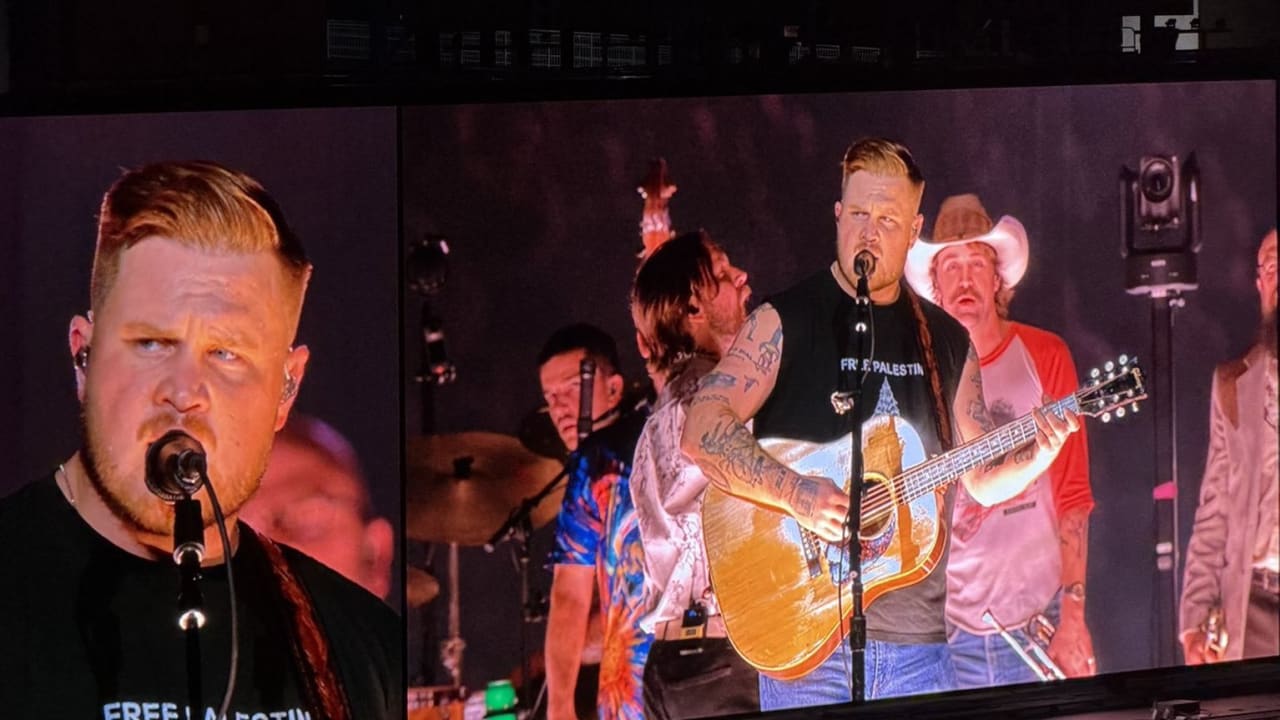
OCTOBER 4, 2026 12:43Updated: OCTOBER 4, 2026 13:10In the early morning hours of October 4, Gillette Stadium posted on X that “tonight, Zach Bryan broke the Gillette Stadium attendance record with 73,538 fans!”Bryan has not been in the headlines primarily for breaking the attendance record, however. Instead, multiple reports have focused on him wearing a “Free Palestine” shirt during his two shows at the stadium.The Boston Globe noted that “a few weeks after Macklemore was prohibited from performing at Gillette Stadium for making pro-Palestinian statements, Zach Bryan took the stage at Gillette in a black T-shirt reading ‘Free Palestine.’” Fox News provided more detail, noting that by wearing the shirt, Bryan had put “the same message at the center of another high-profile concert moment.”It added that “the country star wore the shirt during his Friday night stop in Foxborough, just weeks after Kraft confirmed he did not want Macklemore performing at Gillette Stadium following the rapper’s pro-Palestinian remarks during Ed Sheeran’s tour. Macklemore had shouted ‘Free Palestine’ at MetLife Stadium before he was later dropped from Sheeran’s tour. Sheeran said the decision came from the promoter and venues, not him.”The story of how Bryan came to wear the shirt is not fully known. The shirt is also not a traditional “Free Palestine” shirt and does not feature a Palestinian flag. Instead, it also says “An Appeal to Heaven” and features a pine tree.The phrase comes from John Locke’s Second Treatise of Government, while the symbol and motto have roots in the American Revolution. The “Appeal to Heaven” motto and flag have changed in meaning over time. Initially used by several naval vessels during the American Revolution, the flag was also briefly used as a maritime flag in Massachusetts.However, in 2024, the Associated Press noted that it had also become associated with the American Right. This could suggest that Bryan was doing two things at once: wearing the “Free Palestine” phrase to demonstrate that, as a musician, he could wear what he wanted, while also wearing a shirt bearing imagery that might appeal to some members of the more right-leaning country music audience.Bryan was born in Japan in 1996 and raised in Oologah, Oklahoma. He served eight years in the US Navy, including in aviation ordnance. Like Johnny Cash, who served in the US Air Force, Bryan honed his songwriting skills while in the military.Bran's band wore shirts supporting Palestine, Hind RajabBryan’s clothing choice has become a major topic of conversation on X. Well-known commentator Yashar Ali noted, “He is one of the biggest live draws in music, filling stadiums across the United States and in major cities around the world. Bryan served eight years on active duty in the US Navy and served overseas in Bahrain and Djibouti. Members of Bryan’s band also wore shirts supporting the Palestinian cause, including his drummer, who wore a jersey honoring the memory of Hind Rajab.”This indicates that the decision to wear the “Free Palestine” shirt extended beyond Bryan himself. Members of his band also appeared to want to send a message.Hind Rajab was a five-year-old Palestinian girl killed in Gaza in 2024. The band’s appearance in the shirts has generated controversy. Sean Spicer, the former White House press secretary, wrote on X after Bryan’s first show, “Here’s hoping there is no night 2.” However, the second show appears to have been even larger than the first.Unlike in the Macklemore controversy, no one has stepped forward to try to prevent Bryan from performing. This may be because the Macklemore controversy backfired.This phenomenon is sometimes called the Streisand effect: efforts to suppress, censor, or conceal something can instead draw greater attention to it. The dynamic is well known in music. Consider the film Straight Outta Compton, which detailed the rise of hip-hop group N.W.A. Controversies surrounding the group also helped propel it to prominence in the late 1980s and early 1990s.Support for the Palestinians is hardly a new cause. Many people around the world support the Palestinians, and for some, the issue has been a cause célèbre for decades, going back to the 1970s. The controversy surrounding such expressions has grown since October 7, particularly amid increased pushback against the phrase “Free Palestine.”Bryan’s appearance at Gillette Stadium in the shirt may offer a lesson. Many forums are not appropriate for raising the Palestinian issue. Music and artists, however, are likely to be a difficult group to impose such restrictions on.Musicians have history of political statementsMusicians have historically tended to be political, despite arguments that they should stay in their “lane.” Music, for instance, helped define the Vietnam War era and opposition to the war. Consider the impact of Woodstock in 1969 and the broader idea it came to represent.WGBH, reflecting on the music of 1969, noted, “Joe McDonald’s "I-Feel-Like-I’m-Fixin'-to-Die Rag" electrified a crowd of young men and women who were sick and tired of hearing about the evils of communism and government excuses for dragging on the war in Vietnam that had never been officially declared - a war now in its 15th year.”Over the years, however, musicians have also faced pushback for political statements. When the Dixie Chicks criticized the War on Terror and US president George W. Bush, many people were angered. This may have been partly because they made the comments in London rather than in the US. They could have spoken to an American audience about the war.Not all music about war is protest music. There have also been songs expressing American patriotism after the September 11 attacks. Musicians are not always part of a counterculture.Bob Marley, for instance, sought to promote peace amid political infighting in Jamaica during the 1978 One Love Peace Concert in Kingston. He brought People’s National Party leader Michael Manley and Jamaican Labour Party leader Edward Seaga on stage, where he clasped their hands together.Marley knew the risks of involvement in politics, or even the perception of involvement. Jamaica in the 1970s was not America in 2026. In December 1976, seven armed men attempted to kill Marley, shooting the reggae musician and four others.There is likely a lesson in the story of Bryan and Gillette Stadium. Far more people are drawn to music and sporting events than to political rallies. Most major musicians are not wearing “Free Palestine” shirts. However, if artists feel they are being pressured not to do so, it is possible that more of them will.Follow us on Google
Zach Bryan’s ‘Free Palestine’ shirt at Gillette Stadium offers lesson in music, politics - analysis
Full Article
Original Source
Read the full article at Jpost →KhanList aggregates and links to publicly available news content. We do not host full articles from third-party sources. Always verify important information with original sources.