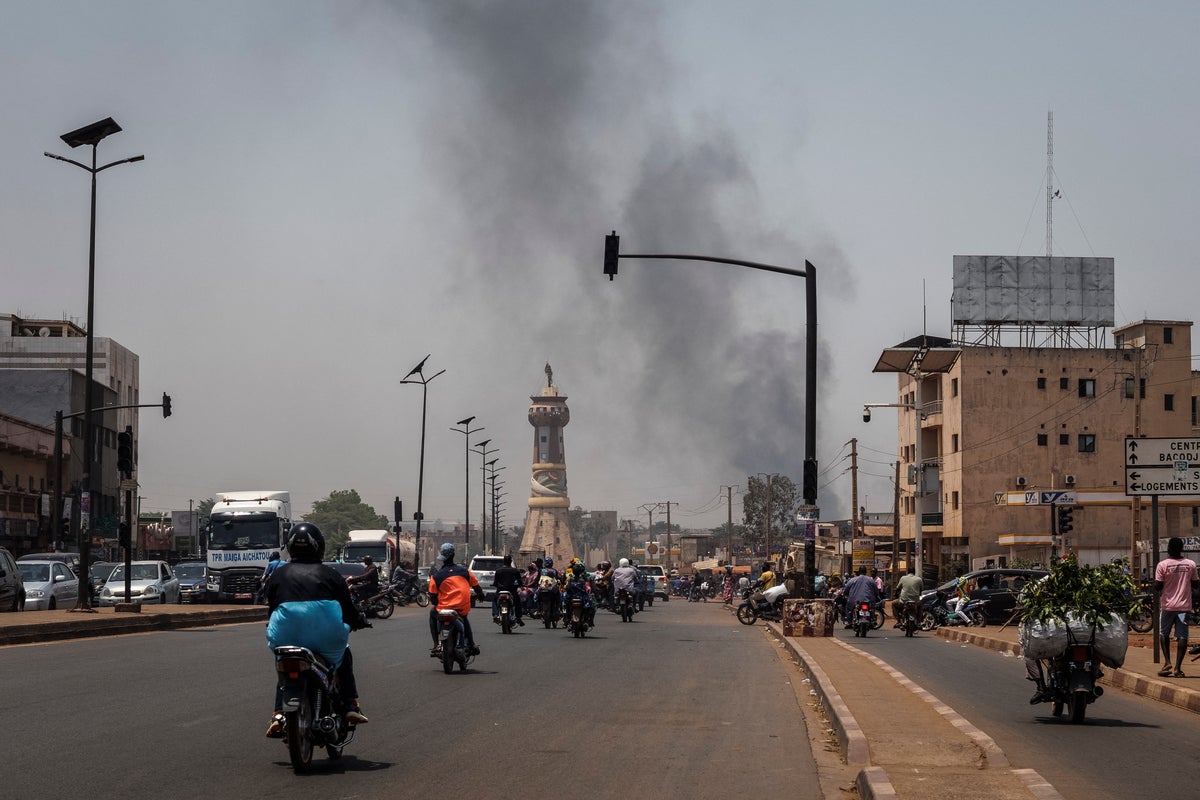
Donald Trump’s administration is reportedly considering military action against an al-Qaeda-linked group in Mali, what could be the eighth country targeted by the president since he returned to office last year.The administration is weighing strikes against JNIM, or Jama’at Nusrat al-Islam wal-Muslimin, which has claimed responsibility for a series of deadly attacks and kidnappings since announcing its formation in 2017. The group, which is allied with al-Qaeda, has increasingly attacked nearby West African nations, including a lethal attack at an airport in Niger’s capital last month, while terrorizing Mali’s interior with fuel blockades and sieges.Trump, whose administration labels him “the peace president” with a “peace through strength” platform as he openly seeks international peace prizes, is reportedly mulling whether to take action in Mali while mired in a months-long war with Iran, according to The Washington Post. If approved, the attacks would add to a growing list of nations and international waterways bombed by the U.S. military since 2025. The president has previously ordered strikes in Iraq, Nigeria, Somalia, Syria, Venezuela and Yemen in addition to killing more than 200 people on alleged drug-running boats in the Caribbean and eastern Pacific Ocean.Mali, one of the largest gold-producing nations in Africa, is among an alliance of military-controlled governments including Burkina Faso and Niger that have largely cut Western ties and turned to Russian forces for security help after recent military coups ousted their democratically elected leaders.The Trump administration is reportedly considering whether to attack al-Qaeda and Islamic State-linked groups in Mali, where shock attacks in the capital of Bamako in April resulted in the death of the country’s defense minister (AFP/Getty)Among administration figures reportedly pushing for military strikes against JNIM in Mali is Sebastian Gorka, a deputy assistant to the president and senior director for counterterrorism at the National Security Council.The White House did not confirm whether the president is weighing military action. An administration official told The Independent that it hopes the Alliance of Sahel States “prevails against terrorism, but the blame for the deteriorating security situation falls upon Russia who has proven to be an ineffective security partner for Mali.”“We hope that other African nations take note of Russia’s terrible performance in combating terrorism,” the other said.The administration is urging Alliance governments and other coastal West African governments to purchase U.S. equipment and services “to support their war efforts against the terrorists.”The administration is also urging NATO and regional allies to support Mali.The Department of Defense referred The Independent’s questions to the White House.Mali’s junta-controlled government and Russian mercenaries are struggling to combat JNIM and other paramilitary groups like the Azawad Liberation Front (AFP/Getty)Mali’s junta-controlled government and Russian mercenaries are struggling to combat JNIM and other military groups that have occupied the region. Another group — the rival IS Sahel, which is affiliated with the Islamic State — has pushed into Mali’s border with Niger, where militants kidnapped American missionary Kevin Rideout last year.So far this year, JNIM has launched a series of attacks on the nation’s capital of Bamako and killed the country’s defense minister in a suicide attack. Mali’s military and Russia’s Africa Corps troops also battled the group over several days this month, and JNIM shot down and destroyed a military helicopter after forcibly displacing a village.Last week, the group ambushed a joint convoy, reportedly forcing Africa Corps to leave dozens of Malian soldiers behind. Militants subsequently captured and executed many of them, “demonstrating how exposed Malian forces become when operating without the support of their Russian partners,” according to Héni Nsaibia, West Africa senior analyst at the Armed Conflict Location & Event Data project.“The military relies heavily on aircraft, including helicopters and armed drones, and these losses are likely becoming increasingly difficult to absorb, as this was the second helicopter shot down in just two weeks,” Nsaibia said this week. “The fact that the group eventually succeeded in emptying the town of a population it largely perceives as collectively hostile and state-aligned clearly demonstrates a sustained long-term strategy.”While JNIM and militant groups are believed to be responsible for at least 232 civilian deaths last year, Mali’s military and Russian mercenaries are responsible for killing hundreds more, according to ACLED. Last year, they were responsible for 925 civilian deaths, ACLED found.Mali, home to roughly 25 million people, is among Africa’s largest gold producers and contains large lithium deposits that foreign companies are hoping to exploit.Last year, the Trump administration reportedly began increasing its intelligence sharing and military support to the coup-ruled governments of Mali, Burkina Faso and Niger as part of a transnational deal to boost American access to minerals while also warding off Russian and Chinese influence in Africa.But it’s unclear whether the deal is working in a nation that has largely abandoned any movement towards restoring democratic elections; a similarly designed U.S.-Nigeria security partnership resulted in U.S. strikes that killed one of the Islamic State’s top leaders in Africa last year.“Opting for the military solution one more time won’t get things resolved,” Wassim Nasr, senior research fellow at the Soufan Center, told The Washington Post. “The French tried that for 10 years. The Russians have been trying for five years. The situation has only gotten worse and worse.”
Trump considers military strikes in Mali — which would be the 8th country he’s attacked this term
Full Article
Original Source
Read the full article at Independent →KhanList aggregates and links to publicly available news content. We do not host full articles from third-party sources. Always verify important information with original sources.