
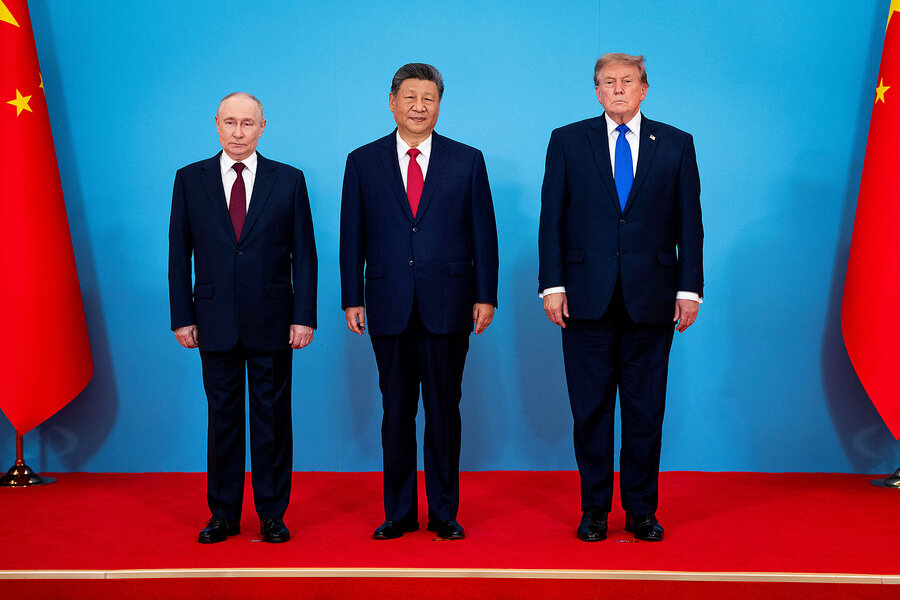
Shenzhen, China | Nov. 19, 2026, 6:00 p.m. ET | 4 min read In their historic summit, Chinese leader Xi Jinping, U.S. President Donald Trump, and Russian President Vladimir Putin agreed to a dialogue on reducing the risks and proliferation of nuclear weapons.They also pledged, in a “Declaration toward Peace,” to reform the United Nations and bolster the international body’s impact on global security – signaling a desire to bring greater order to what they describe as a chaotic world.The three leaders – who command the earth’s biggest militaries – each underscored that they shoulder a distinct obligation to the rest of the world to safeguard peace. “We have a special responsibility,” Mr. Trump said in opening remarks to Messrs. Xi and Putin as they faced one another around a circular table during the highly anticipated meeting on the sidelines of this week’s Asia Pacific Economic Cooperation (APEC) forum.“As the world’s three largest nuclear powers,” the countries are “uniquely positioned” to discuss nuclear arms reductions, he said. Sputnik/Sergei Bobylyov/ReutersRussia's President Vladimir Putin reacts while delivering a speech at the Asia-Pacific Economic Cooperation (APEC) leaders' summit in Shenzhen, China, Nov. 19, 2026. But as fighting in Ukraine drags on and the Iran war simmers, it’s unclear whether their lofty declarations will translate into resolving today’s most pressing regional conflicts – let alone curtailing the threat of nuclear war. Mr. Putin has so far shown little willingness to negotiate an end to the war he began by ordering the full-scale invasion of Ukraine in 2022.“This is a good start,” says Lyle Goldstein, who directs the China Initiative at Brown University The symbolism of the meeting itself lowers tensions, sending a top-down message to the nations’ militaries to “rein it in at the brink,” he says. “But now the question is, will there be follow-up? Or will we retreat back to a world of hot rivalry?” says Dr. Goldstein.“Mutual respect and equality”Beyond the high-minded goals voiced by the three leaders, perhaps the most striking outcome of the summit was to lift the Russian president out of his longstanding international isolation. Mr. Trump pointedly called him “my friend.”“Putin got ... a dose of respect from the Chinese and American leaders,” says Sergey Markov, a political analyst and former Kremlin advisor.The choreography of the trilateral meeting, held at the Kylin Villa, nestled in the lush foothills above the Chinese city of Shenzhen, was particularly telling.Mr. Xi’s position was the most statesmanlike, as he sat table against the backdrop of the three national flags. On his right was Mr. Putin, whom Mr. Xi invited to speak second, before Mr. Trump.Mr. Putin stressed that Russia must be treated as a peer by the two economic superpowers. “Russia, China, and the United States ... can make a significant contribution to strengthening global security,” Mr. Putin said in his opening remarks, provided their cooperation is rooted in “mutual respect and equality.”Two other agreements reached by the leaders also promise to benefit Mr. Putin. They pledged to “increase the production and supply of refined petroleum products” and stabilize energy flows. While no details were provided, this could mean an easing of U.S. sanctions targeting Russian oil exports.They also warned the International Criminal Court not to “abuse their jurisdiction,” underscoring the importance of respecting the “immunities of state officials.” Mr. Putin is wanted by the court, which Mr. Trump on Thursday criticized as a “rogue” organization. Andres Martinez Casares/ReutersChinese leader Xi Jinping speaks as he holds a trilateral meeting with U.S. President Donald Trump and Russia’s President Vladimir Putin on the sidelines of the Asia-Pacific Economic Cooperation (APEC) China Summit in Shenzhen, China, Nov. 19, 2026. Mr. Xi, Moscow’s top benefactor and closest ally, benefits from Mr. Putin’s elevation. But the bigger win for the Chinese leader was the meeting’s advancement – symbolically, at least – of his vision for a revised, more Beijing-centric world order.The leaders’ pledge to reform the United Nations is something Mr. Xi has advocated with increasing urgency under his new “global governance initiative.” Under this plan, Mr. Xi seeks to “democratize” the international system, especially by giving greater say to countries in the Global South, where Beijing enjoys broad influence.“An outstanding personal relationship”Mr. Xi also used the platform of the high-profile trilateral to chip away at key U.S. alliances already weakened by Mr. Trump’s “America First” approach to foreign policy, including in Europe.The images of Messrs. Trump and Putin hob-knobbing at APEC clashed sharply with the atmosphere in Berlin, where the leaders of Ukraine, France, the U.K., and other countries gathered Thursday for a “coalition of the willing” summit to discuss security imperatives. While today’s peace declaration made no mention of Ukraine, Mr. Trump said that he discussed the conflict at length with both the Russian president and Mr. Xi, stressing they all want it to end. Europeans earlier bristled at not being at the table.In a statement released by China’s Foreign Ministry after the trilateral summit, Mr. Xi praised the meeting in unusually glowing terms, saying “the seeds sown at the summit today will surely take root, sprout, bloom and bear fruit.”For his part, Mr. Trump relished the media limelight of the summit, as well as his time with two authoritarian leaders he’s often expressed admiration for.“Xi and I have formed an outstanding personal relationship,” the president said. “It’s gotten closer and closer.”Back home, however, Mr. Trump’s own strongman tendencies were recently rejected by U.S. voters. His party’s sweeping defeat in this month’s midterm elections reduced the president’s leverage as he headed into this week’s summit, and may complicate his ability to translate the summit goals into policy when he returns. Deepen your worldviewwith Monitor Highlights.Politics with respectGet political stories with respectful analysis.There‘s a world of new ideas in everyBooks newsletter.There‘s more to life, enrich yours withCulture & Learning weekly.Follow humanity‘s discoveries withScience & Nature stories in your inbox.Gain a spiritual perspectivefrom the stories in your inbox.Want to understand the deeper impact of critical events? Learn the Monitor‘s insight.Already a subscriber? Log in to hide ads. That’s a problem Mr. Xi and Mr. Putin won’t have.Olga Podolskaya contributed reporting for this story from Moscow. ALREADY A SUBSCRIBER? LoginReal news can be honest, hopeful, credible, constructive.The Christian Science Monitor was founded in 1908 to lift the standard of journalism and uplift humanity. We aim to “speak the truth in love.” Our goal is not to tell you what to think, but to give you the essential knowledge and understanding to come to your own intelligent conclusions. Join us in this mission by subscribing.
Trilateral meeting brings lofty goals – but no certainty on ending wars
Full Article
Original Source
Read the full article at Csmonitor →KhanList aggregates and links to publicly available news content. We do not host full articles from third-party sources. Always verify important information with original sources.