
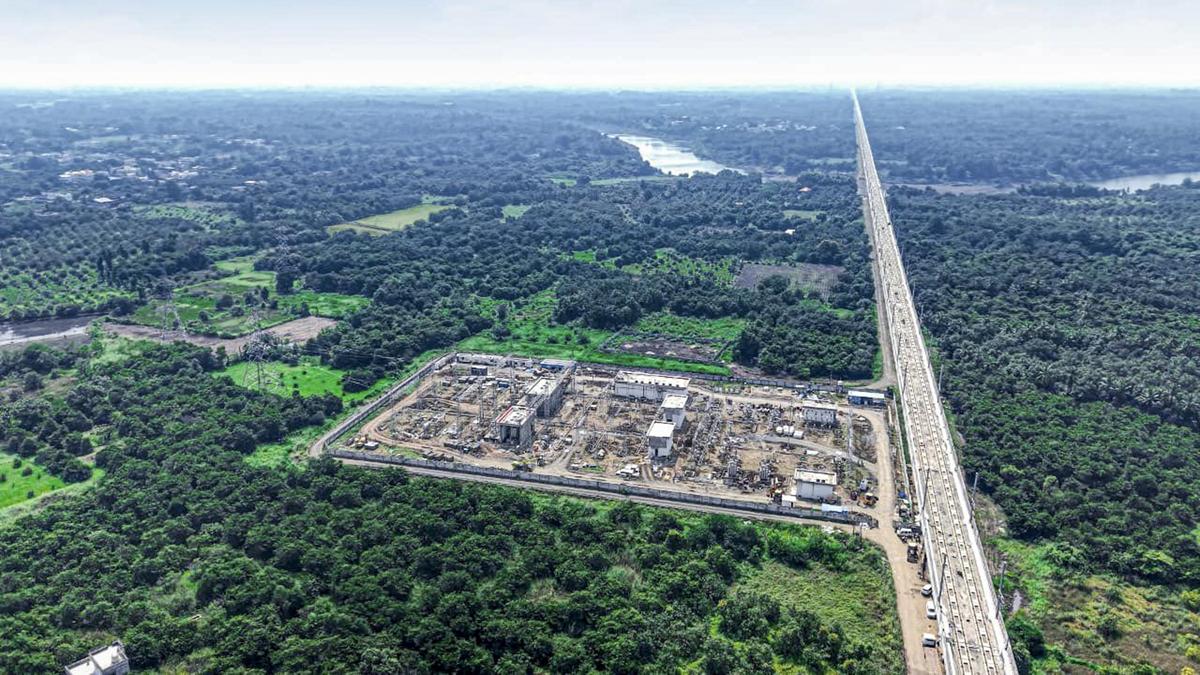
An aerial view of a traction substation under construction along the Mumbai-Ahmedabad bullet train corridor. Photo: X/@RailMinIndia via PTI. Trial runs of the indigenously manufactured high-speed train that will run on the bullet train corridor between Surat and Bilimora will begin in April and May next year, Railway Minister Ashwini Vaishnaw said on Monday (November 13, 2026).Sources indicated that the high-speed rail service — which is set to cover the 50 km stretch in about six minutes, as opposed to the regular trains that currently take 45 minutes to 1.5 hours — may open to the public as early as Independence Day, August 15, 2027.In a Substack post in October, Mr. Vaishnaw had said that the first section to open would be from Surat to Vapi, a distance of almost 120 km. “Due to multiple reasons including non-completion of work and delays, it has been designed to begin the trial runs on only the Surat to Bilimora section to begin with,” a senior official told The Hindu.500 km in two hours“Manufacturing of rolling stock for the first Made-In-India bullet train - B28 is underway at the Aditya manufacturing facility run by BEML in Bengaluru. Work on signalling systems will be finished by January end next year, and the section will be ready to receive trains in April and May for trial runs,” Mr. Vaishnaw said.The entire bullet train corridor between Mumbai to Ahmedabad spans 508 kms, and will take approximately two hours to traverse when the full stretch is operationalised. The corridor is being constructed by the National High Speed Rail Corporation Limited (NHSRCL).Successful squeeze testMr. Vaishnaw added that the train sets manufactured by BEML had recently undergone a successful ‘squeeze test demonstration,’ which is a critical quality assurance process in which a train car’s body is subjected to heavy pressure generated by controlled compressive forces to test its structural strength, rigidity, and stability.“This is a crucial test because when the train runs beyond 240 kmph, a vacuum is created where the entire atmospheric pressure falls on the train. Such trains need to have a capability to sustain this heavy pressure. So, in the squeeze test we subject the train car body to double the pressure that could be generated in real life situations,” Mr. Vaishnaw explained.Change of plansIt is pertinent to note that there is no technical difference between a high-speed train and a bullet train. The latter is an informal, popular nickname for a high-speed train, that originated in 1964 with Japan’s Shinkansen series that had pointed, aerodynamic nose cones.India was earlier set to receive Japanese Shinkansen train sets (E5 series) which ply at a speed of up to 320 kmph on certain routes in Japan. However, it was later decided to manufacture indigenous high speed train sets after negotiations with Japanese counterparts stagnated on multiple grounds, including the costs of acquiring the train sets.While the Shinkansen train set plan has not been scrapped, it has been shifted to a later timeline as Japan transitions from the older E5 series to the next-generation E10 series, which India is set to receive tentatively in 2030, officials added. Published - November 23, 2026 09:19 pm IST
Trial runs for high-speed Surat-Bilimora train to begin in April-May 2027: Railway Minister
Full Article
Original Source
Read the full article at Thehindu →KhanList aggregates and links to publicly available news content. We do not host full articles from third-party sources. Always verify important information with original sources.