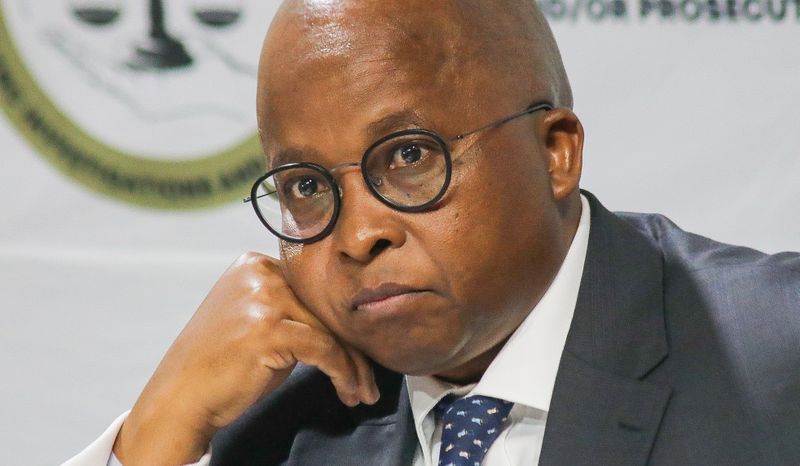
Former Presidency intelligence head Loyiso Jafta’s previous appearance before the Khampepe Commission of Inquiry into delayed Truth and Reconciliation (TRC) prosecutions and again on 13 July to face cross-examination, is significant as former Jafta’s then-boss, former president Thabo Mbeki, is cited as a witness at the inquiry.Jafta denied that Mbeki had sought in any way to influence the work of an Inter-ministerial Task Team (ITT) which had been set up post-TRC to deal with former apartheid officials accused of human rights abuses and who had not applied for amnesty.Former president Thabo Mbeki. (Photo: Gallo Images / Volksblad / Mlungisi Louw) He noted that minutes proved he had only attended the “constitutive” meeting of the ITT “to ensure the programme of action was outlined”. Subsequent meetings, he noted, had been operational and thus of no concern to the Presidency.Families of survivors who have fought for three decades to hold the government to account for the delays have claimed a “backdoor” agreement with former government players and the ANC, as the new democratic government, had derailed the quest for justice.Stratcom bogeymanAdvocate Howard Varney, appearing on behalf of the families – known as the Calata Group – has consistently argued that former apartheid security “elements” employed within the post-apartheid government in the early 2000s had used “Stratcom-like” tactics to manipulate the new government’s approach to TRC cases. This “deception”, Varney said, included suggesting to various officials, particularly former SAPS National Commissioner Jackie Selebi, that the National Prosecuting Authority (NPA) was about to prosecute 37 ANC members, including then president Mbeki. The newly established prosecuting authority was headed at the time, first by advocate Bulelani Ngcuka and later by advocate Vusi Pikoli. Both of their terms of office were controversially cut short, leading to years of turbulence, instability and infighting in the NPA, SAPS and the Scorpions later the Hawks.A circle can in fact be drawn all the way to the current Madlanga Commission, which has exposed 30 years of criminal creep into the country’s law enforcement and justice cluster and which has crippled the state.With regard to Stratcom, the infamous and ruthless propaganda and black-ops arm of the apartheid police and military intelligence, Jafta offered his scepticism as to its effectiveness. “I may just suggest, for what it is worth, that powerful as Stratcom was, I am not sure that it would have played a material role in influencing decisions about whether or not anybody was prosecuted,” said Jafta.The alleged threat, proffered by Jan Wagenaar, legal representative of former generals, that ANC officials would be arrested, was, said Jafta, “abstract rather than being informed by reality”. He argued that individuals like Mbeki, Jacob Zuma and many others in the early government who had spent years in exile or incarcerated on Robben Island, were unlikely to be “paralysed by the abstract threat of prosecution”.No history of retaliationJafta further pointed out that previous prosecutions of apartheid-era figures, such as Eugene de Kock, as well as former minister of police, Adrian Vlok, and former police commissioner Johan van der Merwe, for the poisoning of Reverend Frank Chikane, had not triggered “the retaliatory prosecutions of ANC members that the former generals had threatened”. Former apartheid police commander Eugene de Kock testifies at the Cradock Four inquest in Gqeberha on 23 March 2026. (Photo: Gallo Images / Die Burger / Lulama Zenzile) As important as these prosecutions might have been, he said, they “did not trigger a chain of events that would justify the anxiety that is being talked about.“The generals, whatever they would have been threatening or suggesting that was going to be their response, I really have no evidence suggesting that whatever they threatened materialised after the prosecution of Eugene de Kock and other people, and including the people who poisoned Reverend Chikane.”Reverend Frank Chikane testifies at the Khampepe Commission of Inquiry on 19 May 2026 in Johannesburg, South Africa. (Photo: Gallo Images / Fani Mahuntsi) Buried bodiesJafta, who chose his words with the circumspection of a man accustomed to holding confidences, said Wagenaar was the first to have raised the issue of finding the remains of murdered activists. And if bodies needed to be found, perpetrators would have been exposed. Commissioner Frans Kgomo read into the record comments by Wagenaar about a letter to Dr Marjorie Jobson, an advocate for TRC justice and national director of the Khulumani Support Group.“And then I said to her… because my memory serves me right, I said to her, but let us suppose those missing people were murdered by the security forces. I think it was at that discussion. I am not sure. “I think then I said to her, Dr Jobson, that suppose that was the case, you cannot expect those people to come forward and say we killed someone and we buried him there, and there, and there, if you merely want the remains, because there is no legal privilege attached. I think that is what I said to her that day. You need a process where there is legal privilege, and that directive, that prosecution directive created the situation of legal privilege.”In response, Jafta told the inquiry: “There are people who were captured by the security apparatus of the former regime, tortured and their remains disposed of. “There are cases that are known and there are cases that may not be known, because there are people who would have been intercepted, tortured and killed because of mistaken identity.“So it is not always the case that people referred to here will all of them in all circumstances be activists. Now, the operatives who would apprehend a person, torture him and get him killed and dispose of the body, would not be a very large number. In order for you to get to the nitty-gritty of the detail, one of them has to come forward, one way or the other.”‘Not accounted for’He added that “we know for a fact” – revealing his long career in intelligence – that people were apprehended and not accounted for.“But you know the police station where they were last in some form of detention or custody of the state. Typically, when somebody went into the custody of the state, say in Ladybrand or a place such as, such-like place, almost always bordering one of the neighbouring countries, you can make an entry into the investigation through there. “You would know who was the officer commanding on duty on the day. But then the obstacle would be to get to the actual functionaries who can take you there.” It was also the “enablers” of these operations, the policy makers and those who approved the operations, who were reluctant to come forward.“My experience is, the operatives, and particularly their supervisors, at a policy level and other levels, say at the level of an accounting officer, I do not think they were ever, ever keen, and this would vary from one department to the other. I do not think they were ever, ever keen on the very project of transitioning from apartheid to democracy.”There were many of these cases, Jafta told the commissioners.“I may as well abuse my being here. I think president Mbeki himself lost a child and maybe another sibling to the same kind of... and these are mere examples. There are numerous other families, spanning generations, who have got this wound that will never heal.” DM
TRC Roulette : Former presidential intelligence head denies ‘Stratcom’ pressure derailed TRC cases
Full Article
Original Source
Read the full article at Dailymaverick →KhanList aggregates and links to publicly available news content. We do not host full articles from third-party sources. Always verify important information with original sources.