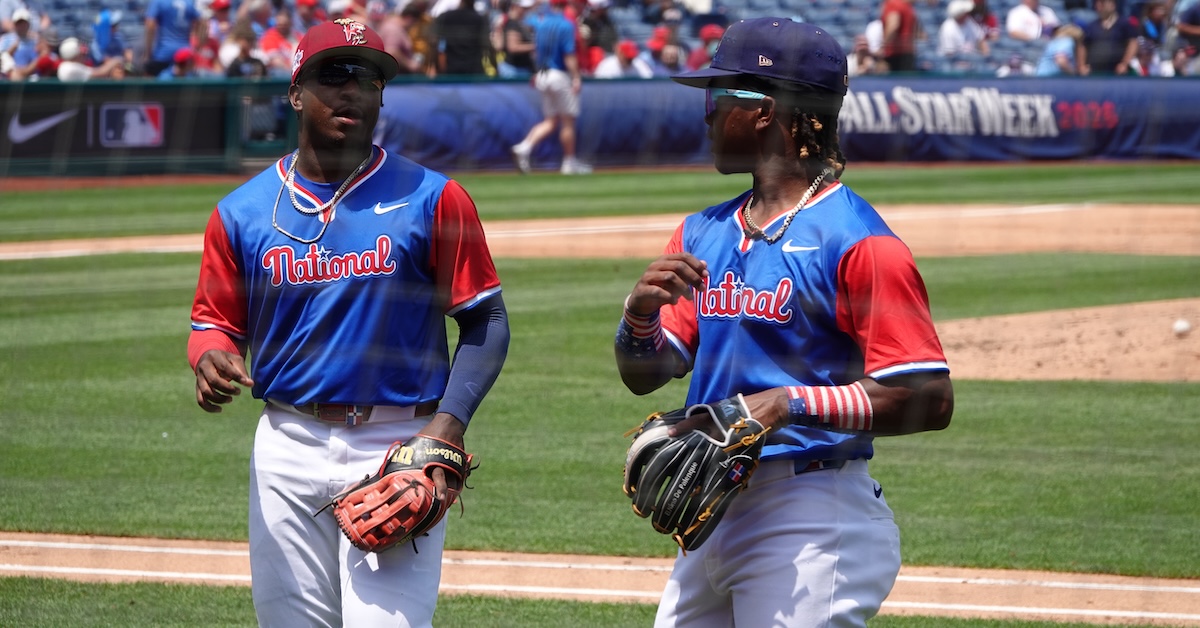
Luis Peña and Jesús Made Photo: Eric Longenhagen As August 3 draws closer, we’re continuing to update the farm systems of some of the clubs we expect to be buyers at the trade deadline. These teams are both contending for a playoff berth and in clear need of a significant upgrade, the kind that will likely require parting with a top farmhand or two. Today, we’re evaluating the Milwaukee Brewers. In tandem with an evaluation of team needs and posture, we’ve also updated Milwaukee’s Top Prospect list. The new list accounts for the graduations of Brandon Sproat, Logan Henderson, and Craig Yoho, and offers a fresh valuation on several notable farmhands. The big news is that Alexander Frias, Brady Ebel, and Tyson Hardin have moved onto our Top 100, while Jett Williams has fallen off. We’ll cover them, and a couple of the other big changes, in more detail below. The Situation The Brew Crew is at it again. Milwaukee has the second-best run differential in baseball and a 5.5-game lead in the NL Central. As of Thursday afternoon, our Playoff Odds give them an 83.4% chance to win the division and all but guarantee a spot in the tournament. Enviable pitching depth has helped them weather absences from Quinn Priester, Brandon Woodruff, and Kyle Harrison without missing a beat. The club’s big divisional lead has even afforded them the luxury of letting Sproat work through some kinks in the big league rotation. Offensively, they’ve mostly been healthy this year, and are again working miracles with a modern version of small ball. Last in baseball in homers, the Brewers are nonetheless fifth in runs and sixth in wRC+. They take their walks, don’t strike out much, steal efficiently, and otherwise run the bases well. Potential upgrades to this unique club make most sense viewed through the prism of who can help them win a series against the Dodgers rather than who can help them clinch a playoff spot. Big League Needs: High-End Pitching, Third Base You can’t do any better than Jacob Misiorowski for a Game 1 start, and Harrison, assuming he returns healthy, is a perfectly solid choice for Game 2. Plenty of playoff clubs would be content to roll out Henderson and Shane Drohan behind them, and Milwaukee won’t be in bad shape if that’s what the team chooses to do. The prospect of Tarik Skubal here, though, is pretty exciting. The margins in the playoffs are tight. If you’re really going for it, setting up a rotation that allows Skubal to face Freddie Freeman and Shohei Ohtani for two starts in a series instead of, well, anybody else, is the kind of upgrade that justifies parting with real prospect capital. You can also never have enough quality relief pitching. That applies to the Brewers, even though their bullpen is quite good: The unit is third in WAR, fifth in FIP, and eighth in K/9. Trevor Megill, Aaron Ashby, and Abner Uribe are the kind of electric relievers you want to throw at teams on a cold October night. But if we can again be picky, if you’ve got to beat the Dodgers in a couple of close games, you’d really like to have a monster to throw at them in the ninth. Mason Miller may not be available, but if he is, he’s another guy who tangibly moves the needle in a playoff environment. Offensively, the Brewers are mostly solid up and down the lineup. A month ago, shortstop looked like a potential weak spot, but Cooper Pratt is off to a strong start in his big league career, and even if the bat regresses down the stretch, Milwaukee will feel good about his defensive ability there. The most obvious spot to upgrade is to Pratt’s right. Joey Ortiz and David Hamilton are serviceable options at third base, especially defensively, and there aren’t a ton of obvious fits on the trade market at the hot corner, but there are a couple creative solutions if the club is again willing to take a big swing. Could the Brewers make the money work on a Bo Bichette deal? Is there a path to acquiring Zach Neto and plugging him in at third? Prices and availability suggest it’ll be difficult to make any of these kinds of upgrades, but if one of them is in the cards, it would help a lot. You Aren't a FanGraphs Member It looks like you aren't yet a FanGraphs Member (or aren't logged in). We aren't mad, just disappointed. We get it. You want to read this article. But before we let you get back to it, we'd like to point out a few of the good reasons why you should become a Member. 1. Ad Free viewing! We won't bug you with this ad, or any other. 2. Unlimited articles! Non-Members only get to read 10 free articles a month. Members never get cut off. 3. Dark mode and Classic mode! 4. Custom player page dashboards! Choose the player cards you want, in the order you want them. 5. One-click data exports! Export our projections and leaderboards for your personal projects. 6. Remove the photos on the home page! (Honestly, this doesn't sound so great to us, but some people wanted it, and we like to give our Members what they want.) 7. Even more Steamer projections! We have handedness, percentile, and context neutral projections available for Members only. 8. Get FanGraphs Walk-Off, a customized year end review! Find out exactly how you used FanGraphs this year, and how that compares to other Members. Don't be a victim of FOMO. 9. A weekly mailbag column, exclusively for Members. 10. Help support FanGraphs and our entire staff! Our Members provide us with critical resources to improve the site and deliver new features! We hope you'll consider a Membership today, for yourself or as a gift! And we realize this has been an awfully long sales pitch, so we've also removed all the other ads in this article. We didn't want to overdo it. State of the Farm Even with a handful of recent graduations, the Brewers have one of the game’s strongest systems. Our Farm System Rankings have them third in the sport, and they’re flush with potential impact players on both sides of the ball. Like a major college program stacking five star quarterbacks in consecutive classes, the Brewers have good shortstops all over the place: Jesús Made is the top prospect in all of baseball and is currently at Double-A, Luis Peña is a 55 FV at High-A, and as I noted in the intro, Ebel just joined our Top 100 list amidst a strong season in Low-A. Their Top 100 contingent also includes a near-ready starter (Hardin), a catcher who has already made his debut (Jeferson Quero), and arguably the biggest bat on any of the complexes this summer (Frias). A tier down, you’ll find a couple of guys who could make a move into that space. Josh Knoth has the stuff and delivery of a Top 100 prospect, we just want to see him maintain something resembling this level of stuff over longer outings. All of the good things we wrote about Bishop Letson over the winter — athletic, physically projectable, good release traits — hold up, but his performance doesn’t warrant an FV adjustment just yet. Braylon Payne climbs into the 45 FV tier. He might be the most athletic guy in the system, and he’s learning how to make the most of a pretty ugly swing. There’s a ton of hit risk there, but also uncommon upside if everything clicks. He joins a very long list of 45 FV and better prospects. Here are the players graded as 40 FVs and above on the updated list: Updated Milwaukee Brewers Top Prospects The team’s full list, complete with scouting reports and tool grades, can be found on The Board. The Power-Hitting Corner Infielders We’ve shuffled the deck a bit on the upper-level corner bats with big raw power. Blake Burke rises into the 45 FV tier here. For about a year now, he’s been a 150 wRC+ hitter at Double-A, with 40 homers in 123 games. He has 70 raw power, the kind of impact that will allow him to do plenty of damage even when he’s not squaring pitches up. He’s maintained low, if viable, contact numbers (71% overall, 78% in zone) in Biloxi, and even if he swings and misses plenty against big league stuff, we think there’s enough power for him to contribute meaningfully. Then there’s Luke Adams. It’s hard to find fault with the numbers he’s posted throughout his minor league career. This year, he’s whacking the ball as a 22-year-old in Triple-A, where he’s hitting .260/.407/.533, good for a 147 wRC+ with 12 bombs in 52 games. He’s grown into plus power: His EV90 is up three ticks from last year, and his max has risen from 109 mph to 113. He’s doing all this while making contact 75% of the time (82% in zone), which is adequate for someone with that kind of power. He has one of the lowest swing rates in the minors, but unlike many for whom that’s true, his chase rate doesn’t explode with two strikes. He’s also quite good at getting to pull-side lift; every one of his homers this year has sailed out to the left of second base. That said, the stiffness in his swing still scares me, and I’m particularly concerned that he’ll be vulnerable at the top of the zone. The vast majority of his damage comes on pitches down, and while he’s often able to foul off pitches above the belt, there’s a chance big league heaters turn those spoiled pitches into swings and misses. For a righty who profiles at first base, it’s enough of a risk to keep him off our Top 100, but given how well he’s doing with everything else, it felt appropriate to elevate him to the 45 FV tier on this update. Andrew Fischer trades places with them, slipping into the 40+ tier. We don’t see him as more than a fringy fit at third, and we’re pretty worried about the swing and miss here (63% contact rate overall, 70% in zone), particularly since a lot of those whiffs came against A-ball arms; his power is also closer to plus than elite. Brock Wilken also falls a tier, as Triple-A pitchers have exploited the holes in his swing to the point that we see him as more of an up-down option than a regular bench piece. He finds himself near Eric Bitonti, a left-side masher a couple rungs lower with more athleticism but even scarier swing-and-miss data; both are 35+ FVs. Pitcher Movement It’s been a boom and bust kind of season for Milwaukee farmhands on the mound. Henderson and Drohan are pitching like mid-rotation starters, and Hardin could soon join them. He’s a pop-up prospect who has not only maintained the massive control gains he’s made since college, but started throwing harder. But many of the intriguing arms we liked last winter haven’t performed as we’d hoped. J.D. Thompson falls a rung here. We still like the way his fastball plays, but hitters seem to see his secondaries well out of the hand, and he isn’t running over A-ball competition like we thought an early-round, SEC veteran should. Coleman Crow dipped as well. We’re rounding down on his chances to start, as it increasingly looks like he’s a better fit in a spin-to-win, one-time-through kind of role than as a starter or in high-leverage relief duty. Bryce Meccage was wild early and has been hurt since; he gets the dreaded band aid tag. In a different kind of troubling news, Melvin Hernandez is no longer with the organization; he reportedly decided to step away from the game after being the victim of an alleged bullying incident. Ryan Birchard and Yerlin Rodriguez fall off the list as well, as their control hasn’t progressed any over the course of the year. New Arrivals Josiah Ragsdale is Milwaukee’s breakout prospect this year. A seventh-rounder out of Boston College a year ago, the 22-year-old has hit his way to (and soon through) Biloxi. He’s twitchy with wiry strength, and his full-body swing helps him generate more power than you’d expect looking at him, in a way that bears some resemblance to how Dominic Canzone does it. Ragsdale doesn’t have that much juice, but he’s a lot faster. He’s a 70 runner, and while his reads and routes aren’t pristine, he has wheels enough for the job. How much he’s able to grow there, and how well he’s able to handle lefties — he’s making viable contact against them but with no power — will shape his ultimate big league role. For now, we’re projecting him as a fancy fourth outfielder with everyday upside. On the mound, we’ve added a couple velo climbers. Jayden Dubanewicz went from sitting in the low 90s to living in the mid-90s. The pitch has a lot of carry, and given that he’s still young and lean, there may yet be more in the tank. He’s also flashing a couple of above-average breaking balls. These are sufficiently enticing traits to boost him all the way to the 40+ tier even with a little backsliding in his control. Wande Torres, meanwhile, is a lefty who has gone from touching 95 to touching 98. He’s probably a sinker-slider reliever in the end, but it’s worth exhausting him in the rotation for the reps. Finally, it’s always nice to conjure up a reliever like Brian Fitzpatrick, a lefty with average arm strength and a couple interesting secondaries. He made his debut this spring, but unfortunately he’ll be out until at least midway through next year recovering from UCL surgery. Young Position Players First-year pros Diego Frontado, Ricki Moneys, and Leanders Matos all notched 135 wRC+s or better while walking more than they struck out in the DSL; Matos managed to do so at the ripe old age of 16. José Rodríguez fell just a hair short of those numbers, but he’s a great mover and Eric in particular likes him enough to push him into the 40 FV tier. We’ll need the offseason to give this club’s DSL rosters a full look-through, but for now the other three are stacked toward the bottom of the list as 35+ FVs. Moneys has absurd thump for a 17-year-old, already above the big league average. Frontado moves well and has a hitterish look in the box and a chance to stay at short, while Matos’s blend of performance and physical projection warrants putting him on the radar. We’re also downshifting on a few hitters. Kenny Fenelon and Brailyn Antunez are toolsy outfielders with power, but sub-60% contact rates on the complex put them more in the bucket of projectable long-shots than prospective impact pieces. José Anderson has homered 21 times at Low-A this year, but that’s just about all he’s done, as he’s struck out 40.2% of the time, far too much for a guy we needed to see make more contact, not less. He drops off the list, as does Filippo Di Turi, a solid defensive infielder without enough stick to grade out as more than a late-blooming flier at this point. Who Makes a Good Secondary or Tertiary Piece in a Trade? You’re forgiven for thinking “who doesn’t?” at this point. Among the position players, the Brewers are loaded with tool sheds (Payne, Ragsdale), data fliers (Matthew Wood joins a few of the first basemen we touched on above on the hitter side), and catchers who look blocked (Quero, Marco Dinges). For anyone who thinks they can help young guys make more contact, Bitonti, Fenelon, and Antunez are risk/reward plays to add to the end of a deal. There’s a similar “choose your flavor” element on the pitching side. All of the talented arrow-down guys above are enticing reclamation projects. You could well add someone like Jaron DeBerry, a control pitcher who might’ve been spooked out of the strike zone amidst the homer barrage in the minors this year, to that list. I’d also toss out Brett Wichrowski here. He throws hard and flashes plus breaking stuff. He doesn’t execute consistently, and that might push him to the ‘pen eventually, but for teams that can afford to give the guy a long runway, the pitch mix is good enough to stay patient as he tries to figure out the touch and feel elements of pitching as a starter.
Trade Deadline Prospects Guide: Milwaukee Brewers
Full Article
Original Source
Read the full article at Blogs →KhanList aggregates and links to publicly available news content. We do not host full articles from third-party sources. Always verify important information with original sources.