
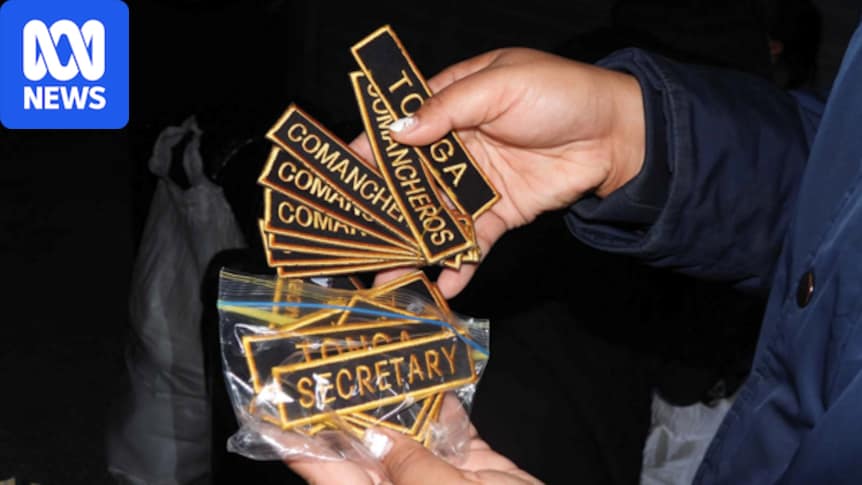
A Tongan man deported from Australia has been convicted over his role in establishing a branch of the feared Comancheros outlaw motorcycle gang in the Pacific Island nation, the ABC can reveal.In a landmark case, Eneasi Taumoefolau was found guilty by a judge in Tonga of participating in an organised criminal group under the Counter Terrorism and Transnational Crimes Act. It is the first time the law has been tested in court.He is facing a maximum sentence of 25 years and will be sentenced at a later date.Tongan police and Eneasi Taumoefolau in the parking lot of Nuku'alofa airport, where investigators discovered Comancheros paraphernalia in a parked car. (Supplied)Taumoefolau is currently serving a life sentence in Tonga's main prison over separate charges, having been convicted in 2025 of importing more than 2 kilograms of methamphetamine into Tonga from the United States.Three other men were charged over the Comancheros case and put on trial. Tevita Shoji, a deportee from New Zealand, was found guilty, while two other deportees from Australia, Lolomana'ia Tilini and Sione Tafokitau, were found not guilty.Court documents revealed Taumoefolau was the president of the chapter in Tonga."Taumoefolau was regularly seen wearing Comanchero vests, riding a bike with the Comanchero label clearly displayed on it, and had a storage unit containing a significant amount of Comanchero uniforms and badges," Justice Elisapeti Langi wrote.Police found Comanchero apparel in their search after arresting Eneasi Taumoefolau and his co-accused. (Supplied)In an exclusive prison interview earlier this year with the ABC's Foreign Correspondent program, Taumoefolau denied having set up a Comancheros chapter in Tonga, saying he had plans to do so but abandoned them when he realised prospective members may not be criminally savvy enough to follow the gang's strict codes.Speaking on the phone from prison this week, Taumoefolau told the ABC he stands by that explanation."I don't know how they've come up with that decision to say it's been set up," he said."We have no clubhouse. We have no set-ups."'We got gang work to do'Justice Langi said she was satisfied the defendants had formed a group based in part on "the physical evidence of a storage unit containing a significant number of Comanchero clothing and regalia together with telephone messages and conversations between all four defendants".Messages tendered as evidence show Taumoefolau saying to one of his co-accused, "We got gang work to do."Evidence submitted to the court also revealed Taumoefolau was in regular communication with Shoji, who was a "nom", a term given to a nominee or prospective member of the gang.A Comancheros tattoo on Eneasi Taumoefolau's leg. (ABC News: Stephanie March)In one text exchange, Taumoefolau described Shoji as "the best nom eva (sic)".Police also submitted evidence Taumoefolau said he would provide a "nom" T-shirt to a drug offender serving time in a Tongan prison.Court documents also referred to text messages from July 2024 between Taumoefolau and a number in New Zealand.Comancheros vests and patches were used as evidence of Eneasi Taumoefolau's plans to start a "Kingdom Chapter" of the outlaw gang in Tonga. (ABC News: Stephanie March)They showed the New Zealand contact asking Taumoefolau to send photos to an individual in Auckland Prison.The contact then warned Taumoefolau "not to post gang colors because gang flicks are not permitted" in prison.It is understood the individual in Auckland Prison was Pasilika Naufahu, the president of the Comancheros New Zealand branch.Eneasi Taumoefolau was interviewed in prison by the ABC earlier this year. (ABC News: Stephanie March)About the same time, Taumoefolau and the New Zealand contact also discuss organising an annual "National Run" in Tonga, an event where club members gather for a motorcycle ride on a pre-determined route.The contact urged Taumoefolau to arrange food, drinks, accommodation and "taahines" (girls).Speaking to the ABC, Taumoefolau said he does not remember either of these conversations and said Naufahu had nothing to do with trying to set up the chapter in Tonga.Photos show search for gang paraphernaliaTaumoefolau and Shoji were the subject of a dramatic arrest in the Tongan capital in August 2024 that saw heavily armed officers from the tactical response group shoot into the engine block of Shoji's car. Police found a bag containing methamphetamine inside.The ABC has obtained photos tendered as evidence in the trial that show Taumoefolau being taken by police as they search various locations for gang paraphernalia after his arrest.They show him being taken to a storage unit, rented in the name of his partner, where police discovered "bags of T-shirts with comanchero logo (sic) and signs", and "suitcases containing vests and labels of ranks".Eneasi Taumoefolau after his arrest in Nuku'alofa. (Supplied)There is also a photo of him with police in the Nuku'alofa airport parking lot where police found more gang paraphernalia in a car that had previously been driven by Shoji, including a vest marked "Commander".Taumoefolau said earlier this year his motivation for trying to establish a branch in Tonga was to "piss off the Australian government" who deported him in 2022 after a string of drug convictions."It was just stupid," he said. "I was reckless, and I was very ambitious in the way I thought, 'I'll do it because it'll really, really piss them off,'" he told Foreign Correspondent earlier this year.A Tongan court cited a storage unit containing Comanchero uniforms and badges in convicting Eneasi Taumoefolau. (Supplied)Taumoefolau has been in an isolation cell in Tonga's main prison since March."It's 23 hour lockdown," he told the ABC this week.Neither he nor prison officials could confirm why he's been removed from the general prison population.He says he plans to appeal the verdict in this case and his drug conviction.Are tides turning on Pacific drug scourge?South Pacific nations have been grappling with a devastating surge in drug smuggling due to what the Australian Federal Police commissioner has described as Australia's "insatiable appetite" for meth and cocaine, with customers willing to pay some of the highest prices in the world for illicit drugs.The Australian government recently announced $600 million for a new Pacific scheme designed to tackle the surge of drug smuggling into the region.Geoff Turner says currently there is no evidence of a cocaine market in Tonga. (ABC News: Stephanie March)Tonga's police commissioner, Geoff Turner, says his force's efforts to combat drug crime in the Kingdom of Tonga are paying off. He says the price of a gram of methamphetamine has increased fivefold in 18 months, meaning supply has dropped significantly."There is a great shortage of methamphetamine in the Kingdom at the moment. Having said that, with the increased prices, it also makes it more attractive," he says."So it's that balance between, you know, stopping supply, but also then making it more attractive because of the prices that are attractive."He says about six to eight weeks ago several blocks of cocaine washed up on the beach in the tourist hotspot of Vava'u, with similar markings as some that washed up in Fiji, which is 800 kilometres away."I'd say it's probably being carried on the tide and probably some part of a load that's fallen over the side or a semi-submersible that may have lost something," he said."Or, alternatively, it's been a raft type or something that's maybe dropped off and a few blocks have gone over the side."So now at this point in time, we don't have any evidence of a cocaine market here in Tonga, but it's certainly something we're monitoring at the moment," he said.
Tongan man deported from Australia convicted over bid to set up Comancheros gang branch
Full Article
Original Source
Read the full article at Abc →KhanList aggregates and links to publicly available news content. We do not host full articles from third-party sources. Always verify important information with original sources.