
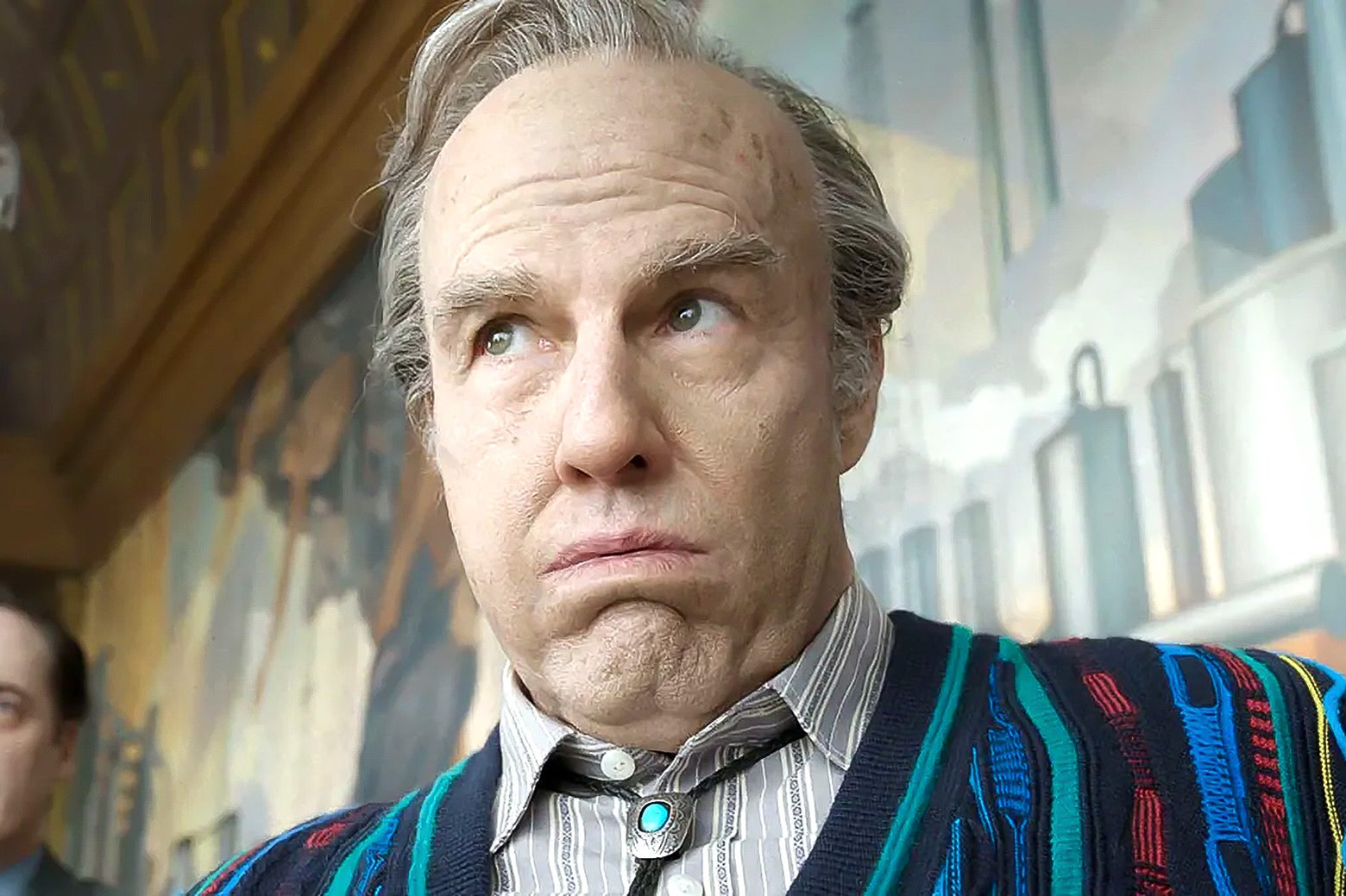
Movies Digger Wants to Be the Next Dr. Strangelove, but I Couldn’t Learn to Stop Worrying and Love This Bomb By Enter your email to receive alerts for this author. Sign in or create an account to better manage your email preferences. Unsubscribe from email alerts Are you sure you want to unsubscribe from email alerts for Dana Stevens? Oct 02, 20265:45 AM Tom Cruise in Digger. Warner Bros. Pictures Sign up for the Slatest to get the most insightful analysis, criticism, and advice out there, delivered to your inbox daily. It’s rare that a big-budget Hollywood movie, much less one that’s trying to position itself in the Oscar race, sets out to assault its audience with the methodical relentlessness of Digger. From its opening scene, with the loathsome title character waking up in a bed soiled by his ancient and decrepit cat, to its final shot, as the camera pans away from the main action and tilts up to reveal a setting even grimmer than the one where we’ve spent the past two hours, Alejandro González Iñárritu’s eighth feature never rests in its mission to flood the viewer with unpleasant sensations. This makes some sense, given that Digger is in large part about an actual flood, a global environmental catastrophe set off by the fatal carelessness and greed of Texas oil baron Digger Rockwell (a jowly, prosthetics-cloaked Tom Cruise). This boorish billionaire, stomping around his taxidermy-filled mansion in silk pajamas and cowboy boots, is like some unholy spawn of Elon Musk, There Will Be Blood’s Daniel Plainview, and the Slim Pickens character who rides a falling nuclear bomb like it’s a bucking bronco at the end of Dr. Strangelove. The ghost of that Cold War classic haunts the colossal, airless sets of Digger, reminding us both that it is possible to make a truly funny comedy about the end of the world and that this laugh-free spectacle is not that movie. A video call from an employee on an oil rig Digger owns lays out the unfolding crisis: His company’s reckless drilling has caused a massive methane explosion, sending a chunk of Arctic ice the size of a major city floating across the North Sea toward Europe. Even Digger, a leader with little investment in the details of his business—he has 42 unread emails in his inbox warning him of the disaster—has to admit that this development is serious enough to call for a meeting of the nation’s top leadership. Unfortunately, that leadership is made up of such nincompoops as the blustering President Compson (John Goodman), his simpering vice president (Michael Stuhlbarg), and the belligerent secretary of defense (Robert John Burke) who wants to nuke the iceberg into submission. It’s at this point that, like the stupid, cruel men in that boardroom, this writer faces a tough choice: Should I reveal anything about the early twist that sets the whole movie on a different path (though without making it any more watchable)? Because there has already been a wave of reviews published that mainly keep the twist under wraps, and because Digger is one of those films that’s hard to discuss meaningfully without disclosing at least its basic premise, I plan to briefly describe that first big tear in the movie’s narrative fabric. So proceed knowing that spoilers are ahead. About half an hour in, this whole story we’re watching turns out to be part of the final dress rehearsal for a massively ambitious play, with the result that every member of Digger’s cast is now playing a dual role: as their character in the stage production and as the actor playing that character. “Is this funny? Is it meant to be funny?” asks Cruise as Curtis, the anxious and decidedly non-Digger-like performer cast in that role. The play’s harried director (Sophie Wilde) doesn’t have a satisfying answer, and it’s not clear that we’re meant to either, but Iñárritu, who wrote the script along with Alexander Dinelaris, Nicolás Giacobone, and Sabina Berman, evidently wants the viewer to reflect on those questions as we make our way through his movie’s intricately constructed, sumptuously designed, yet ponderously oppressive labyrinth. With the introduction of the play-within-a-movie device, the blunt political obviousness of those early scenes—and of the many bluntly obvious scenes to follow—is thrown into a different light. But what is this shift in illumination trying to show us? And what should we make of the disappointing fact that this new extradiegetic universe is even less dramatically engaging than the already dull diegetic one we were previously trying to follow? The choice to turn Digger into a metafiction springs from an instinct that could have been promising: By revealing the story’s structure as a multimedia nesting doll, Iñárritu brings the spectator into his movie’s moral world. Like Curtis when he breaks character to browbeat the director about the play’s meaning, we are suddenly free to question our own role as the paying observers of a representation of a crumbling, chaotic reality eerily similar the one that waits outside the theater. In that sense, Digger, a highly citational film that at times seems to reference Citizen Kane, Fail Safe, and Don’t Look Up in a single overwritten scene, also recalls recent metafictional explorations like Wes Anderson’s Asteroid City or Charlie Kaufman’s Synecdoche, New York. Both those movies built frame stories around proposed fictional entertainments whose sheer scale would have made their full representation, either onstage or onscreen, impossible. The play-within-a-movie segments of Digger are as spatially and visually cinematic as an image created by three-time-Oscar-winning director of photography Emmanuel Lubezki, a frequent Iñárritu collaborator, can be. His nimble camera, alternating between unflattering low-angle close-ups and virtuosically blocked scene-length single takes, never stays bound within a proscenium frame—though images of theatrical-style curtains do abound, alongside a groan-inducingly symbolic poster for John Cassavetes’ backstage drama Opening Night. Lest you be fooled by all these name-drops of other, better movies (yes, even Don’t Look Up is better), let me reiterate that Digger is a grandiose folly of a film, a failure on its own perhaps impossible-to-satisfy terms. It fails even at its most basic task, which was to supply Tom Cruise (who also produced and has been central in the movie’s cryptic marketing campaign) with a role that would allow him to break out of the action-hero cage in which he’s willingly placed himself for the past decade. Cruise can be startlingly fearless and funny when he plays a grotesque antihero: the crude studio executive Les Grossman in Tropic Thunder, the arrogant motivational speaker Frank T.J. Mackey in Magnolia. Hearing he had been cast as a broad comic villain in an Iñárritu political satire, I had hopes that his performance would be memorable even in a less-than-brilliant movie. Alas, neither Cruise nor anyone else in the stacked cast gets a chance to do much more than demonstrate that their speakers go up to 11—or rather, to my ear, at least, start there. As Cruise has shown over a long career of scaling high-rises and leaping between battling prop planes in midair, he is an all-in performer who will risk everything to prove to his audience that nothing was left on the table. But the suffocating bombast of Digger’s script gives both of Cruise’s characters little to do other than expound directly and at length on the movie’s already unsubtle themes. The script presents a similar problem to such usually unsinkable stars as Goodman, Stuhlbarg, Jesse Plemons, the recently ubiquitous Sandra Hüller (who plays the one-note role of Digger’s embittered eco-entrepreneur half-sister), and the always welcome Riz Ahmed. Ahmed does all he can with the slightly more demanding part of the movie’s sole relatively sane and humane character, environmental scientist Dr. Ganesh, who’s brought in to tell Digger and his pasty cabal the unwelcome truth: that their callous selfishness has condemned the whole planet to a future that, if people like them (and us) had only acted sooner, need never have been so bleak. The closest Digger gets to normal human interaction is in the one-on-one scenes between Digger and Ganesh, who, however thinly drawn, at least seem like characters with opposing goals attempting to make themselves understood to one another—a basic component of drama that much of this stylized rhetorical showcase is sorely lacking. An extended one-take scene in which Digger addresses the European Parliament, shot in pallid tones that emphasize that legislative body’s near-uniform whiteness, has been cited by many critics as the movie’s high point. Though I found this bit just as ideologically ham-handed as the rest, it is certainly a master class in endurance, both for the tireless Cruise and for the by then thoroughly tired audience. Iñárritu has long been a master of miserabilism, first in his brutally downbeat dramas (Amores Perros, Babel, 21 Grams, Biutiful) and more recently in his formally recursive would-be comedies (Birdman, Bardo, and now Digger). His decision to turn his gaze outward from the narrowly self-referential show-business milieu explored in Birdman and Bardo to a broader sociopolitical landscape in Digger constitutes, in theory, an admirable big swing of the kind multiple-Oscar-winning international directors with access to big budgets should be taking more often. But for all its well-considered craft—the dazzling production design by Richard L. Johnson and Dennis Gassner, the inventive if gratingly omnipresent score by Cosmo Sheldrake—Digger is so invested in its Brechtian framing conceit that it seems to forget the intended purpose of Bertolt Brecht’s signature “alienation effect.” That revolutionary theatrical technique was meant to keep audiences at a distance from the narrative drama unfolding onstage, forcing them to confront their position as consumers of bourgeois entertainment. Instead, Iñárritu immerses us in not one but two fictional worlds that are both so cacophonous and off-putting all we long for is to get home and throw a nice bourgeois entertainment on the nearest streaming channel. There’s a difference between being high concept and being high on your own supply. Climate Change Donald Trump Oil Industry The Oscars Tom Cruise
Tom Cruise’s Big New Movie Isn’t What It Appears. It’s Something Much Worse.
Full Article
Original Source
Read the full article at Slate →KhanList aggregates and links to publicly available news content. We do not host full articles from third-party sources. Always verify important information with original sources.