
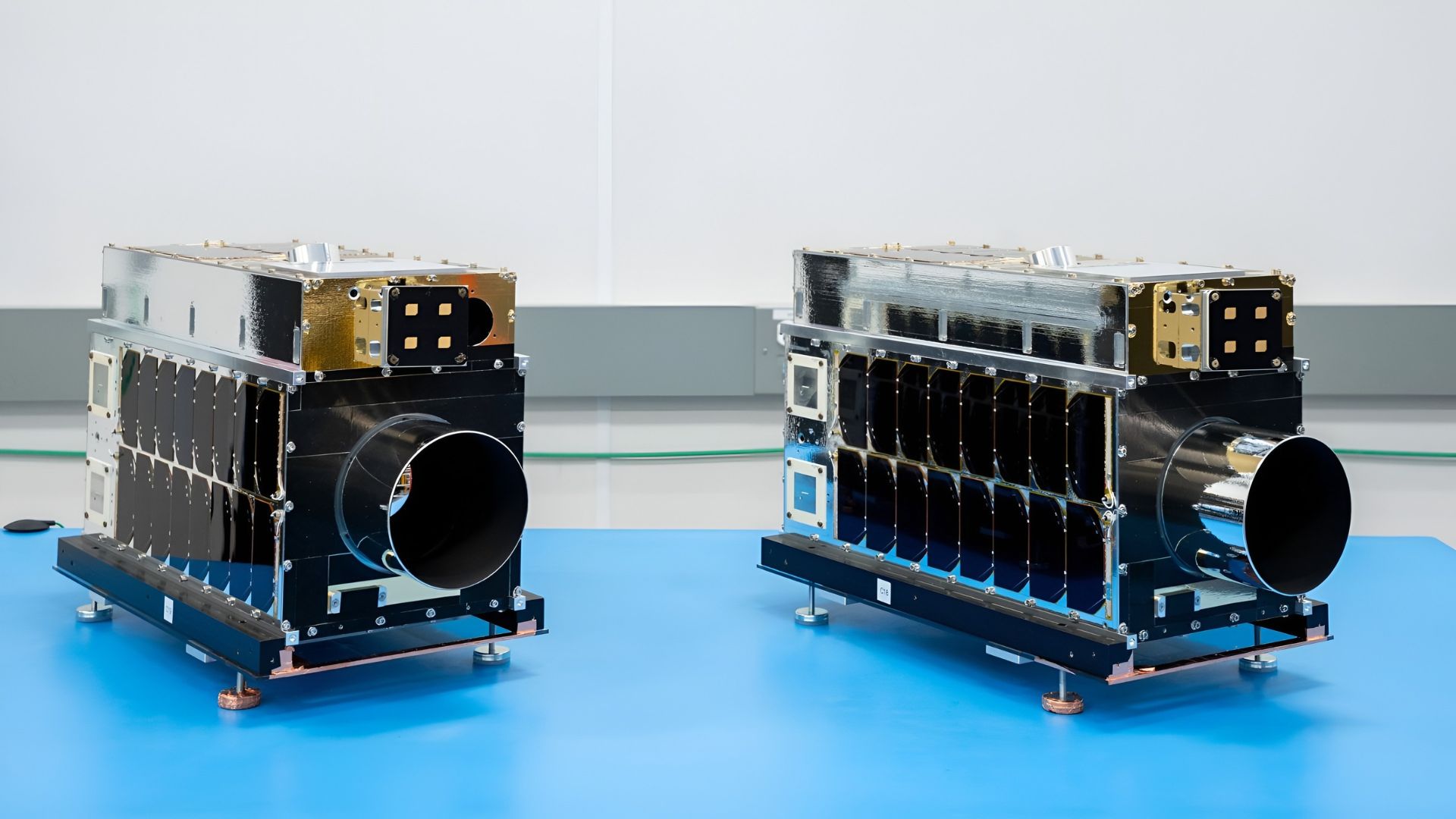
Two tiny satellites have joined an orbital fleet designed to measure greenhouse gas emissions from hundreds of miles above Earth. The 33-pound spacecraft launched Oct. 1 aboard SpaceX’s Transporter-18 mission from Vandenberg Space Force Base in California. Their arrival brings the number of satellites developed for GHGSat to 13. The spacecraft carry sensors that can measure emissions from specific facilities on the ground. Precise attitude control keeps those instruments pointed at their targets as the satellites race around Earth. Precision packed into 33 pounds The satellites use the NEMO spacecraft platform, which has supported 11 earlier GHGSat missions. Its compact design puts significant emphasis on accurate pointing without adding substantial mass. The spacecraft operate about 310 miles above Earth. At that altitude, even small changes in orientation can affect where an instrument looks on the ground. SFL Missions CEO Robert E. Zee said the company’s small satellites can deliver the attitude stability and pointing performance required for the mission. That capability has been central to the partnership since the 2016 GHGSat Pathfinder mission. Engineers needed the spacecraft to track specific targets with enough precision for reliable emissions measurements. The design also leaves additional capacity across several spacecraft systems. Power generation, data storage, and communications all include built-in margins. Those reserves can support longer missions and allow the spacecraft to collect more data. Earlier satellites using the platform have reportedly exceeded their expected collection capacity. Thirteen satellites and counting The latest launch also shows how a common spacecraft architecture can support a growing constellation. GHGSat has worked with SFL Missions for more than a decade. The two new satellites underwent integration and testing at SFL’s facility in Vaughan, Ontario. Stephane Germain, CEO of GHGSat, said the new spacecraft represent another step in expanding the company’s emissions-monitoring network. “Our ability to scale as quickly as we have is a direct reflection of the caliber of partners like SFL,” Germain said. The production pipeline extends well beyond the latest launch. SFL currently has 32 additional spacecraft under development at the Ontario facility. Hunting emissions from orbit Space-based emissions monitoring depends on accurate targeting as much as sensitive detection hardware. The satellites can observe individual facilities from orbit and gather measurements that help identify greenhouse gas sources. Those observations can support monitoring across industries with significant emissions. The system has applications in oil and gas, power generation, mining and waste management. Agriculture also represents a potential use for satellite-based emissions data. SFL says its spacecraft heritage now spans nearly 500 cumulative years in orbit. Its platforms range from 6.6-pound nanosatellites to 1,102-pound small satellites. The engineering challenge remains strikingly compact. A spacecraft weighing only 33 pounds must control its orientation precisely enough to direct an instrument toward a target on Earth. That combination of low mass and high pointing accuracy is what makes the latest satellites notable. The same architecture can now support another round of measurements from orbit as the constellation expands. Get the latest in engineering, tech, space & science - delivered daily to your inbox.Aamir is a seasoned tech journalist with experience at Exhibit Magazine, Republic World, and PR Newswire. With a deep love for all things tech and science, he has spent years decoding the latest innovations and exploring how they shape industries, lifestyles, and the future of humanity.
Tiny 33-pound satellites track greenhouse gas emissions from 310 miles above Earth
Full Article
Original Source
Read the full article at Interestingengineering →KhanList aggregates and links to publicly available news content. We do not host full articles from third-party sources. Always verify important information with original sources.