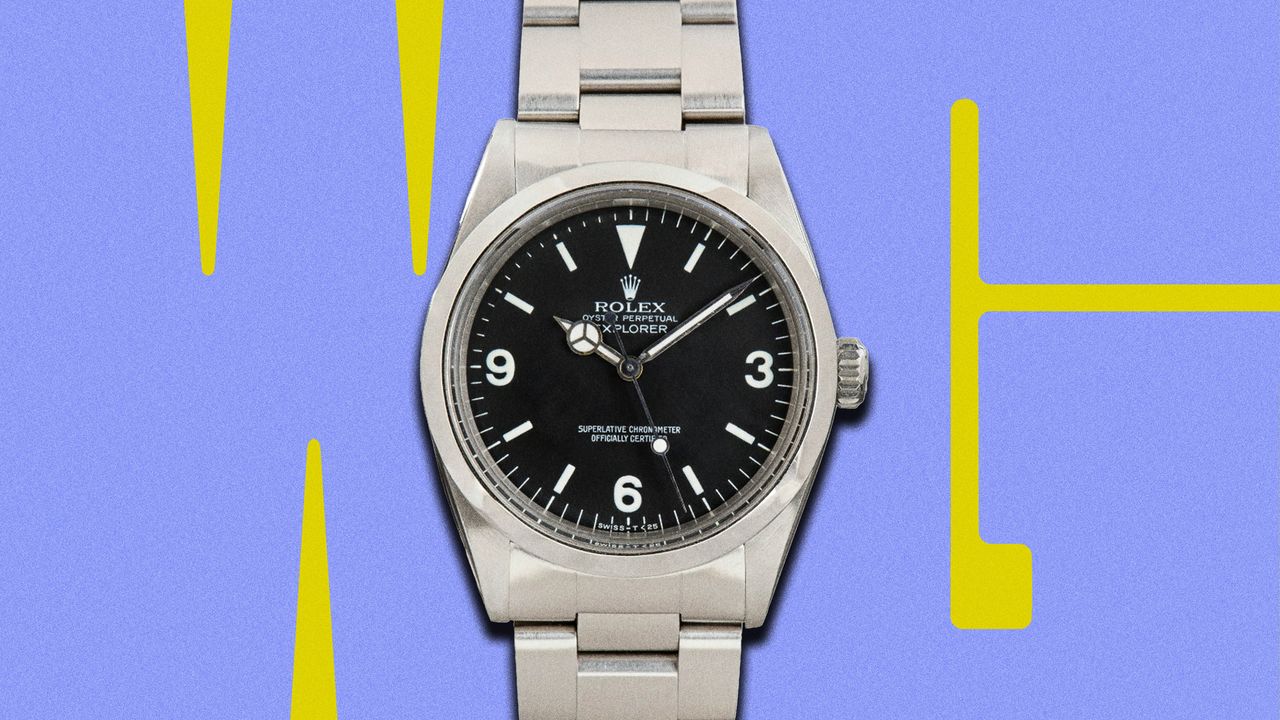
Welcome to GQ’s 201-level Watch Glossary, breaking down the advanced terms and specific references that are essential knowledge for every serious collector.Allow me to propose a scenario that may give my fellow watch nerds a full-on heart attack: you have to pick one watch to wear for the rest of your life. It has to be understated enough not to draw unwanted attention from your boss, but elegant enough to work with a suit and tie in London. Tough enough to brave an adventure through the mountains in Nepal, but pretty enough to be confused with something that’s actually meant to be dressy in New York. You get one watch, and one watch only. Does such a versatile timepiece even exist?What is the 1016?Many Rolex aficionados in particular would argue that it does, and that its name is “1016,” a specific version of the Crown’s flagship Explorer model that debuted in 1960. Although this wasn’t the first iteration of the Explorer, it is thought of by many as the quintessential version of the watch. Housed in a 36mm stainless steel case with a screw-down crown and a smooth bezel, it went through several iterations, but each retained several key characteristics: a black dial with an open chapter ring; a mix of baton, Arabic, and triangular indices; a Mercedes/lollipop handset; chronometer certification text above 6 o’clock; and the words “Rolex Oyster Perpetual Explorer” beneath the Rolex coronet below 12 o’clock. So iconic is this particular index arrangement, in fact, that it’s come to be known as an “Explorer” dial—even when used on other models or by other brands.During its nearly 30-year production run, Rolex would alter the printing process and materials used to create the 1016’s dial, but its essence would remain the same: whether in flashy “gilt” or “matte,” which gives a more subdued aesthetic, a 1016 is immediately recognizable as such. The watch doesn’t feature any extra hands, complications, or functions—which is very much the point. Like a good white T-shirt, it’s a watch that almost takes on the personality of the wearer. “There are plenty of more expressive vintage Rolex watches out there, but that’s the Explorer’s charm—it’s Rolex boiled down to its essence, and it asks you to bring the rest of the vision to the party,” says Stephen Pulvirent, founder of Rime & Reason and longtime 1016 wearer. “In many ways it’s a destination—but it’s also the map for how to get there.”Indeed, the 1016 is an Explorer, and the Explorer is, at its essence, a field watch; at its core, it’s meant to keep accurate time in the great outdoors on the wrist of someone who’s delving into uncharted territory. Born following Sir Edmund Hillary and Tenzing Norgay’s summit of Everest in 1953, the Explorer evolved from an Oyster Perpetual whose own remit was simply to function as a reliable timekeeper in all forms of weather.Why is the 1016 considered the platonic ideal of a watch?The 1016 is simplicity at its best. Because of its pared-back (and undeniably handsome) black dial, it can melt into any sartorial situation, while its relatively compact case dimensions mean that it can slip right under a cuff. Its Oyster bracelet—a key part of its identity—increases its robust character, but also makes it just dressy enough to wear with a suit. Its lack of rotating bezel or pushers, meanwhile, makes it unobtrusive, while its Oyster case and perpetually-winding movement allow it to function in adverse conditions.There’s a reason Rolex made the 1016 from 1960 to 1989, one of the longest continuous runs of production in the Crown’s history. Clearly, its aesthetics and attributes resonated with buyers right out of the gate, contributing to the Explorer’s seven-decade run as one of the most reliable and beloved watches ever designed. Indeed, we would argue that if you’re attempting to buy just one watch to wear day-in, day-out, that an Explorer—and particularly the 1016—is one of the best ways to go.The 1016 todayFunnily enough, we see echoes of the 1016 both on the vintage market and within newer watches being produced today: Certain vintage (and highly rare) Submariner models feature “Explorer” dials, as do smaller Oyster Perpetual references such as the 5500. (Technically, this is an otherwise common Air-King reference, but the Explorer dial and Oyster Perpetual designation make it somewhat of a Franken-watch…albeit an official one actually produced by Rolex.)The current Ranger, meanwhile, is a reissue of Tudor’s vintage Explorer equivalent, and likewise features an “Explorer”dial—albeit with a shovel handset in place of the Mercedes handset, and with other altered features. (The Explorer was also never available with a sand-colored “Dune” dial, an option on the contemporary Ranger.) Widen the aperture further to take in other models from brands such as Nivada Grenchen and Vaer, and you’ve got even more 1016-influenced options.In 2021, Rolex itself re-released a 36-mm version of the Explorer (ref. 124270), proving that the legacy of the 1016 is still reverberating throughout the Crown’s catalog.Most valuable versions of the 1016Even within the 1016 reference, there are myriad versions to choose from: gilt-glossy versions and later matte versions are often referred to as specific “Marks”—as in “Mark 0,” “Mark 1,” etc.—though sometimes they’re simply described rather than designated numerically. Finally, there are also double-signed versions from famous retailers, “tropical” versions, and even ultra-rare white-dialed examples. Some of the most coveted versions of the 1016 are:Matte Dial Mark 1 “Frog Foot”Collectors love these strange Mark 1 matte-dialed 1016s because of the odd appearance of the Rolex coronet: squint, and its five points vaguely resemble the splayed digits of…well, a frog’s foot. Find one with beautiful, puffy tritium lume that’s turned a deep yellow throughout the dial, and you’ve got yourself an auction darling.Tiffany & Co.Unearth a nice double-signed 1016 from Tiffany & Co.—like several that came to auction from American horticulturist and philanthropist Rachel Lambert Mellon’s estate—and you’ve also hit the Explorer jackpot. Though many of these watches traded hands for less than $20,000 back in 2014, today similar examples command significantly higher prices—sometimes double.The “Albino”In 2007, Phillips sold a white-dialed ref. 1016 for CHF 45,600. Fitted with an “exclamation point” dial—so called because of the form taken by the lume plot and chapter ring index at 6 o’clock—and a shorter Rolex coronet, it’s the only known example of the reference to feature such a configuration. When Phillips sold it again in 2023, it hammered for CHF 101,600 (roughly $113,152).A lasting legacyOf course, all of these attributes have made the Explorer ref. 1016 a highly coveted piece of Rolex history—even having been produced for 30 years in millions of examples, they remain incredibly sought after, with prices for particularly good versions reaching mid-five figures. A 1016 isn’t just a classic reference; it’s the platonic ideal of a modern wristwatch, designed to perfection back in the mid-20th century—and not in need of a single tweak today.
This Vintage Rolex Is Considered the "Perfect" Watch
Full Article
Original Source
Read the full article at Gq →KhanList aggregates and links to publicly available news content. We do not host full articles from third-party sources. Always verify important information with original sources.