
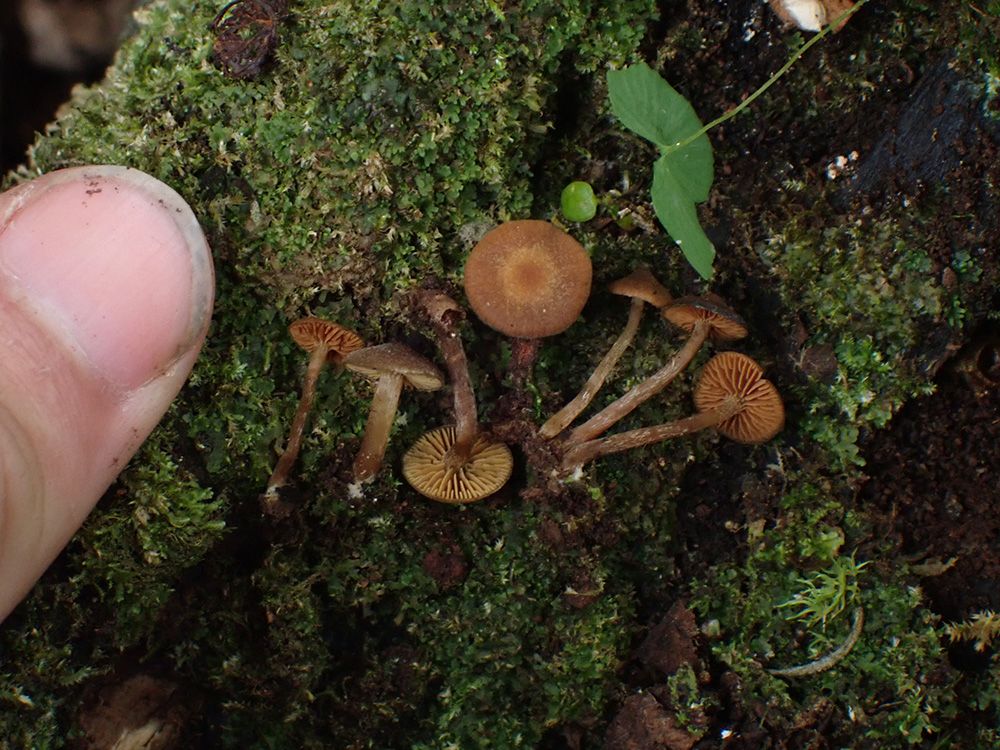
Researchers collected the mushroom from a moss-covered palm trunk in the central Florida wetland. Its relatives are known to produce amatoxins, but the fungus surprisingly turned blue when handled, a telltale sign that the organism makes psilocybin November 17, 2026 4:06 p.m. Galerina indica is smaller than a thumbnail. Andrew R. Kunik A little brown mushroom that grows in the swamps of Florida offers a lethal two-for-one deal: It can get you high and kill you. The fungus Galerina indica, dubbed the “dark magic mushroom,” produces both the mind-altering chemicals psilocybin and psilocin, as well as deadly amatoxins, making it the first species of mushroom known to contain both types of compounds. The findings, published in the journal Current Biology on November 11, offer new understanding of the evolution and diversity of fungi. “Humanity’s cultural infatuation with mushrooms has long been bookended by two categories: mushrooms that induce psychedelic experiences and mushrooms that are deadly toxic,” says study co-author Andrew Kunik, a fungal biologist who conducted the research at the University of Florida, to Ed Cara at Gizmodo. “Our discovery of the ‘dark magic mushroom’ represents an unusual convergence of worlds, where we now know of this rare and unusual species that produces the chemistry responsible for both properties.” Some mushrooms are known to contain either psilocybin or amatoxins, and the latter is well-documented in certain Galerina fungi. G. indica, however, is a less-studied variety. Kunik spotted the unassuming species on a moss-covered palm trunk while studying fungi in the wetland of central Florida in 2025. Surprisingly, the specimen turned blue when handled—a sign that it might produce psilocybin. So, Kunik and colleagues conducted chemical analyses of the mushroom, along with specimens of two unnamed Galerina species collected in the southeastern United States between January 2024 and September 2025. The work revealed that G. indica contained psilocybin, psilocin and two amatoxins, including a toxin that had never been documented in mushrooms. One of the other Galerina species they studied had only the psychedelic substances, while the other made neither type of compound. “This finding shows that there’s a lot more diversity in [fungal] chemistry and the ways that they’re combined than we had really thought about,” says Anne Pringle, a mycologist at the University of Wisconsin-Madison who was not involved in the work, to Tina Hesman Saey at Science News. Quick fact: Tiny treasures The largest G. indica mushrooms found stood around 0.2 inches tall and had caps up to roughly 0.1 inches wide, according to Live Science. The team then examined G. indica’s DNA and compared it with that of other psilocybin-producing mushrooms. Genetic analyses revealed that the mushroom’s ancestors likely picked up the genes to make psychedelics through a process called horizontal gene transfer. That means the species did not inherit the genetic material from a parent but received it from another organism, probably an unrelated mushroom. The researchers suspect the G. indica lineage could already produce amatoxins before it acquired the five-gene Psi cluster, responsible for psilocybin production. Two hypotheses might explain what happened: The dark magic mushroom and the other psilocybin-producing Galerina species may have independently acquired the psychedelic genes from other fungi, or they could have both inherited them from a common ancestor that previously acquired them through horizontal gene transfer. The first scenario is more likely, the scientists say, though they’re careful to note they still don’t have a clear understanding of the genus’s family tree and would need to identify the donor mushrooms for more definitive answers. It was interesting to see “both of these [compounds] present, seeing that this gene cluster jumped in, got rearranged, maybe came in twice—it’s very cool,” says Hannah Reynolds, a fungal ecologist at Western Connecticut State University who wasn’t involved with the study, to Olivia Ferrari at Live Science. The findings open the door to further research on how mushrooms benefit from producing amatoxins or psilocybin. Many scientists speculate the compounds help fungi ward off predators, Pringle tells Science News, but they don’t have enough evidence to prove it. “What’s exciting is that there are small, seemingly uninteresting fungi that can conceal extraordinary chemistry that we’re only beginning to understand,” Kunik says in a statement. You Might Also Like Get the latest stories in your inbox every weekday. More about: Biology Chemistry Ecology Florida Fungus Nature New Research
This Tiny, Unassuming Fungus Is a 'Dark Magic Mushroom'—the First Found to Contain Both Psychedelic Compounds and Deadly Toxins
Full Article
Original Source
Read the full article at Smithsonianmag →KhanList aggregates and links to publicly available news content. We do not host full articles from third-party sources. Always verify important information with original sources.