
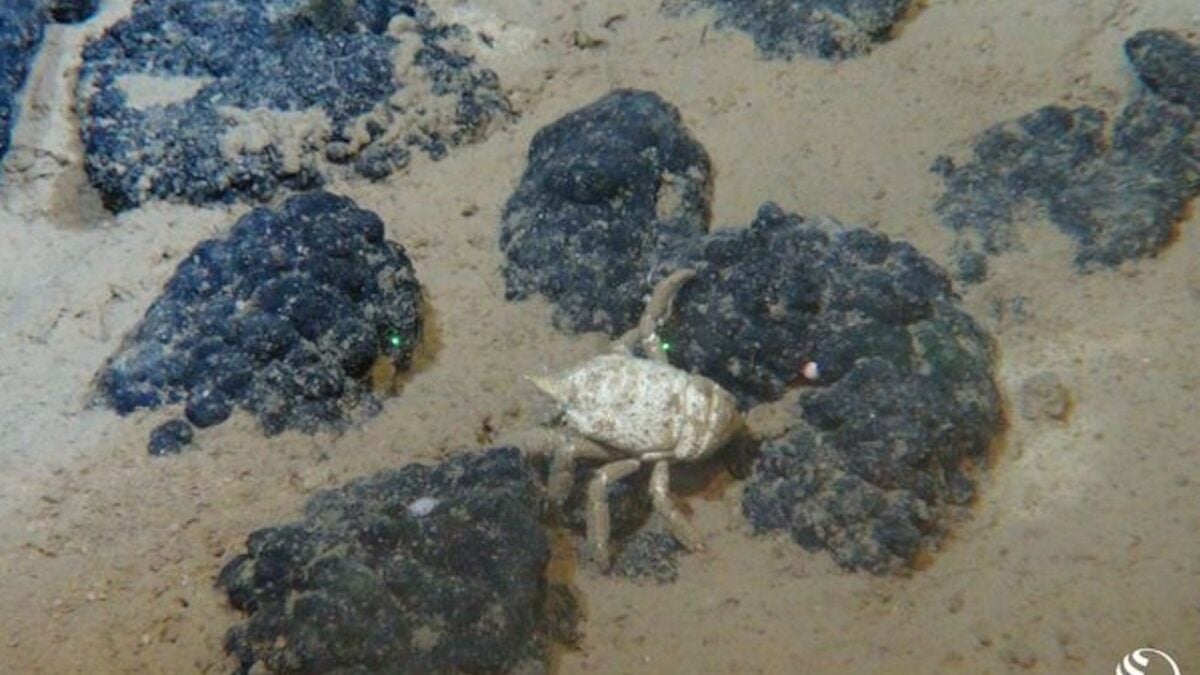
At the bottom of the Pacific Ocean, seemingly unremarkable, stone-like formations are hiding a surprisingly rich ecosystem. Known as polymetallic nodules, these mineral deposits are home to a variety of tiny marine animals, according to new research. Those same rocks are also a source of critical metals, making them a target for a burgeoning deep-sea mining industry. In a recent study published in Scientific Reports, researchers report thousands of microscopic animals hidden among the crevices of polymetallic nodules in the Clarion-Clipperton Zone in the central Pacific Ocean. The nodules provide a unique habitat that’s different from the surrounding environment and may play a crucial role in the survival of certain species. The findings shed light on the nodules’ contribution to deep-sea biodiversity and the potential risks of future commercial mining. Tiny homes Polymetallic nodules are tiny geological formations that sit on the ocean floor, generally between 13,000 and 21,300 feet (4,000 and 6,500 meters) below the surface. They begin forming around a tiny central nucleus, which could be a fragment of rock, a shell, a fossil, or even a shark tooth. Over time, dissolved metals in seawater gradually accumulate around this nucleus, creating successive layers of iron and manganese minerals. These potato-shaped, rock-like formations grow at an incredibly slow pace, taking millions of years to form. In other words, nodules are effectively non-renewable on human timescales. To explore those ancient habitats, the researchers behind the new study collected hundreds of nodules from the Pacific’s Clarion-Clipperton Zone, a vast area between Mexico and Hawaii that’s of greatest commercial interest for deep-sea mining. They found thousands of microscopic animals living within the cracks and cavities of these unique formations. The team identified 4,139 animals across 244 nodules. A single nodule contained an average of 17 animals, while one particularly crowded formation had 245 inhabitants. “The crevices in the polymetallic nodules function as small shelters and provide home to animals that we do not encounter in the soft sediment of the seafloor,” Coral Diaz-Recio Lorenzo, a researcher at the Royal Netherlands Institute for Sea Research and lead author of the study, said in a statement. A vulnerable habitat Compared to their surrounding environment, the nodules offer something otherwise not found at the bottom of the ocean. The formations create a hard surface, whereas the rest of the ocean floor is made of muddy sediment. As a result, the animals found within these unique habitats are quite different from the ones inhabiting the surrounding sediment. The animals inhabiting the nodules also formed distinct communities that were similar to one another even when they were separated by hundreds of miles, according to the study. At the same time, they differed significantly from the animals found in the surrounding seafloor sediment. This suggests that the nodules help support a unique ecosystem and provide certain living conditions that a group of species rely on for survival. The authors behind the study argue that the diversity of life hiding within the nodules should factor into future plans to mine them. The emerging industry of deep-sea mining has not yet gone into full-scale commercial operations, but it is currently undergoing technology trials. “Our findings point out that commercial mining may result in an irreversible loss of undescribed and unique biodiversity associated with nodules,” Sabine Gollner, a researcher at the Royal Netherlands Institute for Sea Research and co-author of the study, said in a statement. “This needs to be considered in the environmental management of deep-sea mining.” Scientists are racing to discover just how much life these seemingly ordinary rocks support, while the mining industry is looking to remove them from the ocean floor.
Deep-Sea Miners Want These Rocks for Their Metals. Scientists Found Them Teeming With Life
Full Article
Original Source
Read the full article at Gizmodo →KhanList aggregates and links to publicly available news content. We do not host full articles from third-party sources. Always verify important information with original sources.