
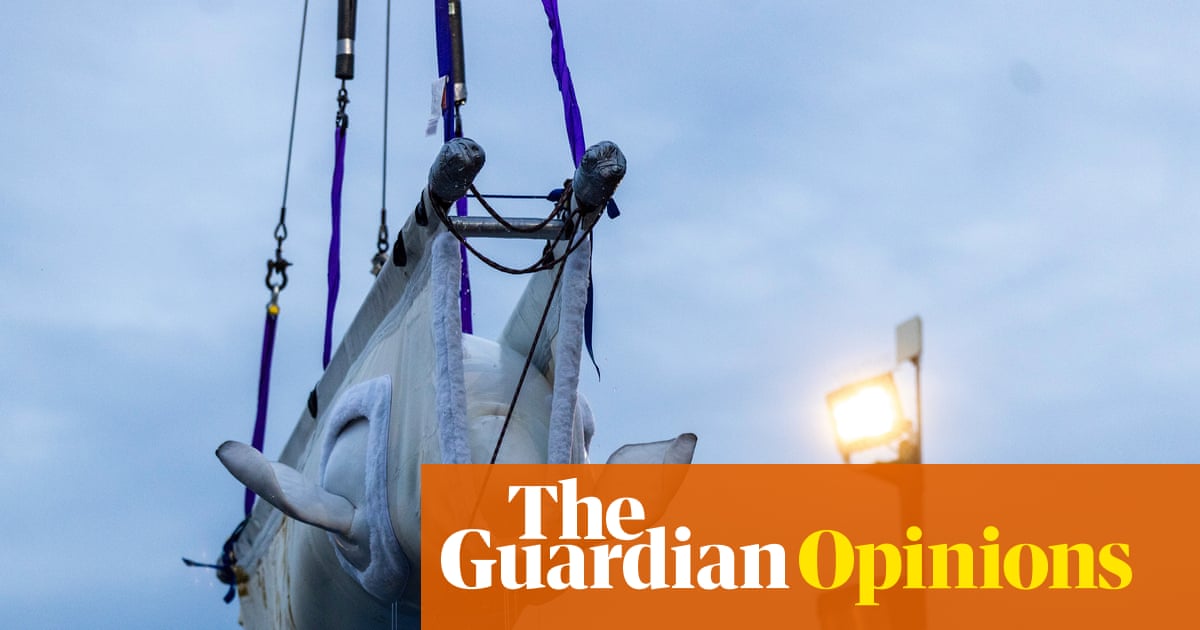
Remember “Save the whales”? Now that was an environmental campaign everyone could get behind. Surely you don’t want whales to die!It may have got the 1986 global ban on commercial whaling over the line, but in these sophisticated times that slogan seems woefully reductive, even naive. As Greenpeace warns on its website, 40 years later: “There is still more work to be done to save the whales.” Yes. You might say, surveying the state of our ocean ecosystems, there’s quite a bit.Even saving the whales from captivity – broadly agreed to be the right thing to do ever since the Blackfish documentary, about Tilikum the orca at Seaworld in Florida – is far from an easy win. Over the past few months, I’ve been following the sorry saga of Marineland, Canada’s most famous marine park, known for its nostalgic advertising jingles as a “magical place” where “the fun never stops”.Marineland closed to the public two years ago due to financial pressures and performing whales and dolphins falling out of favour as family-friendly fun. Public sentiment has steadily turned against cetaceans in captivity. By mid-2019, when Canada finally outlawed the keeping of dolphins and whales, Marineland had been embattled for decades over both the principle issue and persistent allegations of mistreatment (including from whistleblowing former employees).The lengthy list of reported whale deaths on Marineland’s Wikipedia page, dating back to the 1992 fatality of an unnamed whale from drowning, makes for grim reading. The Canadian Press newspaper counted 21 deaths since 2019 alone. You might assume, then, that Marineland’s closure was a rare win for animal lovers, a cut-and-dried case of saving the whales – but for many of its former residents there has not been a happy ending.Despite what Free Willy led us to believe, saving the whales is not simply a case of triumphantly releasing them into open waters. These animals – adapted to captivity, if not traumatised – aren’t capable of surviving in the wild, forcing a difficult choice: either organise their transfer to another marine park or put them down.Even relocation can be traumatic for such complex, sensitive animals, as seems to have proved the case here: of the 30 whales and four dolphins that were moved from Marineland to aquariums in the US and Spain, seven (six beluga whales and one dolphin) have died in their new homes.It’s not known whether this was a direct result of the move or underlying health conditions. Either way, experts say it is likely the animals were already under chronic stress – and also that relocation was really the only option possible. Doug Whiteside, the head vet at Calgary Zoo, told CBC News it was a “kind of Hail Mary effort … [to] provide a better life for these whales”. Now 20% of Marineland’s beluga whale population is dead and more are thought likely to follow, with whale welfare advocates on “death watch”.What can we take from this grim ending? Well, first, that we were wrong to put these animals in tanks to begin with. To rework the Dogs Trust motto, a whale is for life. We might have finally woken up to the wrongs of keeping cetaceans in captivity for our entertainment, but the animals themselves do not just disappear once we’ve lost the desire to see them. There’s a tendency to imagine animal rights and welfare as a balance that – with a will and a way – we can eventually redress. For example, if animals are suffering in captivity, we just need to free them; if their habitat is being lost, we can always restore it.Most of the time this is a comforting fallacy, overstating humans’ potential for impact when we’re doing the right thing and understating it when we’re not. The truth is, our activities and interference irrevocably change animal lives, typically for the worse. An orca such as Junior, for example – caught off the coast of Iceland in the mid-1980s then kept in a concrete pool at Marineland, indoors and alone – never had a chance of recovering the kind of life he might have lived had he remained in the wild with his pod. Keiko, the cetacean star of Free Willy and the first captive orca to be fully released into the wild, lasted only about 18 months.skip past newsletter promotionafter newsletter promotionIn these situations, trauma is surely not too strong a word and, in animals as in people, it is not easily undone. The Whale Sanctuary Project is most engaged with the work, developing a 100-acre marine sanctuary in Nova Scotia for formerly captive cetaceans that can serve as a model for future projects elsewhere. But even that project has realistic aims, setting out not to save the whales but to give them sanctuary and “a new life that makes up for as much as possible of what went before”.As a mission statement, it is appropriately humble, aimed not at absolution but atonement. I’ve never forgotten what I was told by Signe Preuschoft, a primatologist who has dedicated her life to the painstaking work of teaching orphaned young orangutans how to survive in the wild. That kind of rehabilitation and reintegration won’t play a meaningful part in the species’ survival, and is arguably low-priority compared with conserving habitat and ecosystems.But, Preuschoft argued, we owe it to the individuals whose lives have been so catastrophically derailed by our species. Our destruction of these animals’ ecosystems and environments means suffering, she said. “It means maiming, disease, living in fear, dying, seeing your children die.” We might not be in this awkward position – of attempting to save the whales from a multitude of threats of our own creation – if we had valued their lives to begin with. Even the survivors might be free from Marineland but they are not unscathed. Elle Hunt is a freelance journalist
This grim story of marine park whales could yet have a positive outcome – if it teaches us to value other species | Elle Hunt
Full Article
Original Source
Read the full article at Theguardian →KhanList aggregates and links to publicly available news content. We do not host full articles from third-party sources. Always verify important information with original sources.