
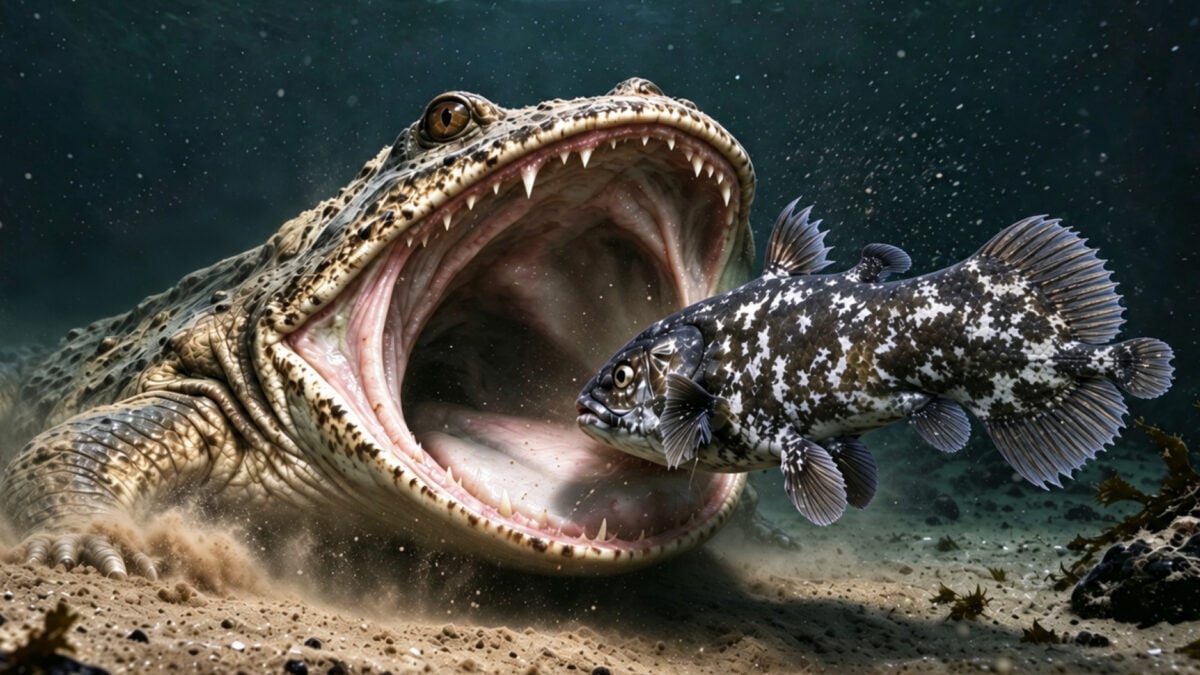
Many ancient creatures were somehow both terrifying and awesome at the same time. Take, for instance, humongous griffinflies big enough to blot out the view of the Sun. Similarly, a newly discovered ancient amphibian is terrifying, awesome—and, importantly, illustrative of the remarkable evolutionary pathways of life on Earth. A study published today in Nature Ecology & Evolution describes the physiology and biology of Gerrothorax maritimus, an amphibian from roughly 237 million years ago, during the Late Triassic. The amphibian’s skeletons—recovered from previous excavations in China—were nearly complete, allowing the researchers to estimate its length at about 30 inches (75 centimeters). Similar to an extant suction-feeding shark, the animal likely sat in wait on the seafloor for prey unfortunate enough to cross its path—as vividly depicted in the terrifying image above. Importantly, the creature, thanks to its heavily armored body, is the first known amphibian to fully adapt to life in salty ocean water. Holotype of the new marine amphibian Gerrothorax maritimus. The specimen is exposed belly side up. Credit: Ryosuke Motani “We hitherto did not know of any amphibians that live in the sea full-time,” corresponding author Ryosuke Motani told Gizmodo. This was “despite the fact that all other land vertebrate lineages have such members and that there are over 8,000 amphibian species today,” added Motani, a vertebrate paleontologist at the University of California, Davis. Far from home? The two skeletons analyzed for this study were initially collected by local farmers in Guizhou Province, southwestern China, and recently acquired by a local fossil repository. This province is now inland, but the fossils were deposited at least 18 miles (30 kilometers) away from any islands, according to the paper. Of course, Earth’s landmass changed multiple times in the last hundreds of millions of years, which means it’s not unusual for a formerly marine creature to end up inland. But the team took additional measures to ensure that this species lived in the sea, as opposed to its carcass getting washed away and deposited at the bottom of the sea by chance, according to an accompanying Behind the Paper blog by Motani. For instance, the fingers—typically the first body part to disappear for carcasses lost at sea—of the skeleton were more or less intact. Left hand of the holotype. Fingers would not be preserved in specimens that drifted in the ocean, suggesting the animal lived near where it was buried. Credit: Ryosuke Motani However, the “most striking” evidence had to do with the strontium isotope ratios identified on the bones and their surrounding sediment, Motani said. The element has “nearly consistent isotope ratios” that point to a specific period of the ocean’s history, with the isotope analysis strongly suggesting that the bones “grew at sea” and weren’t significantly contaminated by sediments during preservation, Motani explained. “You can only imagine how nervous we were as we waited for the test results to come out,” he wrote. “It was the moment of truth for us.” Salt protection According to the blog, amphibians we’re familiar with today, like frogs or salamanders, struggle to survive in seawater. This is because they have soft, permeable skin that helps them breathe and absorb water, which is “wonderfully designed” for amphibian lifestyles—as long as they don’t try something unusual, like swimming in seawater, Motani added. That sensitive skin gives them much lower salt tolerance compared to other vertebrates, and osmotic pressure from saltwater would disturb their body water levels. Meanwhile, G. maritimus had bony armor, which would both protect its sensitive skin and help it ballast itself toward prey at the bottom of the sea. G. maritimus also held onto its gills, a feature most modern amphibians lose by adulthood. So the ancient creature likely breathed primarily through its gills instead of through its skin, which was covered in armor, according to Motani’s blog. The skeleton suggests it had a large mouth with a strong gill arch similar to modern suction feeders, specifically wobbegongs, he told Gizmodo. (Gamers, I know what you’re thinking—yes, it’s literally Frox from Tears of the Kingdom.) The body armor of G. maritimus. The backbone runs vertically in the middle, whereas the belly side of the armor can be seen on the right side. Credit: Ryosuke Motani That said, the softer body tissues weren’t preserved for the otherwise intact fossil. As a result, the team cannot ascertain specific aspects of the amphibian’s physiology, like whether its digestive system also evolved to accommodate saltwater or how it would have reproduced. To Gizmodo, Motani said that the goal is to identify more specimens of the same species. “For example, the two specimens we reported were found belly-side up, so it would be nice to see the back side,” he said. “We also want to find out about its environment in more detail to reconstruct its ecology more accurately.”
This Armored Amphibian Turned the Triassic Seafloor Into a Living Nightmare
Full Article
Original Source
Read the full article at Gizmodo →KhanList aggregates and links to publicly available news content. We do not host full articles from third-party sources. Always verify important information with original sources.