
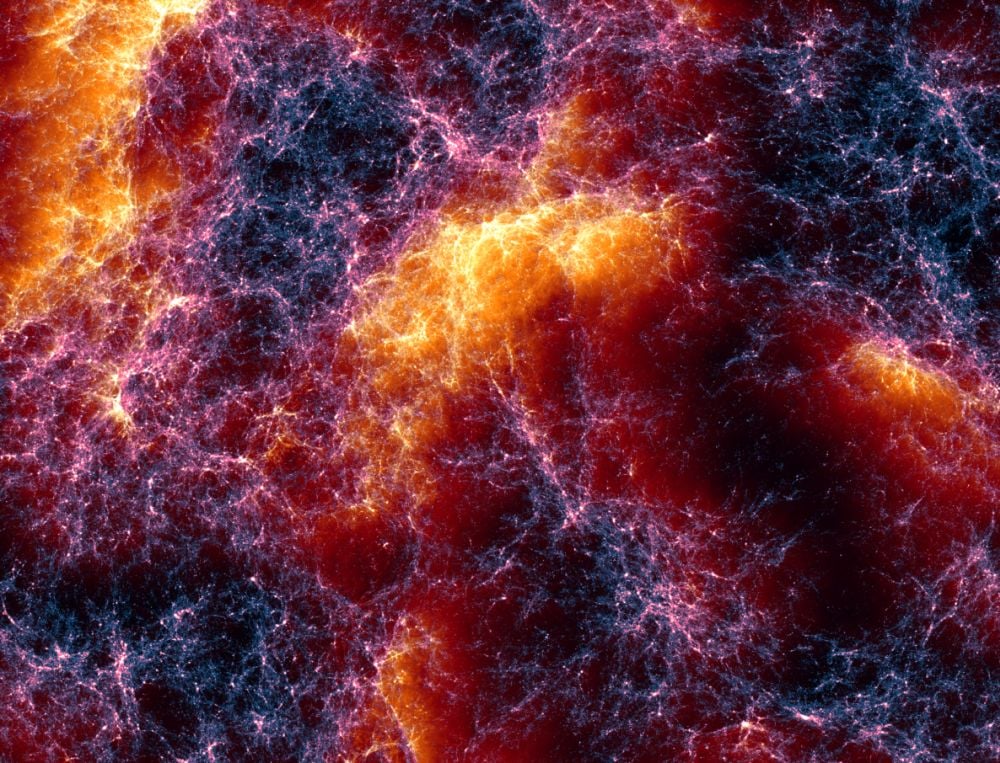
Modern astronomy features massive telescopes with segmented mirrors, huge digital cameras, sophisticated data pipelines, and suites of powerful instruments with different specific purposes. But that's the observational side. Making sense of the exquisitely-detailed data these telescopes deliver requires its own approach. This is where simulations come in. We live in an era of increasingly detailed cosmological simulations, all run on the world's fastest supercomputers. Cosmologists use them to understand everything from star formation to the expansion of the Universe. The James Webb Space Telescope (JWST) and the Nancy Grace Roman Space Telescope (NGRST) are the two most capable space telescopes in existence. They're especially good at illuminating the Universe's very early days with their infrared capabilities. While the NGRST is just getting going, the JWST has been busy for a few years and has already delivered some surprises. The NGRST was only launched two months ago, and its mission hasn't really started yet. But once it does, it may deliver some surprises of its own. This is where a new simulation from the Center for Astrophysics | Harvard & Smithsonian (CfA) comes in. Its name is Lumina, and it's one of the largest and most detailed simulations yet. Lumina is presented in new research in the Monthly Notices of the Royal Astronomical Society titled "Introducing the lumina project: large-volume radiation-hydrodynamic simulations of the epochs of hydrogen and helium reionization." The lead author Oliver Zier, an Institute for Theory and Computation Fellow at the Center for Astrophysics | Harvard & Smithsonian. "Understanding how galaxies and active galactic nuclei (AGNs) jointly drive the reionization of the intergalactic medium (IGM) across cosmic time remains a major challenge in cosmology," the authors write. "We present Lumina, a large-volume radiation-hydrodynamic simulation thatself-consistently follows the coupled evolution of the IGM, galaxies, and AGNs through H i, He i, and He ii reionization down to redshift z = 3." Redshift z=3 corresponds to a lookback time of about 11.7 billion years, or about 2.1 billion years after the Big Bang. This is in the Cosmic Noon, which is when star formation peaked in the Universe, and when quasars were most active. It's also at the end of Helium II reionization, which is usually considered the last phase transition in the IGM, after neutral hydrogen had already reionized. "Its galaxy population remains consistent with the original IllustrisTNG project, while the larger volume improves statistics for rare objects, large-scale environments, and cosmic variance, enabling forward modelling of observables linking H i and He ii topologies to the evolving galaxy and AGN populations," the researchers explain. Exactly how the Universe's neutral hydrogen and helium reionized is still not fully understood. The contribution from the various sources—stars and supermassive black holes and their AGN—is unclear. The timeline on which it all played out is also something cosmologists are still puzzling over. Did it end all at once, in a smooth denouement? Or was it patchy? The JWST's observations are helping drive a new effort to understand it all. “With JWST, the early universe has become an exciting new frontier in astrophysics,” lead author Zier said in a press release. “To understand what we are seeing with this telescope, we need to translate our theories into detailed predictions. After several years of work, with plenty of ups and downs, it is incredibly rewarding to see the simulation results and watch our predictions come to life in video.” Lumina has a larger volume than another well-known simulation, Illustris TNG. TNG 300 was its largest run, with a box side of about 3.3 megaparsecs. But Lumina has a box side of 500 Mpc. (Simulator nerds are right to point out that these are co-moving parsecs.) So Lumina simulates an area about 1.5 billion light years on each side, which is roughly the same as astronomers can see with our most powerful telescopes. This image shows the density of baryonic matter, meaning gas and stars, in zoom-in boxes with side lengths of 500 cMpc , 50 cMpc, 5 cMpc, and 500 ckpc. The figure illustrates the embedding of the halo in the cosmic web, its filamentary gas supply, and the compact stellar structure at its centre. Image Credit: Zier et al. 2026 MNRAS Though hydrogen reionization has been studied extensively, since it's the most abundant element in the Universe, helium reionization hasn't been. Lumina captures helium reionization and feeds those results into the rest of the simulation. This sheds light on helium reionization's effect on the cosmos. While hydrogen was reionized predominantly by lower-energy ultraviolet photons from star-forming dwarf galaxies, they weren't energetic enough to reionize helium, which made up about 25% of the IGM. It had to wait for a massive population of quasars and extremely luminous active galactic nuclei, and those populations peaked during Cosmic Noon. But extending a simulation to cover helium reionization wasn't easy. "Modelling He ii reionization introduces significant computational challenges," the authors explain. "To reach z = 3, the simulation must evolve for almost an additional gigayear after the end of H i reionization, during which the matter distribution becomes increasingly clustered." To accomplish that, Lumina runs on more than 15,000 graphics processing units on the Oak Ridge National Laboratory's Frontier supercomputer, the third fastest supercomputer in the world, after El Capitan and Line Shine. Frontier had the power to compute a massive volume of space at the required level of detail. Lumina's first results on He II reionization are a good match with observations. "He ii reionization begins at z (about equal to) 6 and is driven by the hard radiation field from AGNs. We find a midpoint at z (about equal to) 4 and near completion by z = 3, with a residual He ii volume filling fraction below 1 per cent, in agreement with current observational constraints," the authors write. " This demonstrates that Lumina can self-consistently follow the onset, topology, and completion of helium reionization alongside hydrogen reionization." Simulations and observations together drive progress in cosmology, and it looks like theorists now have another powerful tool in their toolbox. “We feel incredibly fortunate to be building simulations like Lumina,” said co-author Aaron Smith, an assistant professor of physics at the University of Texas at Dallas. “For the first time, we can follow along as both hydrogen and helium changed into their modern form across such an enormous volume of the universe, while still resolving the galaxies and other luminous objects driving that transformation.”
A Huge and Powerful New Simulation Helps Explain the Universe's Reionization
Full Article
Original Source
Read the full article at Universetoday →KhanList aggregates and links to publicly available news content. We do not host full articles from third-party sources. Always verify important information with original sources.