
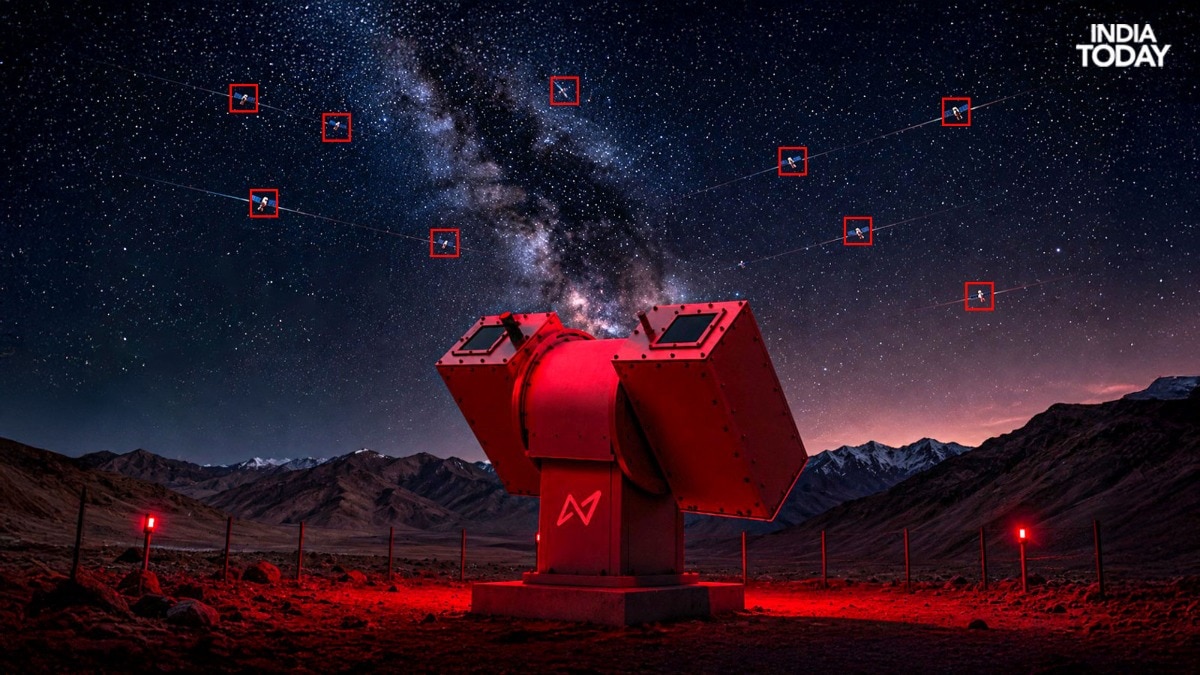
Digantara is developing MOSAIC, an autonomous system to detect and track objects moving above India. The effort reflects a wider push to build independent space awareness as satellite activity grows.The system functions as a wide-field, autonomous surveillance platform. (Generative AI by India Today)On a cold night in Ladakh, a small instrument points silently towards the sky.It does not know in advance which satellite it is looking for. It is not waiting for an operator to tell it where to turn. Instead, it watches a section of the sky, detects whatever moves through it and begins separating satellites from stars and space debris.Each passing object can become a piece of a much larger puzzle: Who is above India? When will they return? And what could they be watching?For a country that once had to carefully conceal its preparations from foreign spy satellites during the Pokhran nuclear tests, those questions are becoming increasingly important. Thousands of satellites crisscross the skyies through day and night. (Photo: Getty) In the years since Pokhran, the world above India has changed dramatically. Space is no longer occupied by a limited number of satellites operated by a handful of countries. Thousands of satellites now circle the Earth, providing communications, navigation, imagery and intelligence. Modern militaries are increasingly dependent on information flowing through space.In a post-Operation Sindoor security environment, the ability to understand what is happening in orbit could become as important as monitoring activity on land, at sea or in the air. India has some space surveillance capability through its Netra programme. But a new generation of Indian companies is attempting to build additional capabilities that could give the country a clearer and more independent picture of what is moving above it.One such effort is MOSAIC, a space surveillance system being developed by Indian startup Digantara.The larger ambition is not simply to track space debris or avoid satellite collisions. It is about building what experts call Space Situational Awareness, the ability to know what objects are in space, where they are and where they are likely to move next.FROM HIDING ON THE GROUND TO WATCHING FROM BELOWThe importance of knowing when satellites are overhead is not new to India.During the preparations for India's nuclear tests at Pokhran, avoiding detection by foreign surveillance satellites was a critical concern. Activities had to be carefully managed to prevent unusual movement or preparations from being observed from space."That episode illustrated a fundamental reality of modern security: before you can hide from something, you need to know when it is looking," said Lt Gen (Retd.) AK Bhatt, Director General, Indian Space Association.That principle is now becoming even more relevant.Satellites today can support military operations through imagery, communications, navigation and intelligence. A country that knows when a particular satellite is likely to pass over a sensitive location can better understand when that area may be under observation.“It all begins with knowing,” as the logic behind space situational awareness suggests. If an object has been detected and catalogued, its orbit can be calculated, allowing future passes to be predicted.This does not mean that a surveillance network can reveal everything about another country's intentions. But it can help create a picture of the environment in which military and strategic infrastructure operates.If a particular satellite repeatedly observes a region, that pattern itself may provide useful information. It can indicate increased interest in a location and allow planners to better assess the surveillance environment.In a future conflict, the challenge may not come from a satellite alone. Space-based systems could provide the communications, navigation, imagery or intelligence needed to support operations on the ground, in the air or at sea.A coordinated airborne or space-enabled attack would therefore not exist in isolation. Satellites could potentially form part of the larger information network supporting it.The ability to maintain a continuous picture of objects in orbit could give India an additional layer of awareness around its critical infrastructure and strategic assets. Mosaic system placed in Ladakh. (Photo: Digantara) A SCANNER FOR THE SKYTraditional space surveillance systems often work like a telescope with an appointment book.An operator identifies the object they want to observe, calculates where it is expected to be and then directs the instrument towards it.MOSAIC is designed differently.According to Anirudh Sharma, Founder and CEO of Digantara, the system functions as a wide-field, autonomous surveillance platform. Once it is switched on and pointed towards a particular portion of the sky, it watches that area and automatically detects and tags everything passing through its field of view.The system does not need to be told in advance which satellite to track.Instead, it scans.India gets new eyes on orbit. Introducing MOSAIC, our AI-powered Wide Area Sensing Architecture, built to search, detect and track hundreds of objects simultaneously, turning observations into orbital intelligence.Mobile. Autonomous. Built in India for the scale of modern pic.twitter.com/pr6Fu2iIdj— Digantara (@Digantarahq) August 15, 2026Artificial intelligence and machine learning are used to distinguish between stars, satellites and space debris. The processing happens within the system itself, reducing the need for constant human intervention.Each unit can typically collect data on around 400 to 500 unique objects during a night. An array of such systems, watching different sections of the sky, could collectively build observations of thousands of objects.The current design uses two cameras, or nodes. Rather than relying on a single 360-degree rotating system, multiple units can be deployed and oriented towards different regions of the sky to increase coverage.That is important because the challenge is not simply detecting an object once.Satellites move. Their positions change continuously. Tracking them intermittently can lead to uncertainty about where they are likely to be. Repeated observations can help update their movement and maintain what the space surveillance community calls “custody” of an object.WHY INDIA CANNOT LOOK UP ALONEThe sky above India cannot be monitored from India alone.A satellite passing over Ladakh may have been over Australia, Africa or the Pacific hours earlier. To understand its movement accurately, observations from different geographical locations become valuable.Digantara's network is being deployed across multiple locations, including India, Namibia, Chile and New Mexico, with another deployment planned in Hawaii. Locations are selected largely for clear skies and low light pollution.The company is also working on space-based sensors, while its ground network is intended to grow over time.This global approach highlights an important point: space situational awareness cannot realistically be a completely isolated national capability. India's security calculations increasingly extend across land, sea, air, cyber networks and now space. (Photo: PTI) India needs sovereign capability, but it will also need cooperation.Historically, much of the world's space surveillance data has been generated by the extensive sensor network of the United States. Such data has been available to other countries to varying degrees, but dependence on an external source comes with obvious limitations.A foreign country ultimately decides what information it shares, particularly when sensitive military or strategic assets are involved.An indigenous capability changes that equation.It gives India its own observations, its own data and, importantly, something of value to contribute to partnerships with other countries.The most effective future model may therefore be a combination of Indian-owned systems, commercial innovation and data-sharing with like-minded partners.MORE THAN SPACE DEBRISThere is also a civilian side to this technology.The rapid growth of satellites has created an increasingly crowded orbital environment. Tracking objects is essential for preventing collisions and protecting satellites that provide communications, weather forecasts, navigation and other services.MOSAIC has also been designed to operate autonomously. It has solar power, onboard computing and communications capability, allowing it to function without continuous human intervention and upload observations within minutes.Another feature, called “Lost in Space”, allows the system to use patterns of stars to determine its own position without manually entering geographical coordinates. The underlying technology could also have future applications in celestial navigation when GPS is unavailable, denied or spoofed.The company is additionally exploring a laser-dazzling capability that could temporarily interfere with the optical system of an imaging satellite observing a sensitive location.Digantara describes the concept as a potential “soft kill” rather than a system intended to physically destroy a satellite. Rapid prototyping is underway, according to the company.INDIA'S NEW FRONTIER OF AWARENESSThe real significance of MOSAIC may lie in a simple shift in thinking.For decades, the question was often whether India could launch satellites into space.Today, the question is also whether India knows what everyone else's satellites are doing.In the era after Operation Sindoor, India's security calculations increasingly extend across land, sea, air, cyber networks and now space. Critical infrastructure on the ground may be supported, observed or targeted through information flowing from hundreds of kilometres above Earth.A surveillance network will not eliminate those threats. Nor can India realistically become completely independent of global space data. There are over 15,000 satellites flying above Earth. (Photo: India Today) But the ability to independently observe, track and predict what is happening overhead could reduce dependence and increase awareness.From Pokhran, where secrecy demanded knowing when foreign satellites might be watching, to a future in which thousands of objects will cross the sky every night, India's relationship with space has changed.The country is no longer simply trying to reach orbit.Increasingly, it is trying to understand and watch the crowded and contested world already there.- EndsPublished By: Sibu Kumar TripathiPublished On: Aug 23, 2026 08:00 IST
They spy on India from space. Now an Indian startup is ready to expose them
Full Article
Original Source
Read the full article at Indiatoday →KhanList aggregates and links to publicly available news content. We do not host full articles from third-party sources. Always verify important information with original sources.