
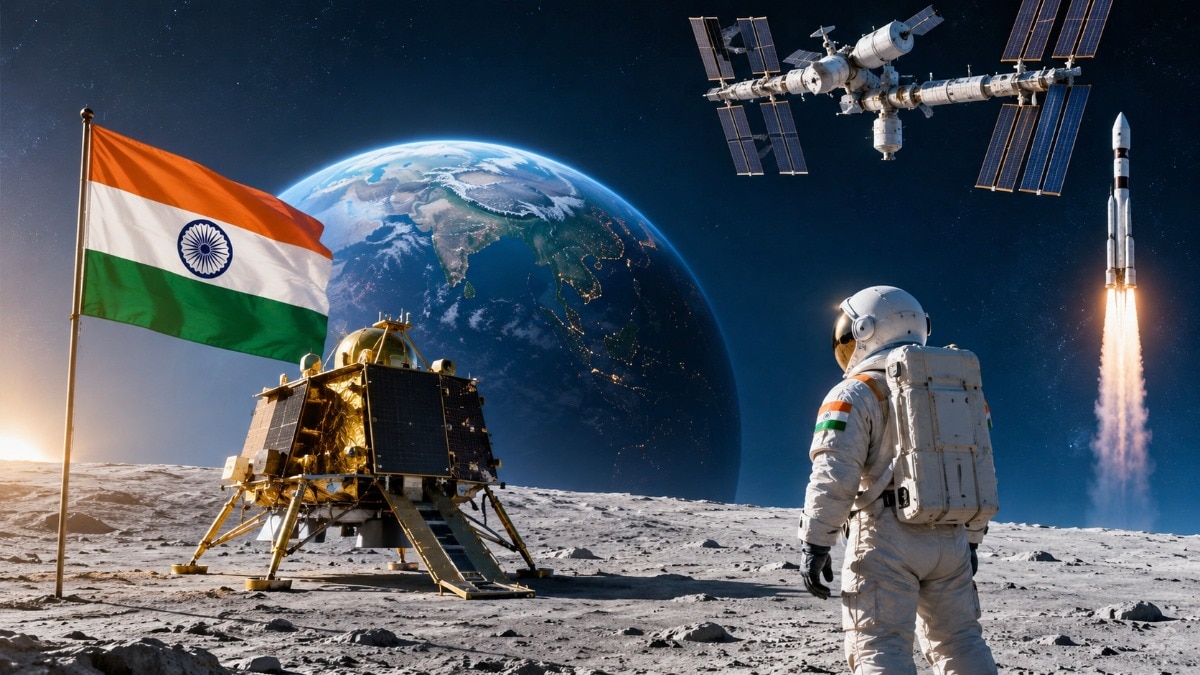
Three years ago, India made history by landing a spacecraft near the Moon's south polar region.On August 23, 2023, Chandrayaan-3's Vikram lander touched down safely on the lunar surface, making India the fourth country to achieve a soft landing on the Moon and the first to land near its southern polar region. The massive 642-ton LVM3 rocket, standing 43.5 meters tall, roared to life. (Photo: Isro) The achievement was so significant that the government declared August 23 as National Space Day.The first National Space Day was observed a year later, on August 23, 2024, with the day intended not only to commemorate Chandrayaan-3 but also to celebrate India's wider achievements in space science and technology. As India marks National Space Day 2026 today, it is also embracing change.Since the historic landing, the nation's focus is shifting from what Chandrayaan-3 achieved to what it helped make possible next. MORE THAN A MOON LANDINGLaunched aboard the LVM3-M4 from Sriharikota on July 14, 2023, Chandrayaan-3 was designed to demonstrate three critical capabilities; a safe and soft lunar landing, rover movement on the Moon and scientific experiments on the surface.After landing, the Pragyan rover rolled out of Vikram and began conducting experiments alongside instruments aboard the lander. Chandrayaan-3 Vikram lander on the Moon. (Photo: Isro) Together, the scientific duo studied the Moon's surface temperature, seismic activity, plasma environment and elemental composition, giving scientists a closer look at an unexplored part of the lunar landscape.The lander and rover were designed to operate for one lunar day, equivalent to about 14 Earth days, and as Isro said, the mission's objectives were completely met. Chandrayaan-3's Pragyan is seen on the Moon. (Photo: X/@beeanup1) Among its findings, Pragyan confirmed the presence of sulphur near the lunar south polar region and detected several other elements, adding to scientists' understanding of the Moon's surface."Chandrayaan-3 gave India not just a moment of national pride, but the confidence to think bigger, from human spaceflight and space stations to deeper planetary exploration," said Deepak Acharya, CEO of INOX India, a cryogenic equipment manufacturer that has been a partner in Isro’s space programmes, supplying tanks used for rocket launch vehicles."It has helped move India’s space journey from proving what is possible to building what comes next."FROM LUNAR ROVERS TO HUMANS IN SPACEOne of the most significant things that comes next, since Chandrayaan-3, is that India's ambitions have expanded well beyond robotic lunar exploration.At the centre of that growth is Gaganyaan, India's first human spaceflight programme.Isro is preparing a series of uncrewed missions before astronauts fly, with the first crewed mission currently targeted for the first quarter of 2027, provided the preceding tests are completed successfully.That journey involves far more than building a spacecraft capable of reaching orbit.Isro has been qualifying the crew module, testing the parachutes that will slow the spacecraft during its return to Earth and developing the tracking and communication systems needed to monitor a crewed mission.In July, the space agency also successfully demonstrated an indigenous ship-borne tracking system for Gaganyaan and future missions. The sea trial validated the performance of the home-grown tracking system. (Photo: NIOT) THINKING BEYOND GAGANYAANGaganyaan is also not just an anomaly, nor is it a one-of-a-kind, ambitious mission.It is increasingly being positioned as the foundation for a much larger human-spaceflight programme.Isro has begun designing critical systems for the proposed Bharatiya Antariksh Station, with the first module targeted as part of a planned space station in low-Earth orbit by 2035. The scale model of the first module of BAS. (Photo: India Today) India also has a longer-term goal of sending an Indian astronaut to the Moon by 2040.That makes National Space Day 2026 different from the first one.Chandrayaan-3 remains the reason August 23 is celebrated, but three years later, its legacy extends far beyond the lunar surface.India is now working towards a future in which it can send humans into orbit, operate its own space station and eventually attempt human lunar exploration.Chandrayaan-3 brought India to the starting line, and the race is now on to turn that historic landing into a sustained presence in space.- EndsPublished On: Aug 23, 2026 10:00 IST
National Space Day: How India's space ambitions have changed since Chandrayaan-3
Full Article
Original Source
Read the full article at Indiatoday →KhanList aggregates and links to publicly available news content. We do not host full articles from third-party sources. Always verify important information with original sources.