
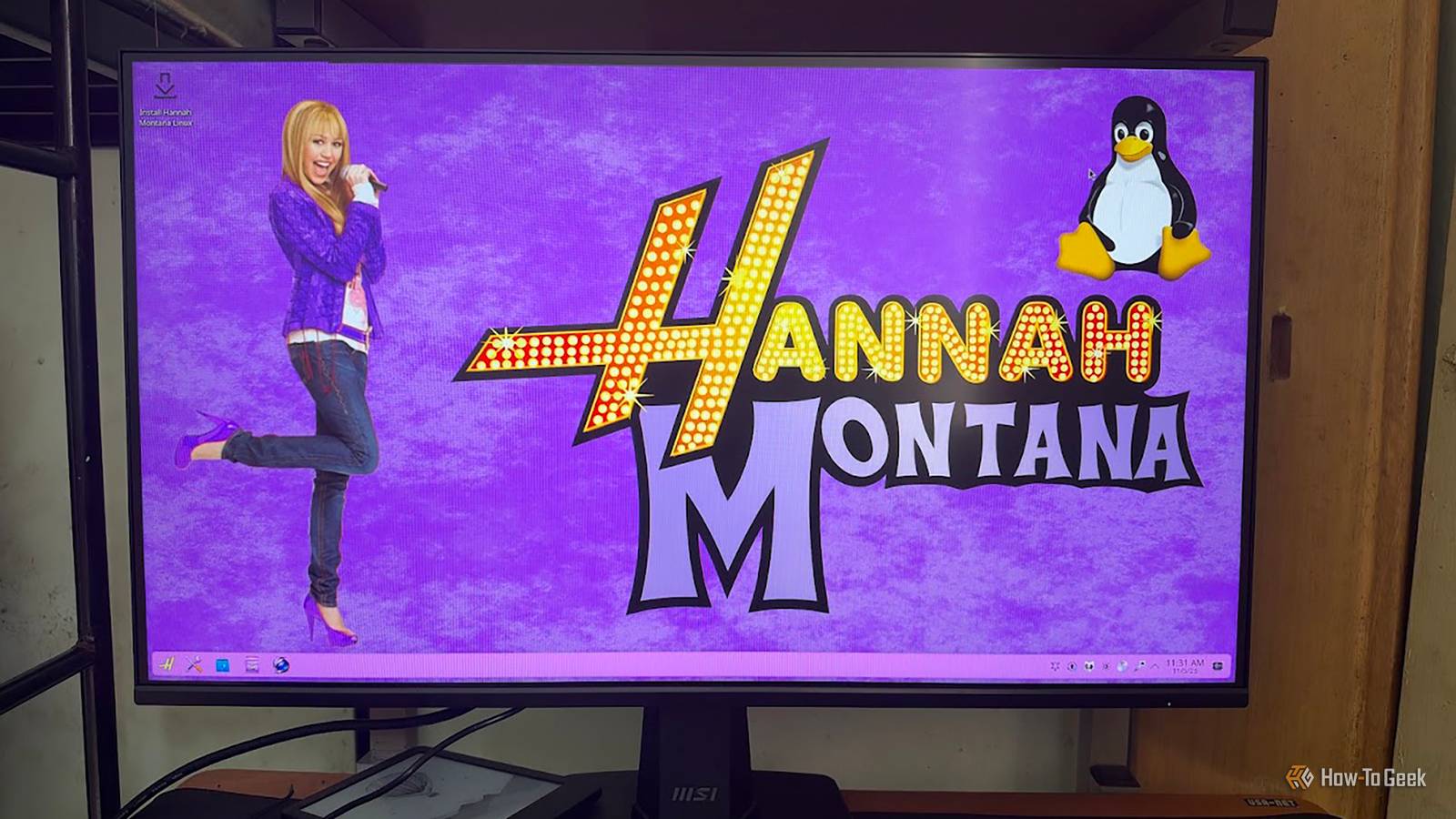
Published Nov 6, 2026, 4:01 PM EST Arol is a tech journalist who currently works as a contributor at How-To Geek since 2022. He first began writing online for the short-lived portal of Spanish-language gaming forum Emudesc in 2013. Years later, in 2017, he got his true start in tech journalism working for a small Google-focused site called Pixel Spot. He transitioned to a news and feature writer role at XDA Developers that same year, where he worked until 2021 before making the jump to other websites. Arol brings nearly a decade of writing experience, and the occasional hot take, to his writings. While he's a technology lover at heart, he holds computer hardware and smartphones particularly close to heart. You'll normally find him covering news, although he has also written the occasional deal, buyer's guide, how-to post, and round-up. He's also written for Android Police and MakeUseOf. He's also a Political Science student at the Central University of Venezuela, and a proud member of student movement Àgora UCV. When he's not writing, you'll probably find him hitting the gym, trying to ace a new hobby, reading his textbooks, or traveling. You can reach him at me@arolwright.com. Most Linux distributions exist for sensible reasons: to make your computing experience easier, safer, or faster. All fully serious stuff. But sometimes, the community has a sense of humor—or a deep sense of malice—and builds operating systems for stranger reasons. I went out looking for weird Linux distros, and here are some of the most baffling ones I came across. Suicide Linux The joke that people actually built (and shouldn't have) This is cheating a bit, as this is not exactly a distro, but bear with me. For what it's worth, Suicide Linux started as an elaborate bit of college humor, and frankly, it still is. Back in February 2009, programmer qntm posed a simple but genuinely terrifying thought experiment: What if Linux autocorrected every mistyped command into the catastrophic sequence, rm -rf /? The answer was obvious. Theoretically, any time you typed a command the system didn't recognize, it would quietly assume you meant to recursively delete absolutely everything on the drive. One typo, and all your stuff is gone forever. Weirdly exciting, I know. Or extremely twisted. qntm pitched the concept as a game—like walking a tightrope where your only goal is to see how long you can keep using the computer before all the data vanishes. He was upfront that the concept had no real technical merit, which, perhaps unsurprisingly, is why it connected so deeply. It taps into that fear every Linux user has half-joked about after accidentally hitting a stray key in the terminal. The premise did rely on a technical misunderstanding, though. An important clarification came in 2015: the autocorrect function qntm described was absolutely not standard Linux behavior. But that didn't stop the hobbyists. By December 2011, someone had actually managed to create a Debian package for it. The result was surprisingly more underwhelming than you'd think—the system didn't go down in a dramatic blaze of error messages; it just silently erased itself. Eventually, a GitHub user named tiagoad packaged the concept in a Docker image. By default, the container keeps your local files safe, but the project also includes a "danger mode" that mounts your host filesystem. This is where a simple typo could actually cause real damage. The concept keeps spawning descendants, too. Unalive Linux, which surfaced in 2025, takes a different approach, removing system libraries one by one instead of wiping everything, making the machine gradually, deliciously unusable after every bad command. Practically speaking, Suicide Linux is useless. But if you're a masochist, or you really like living life on the edge, it's worth a look. Red Star OS North Korea’s Mac-lookalike built for surveillance If Suicide Linux is chaotically dangerous by joke, Red Star OS is actually dangerous in a ton of other ways. As a political science student, I was excited to try this out, but I was also really scared of getting this running on a VM. It was actually the hardest one to get working out of the three I tested here, so that's something. It is North Korea’s official, state-sanctioned operating system, built on Fedora and designed to look exactly like Apple’s Mac OS X. (That aesthetic is actually a relatively recent choice. Version 3.0 was a big visual jump from Red Star 2.5, which had mimicked Windows XP back in 2013.) This friendly, familiar Mac surface, however, masks a system built entirely around control. Researchers Florian Grunow and Niklaus Schiess of the German security firm ERNW presented their analysis, and their most arresting discovery was the watermarking system. Red Star tags every single document or media file on the computer—and on any external drive attached to it—whether the user even opens the file or not. During early testing, simply plugging in a USB drive containing a DOCX file changed the file’s checksum, suggesting the watermark is rooted in hardware data like disk serial numbers. Grunow explained that this watermarking system was implemented as a response to unauthorized sharing of foreign films and music. It allows authorities to trace exactly where a file first landed on a Red Star machine and who opened it. The system can also identify and delete files it deems undesirable. It’s aggressively protective, too: if a user tries to disable or modify the firewall or antivirus, the system simply reboots. For all this tech, the researchers were unsure how widely Red Star is actually used in North Korea—visitors reported that most local computers run Windows XP. Still, as a demonstration of what open-source code can be twisted into, it’s pretty hard to beat. Out of all the distros showcased here, this is one I wouldn't install if I were you, not even as a joke. It's jam-packed with malware, as you might expect from something coming from North Korea, so shutting down all network access to the VM—and preferably installing it on a computer that has no physical way to access a network—is the correct course of action if you're going to do it. If you really want to read a full hands-on review, Adam Conway published an in-depth dive over at our sister site XDA. Hannah Montana Linux The pink Kubuntu meme that refused to die Not every chaotic distro is malicious. Some are just baffling, and few are as baffling as Hannah Montana Linux. It arrived in 2009, built on Kubuntu 9.04 and KDE 4.2, and covered head-to-toe in hot pink Disney Channel branding. Its creators claimed the goal was to lure young users to Linux, pitching it as fast, stable, and powerful—which was technically true because, underneath all the glitter, it was just Kubuntu. The changes were purely cosmetic, but they were deep. It shipped with a themed boot screen, login manager, icon set, splash screen, color scheme, and wallpapers, and about half of the oxygen icons were shaded pink or purple. Crucially, it relied on the same core tools (like dpkg and apt) as any other Kubuntu system, meaning it could run the same packages. Basically, a fully functional distribution trapped inside an aggressively glittering costume. What makes it truly chaotic, at the end of the day, isn't what it did, but simply that it persisted. Little is known about why it was ever developed, released, and almost immediately abandoned, yet it became one of the most enduring running jokes in Linux culture, the mandatory punchline whenever someone asked, "Which distro should I install?" That joke came full circle in 2026. Developer Noah Cagle released Hannah Montana Linux v26.0—a modern remaster built on Debian with a re-skinned KDE Plasma desktop. It's what we're using for our testing, as a matter of fact. Its wallpaper was rebuilt from the original 2009 file, resized for widescreen, complete with a recreated glitter effect, and it now uses the modern Calamares installer. The project's documentation even notes that it's mostly a Plasma re-skin based on modified Breeze themes, and nobody should mistake it for a serious production system. But after nearly two decades, the most absurd distro of the 2000s is running a modern kernel, which is bonkers on its own. Linux freedom cuts in every direction Linux's greatest strength is its openness, and these three distributions are living proof. All of them are ridiculous in their own right, but they go to show that Linux can be as ridiculous as it is serious.
These are the 3 most chaotic Linux distros of all time
Full Article
Original Source
Read the full article at Howtogeek →KhanList aggregates and links to publicly available news content. We do not host full articles from third-party sources. Always verify important information with original sources.