
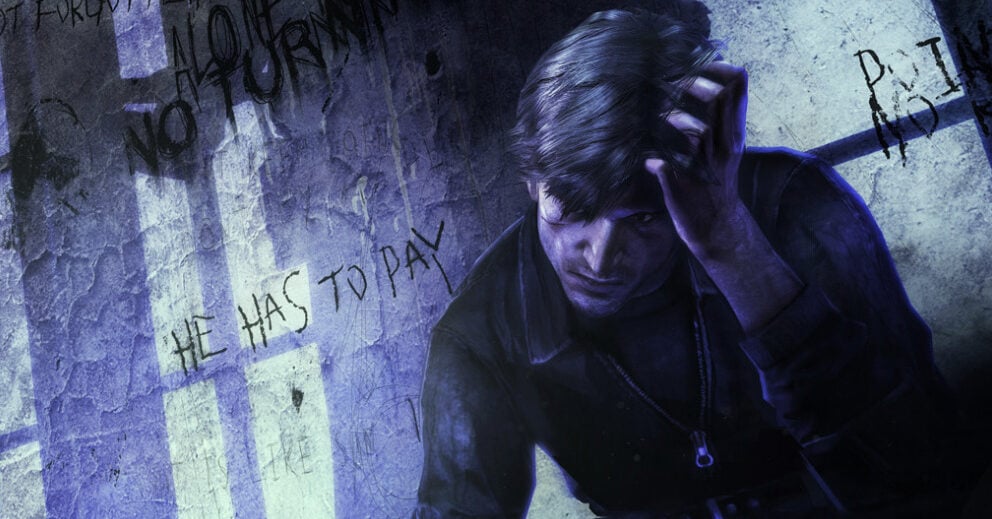
Every few years, I play through my favorite Silent Hill games. Silent Hill 2 is the best and the remake is equally excellent. But there’s also another game in the series that has really grown on me, and that’s Silent Hill: Downpour. I wrote about the game a couple years back and how it changed up the formula by making you the monster. Playing through the game again earlier this year, I felt the same sense of haunting awe. Downpour, which came out in 2012, follows Murphy Pendleton’s tragic journey through Silent Hill. But he’s not the only one wandering its streets. I wanted to know more about the game’s development and spoke with Tomm Hulett online. He was senior associate producer and writer at Konami on Downpour. The game’s inception came shortly after Hulett had finished work on Silent Hill: Origins and Homecoming. He was “very determined to make an ‘authentic’ Silent Hill that could “meet fan expectations and prove the West could create a proper Silent Hill. All the parties obviously had a variety of ideas, so we tried to focus on the ones that felt true to Silent Hill, like keeping things atmospheric or telling little mini-stories such as the side quests, and then avoiding things that felt less true to the franchise.” ©Konami In pursuing that goal, he developed a list of pitches for Downpour. “We wanted the ‘pitch’ to be very clear with a strong hook. SH2 famously has one of the best hooks of all time (man receives letter from his dead wife). SH4 has another strong hook. We wanted something that was clear and concise, and carries through the entire game.” Everyone felt that the idea of a “convict ending up in Silent Hill” was the strongest of them. From there, a lot of discussion happened about “why Murphy was in prison, why he was in Silent Hill, and so on, ultimately resulting in the Murphy that was featured in the game.” Murphy Pendleton might be a convict, but in some ways, he has one of the most sympathetic stories in the series. The tragedy behind what happens to his child drives him to extreme acts, but he’s still wracked with guilt by his actions. What’s so fascinating is that what he’s actually guilty of depends on the player’s actions, dramatically affecting the ending. ©Konami In Downpour, there are moments where Murphy is given a choice on how to interact with players. For example, Anne is about to fall. Does Murphy help or ignore her? Regardless of which you choose, Anne falls, which made me wonder why the choice was even given to the player. Hulett flipped this idea around. “These were ways to understand how the player viewed Murphy. What kind of guy is this criminal? Players have pointed out your choices don’t change the events (ie. Anne falls either way) but that wasn’t really the point.” So those decisions weren’t so much about the actual act, but our perception of who Murphy was. It’s a subtle point, but also a creepy one in that we’re also participating in Silent Hill’s journey. This is something I also loved in Shattered Memories, where your answers to the psychiatrist actually affect the way the city of Silent Hill looks. I’m glad to see it return, even if in a different form. Vatra Games, the game studio based out of the Czech Republic, developed Downpour and brought their own unique take on the series. Hulett told me, “I’ve worked for a lot of Japanese companies so collaborations in that direction feel natural at this point, and obviously working with other American teams or even British teams are not so different. But Eastern Europe has its own quirks and things that none of us were used to, so it was a learning experience! But I do think Vatra’s own flavor gives the game an identity. This is another thing you can see as new SH’s come out from different international teams. It’s very interesting. “Konami is very collaborative with its developers (which I’ve now experienced from the other side – everyone play Contra: Operation Galuga!), so there is a lot of sharing of ideas back and forth. Devin and I tried to be the ‘Silent Hill check’ while allowing Vatra freedom to explore their own ideas without feeling too chained to what came before. We brought in Tom Waltz from IDW to handle story writing, and since he lived near us in Southern California we could handle those aspects face-to-face more often, though Devin and I each spent several months out of the year in Czech Republic.” ©Konami One of their earliest ideas in the game was to have a cave system that was also a derelict tourist destination. That would become the mining ride, which is a very creepy sequence, tying in with a tour guide named JP Sater. He was responsible for an accident that led to the death of several children and he’s still tormented by what happened. Hulett explained, “On one visit to the Czech republic they took us to a similar place that actually exists. Rather than a train, you could take a boat ride through the caves. The level of danger changes based on rainfall, as it determines the amount of water in the cave! It was quite a bit different from the cave tours I’d done in the American northwest as a child. In Czech, taller people would need to bend down to avoid hitting their head as the boat passed crags and such. We could really appreciate that a disaster could strike at a place like this.” At one phase, there was a boss connecting with Sater called the Monocle Man. The giant figure makes a brief appearance during the mining ride, but doesn’t show up again. Hulett mentioned, “Sometimes cuts like this happen in game development. I do think the final game works better without the boss that we had.” ©Konami Vatra were big fans of the series and one of my favorite parts they added is an Easter Egg recreation of the Room from Silent Hill 4. I’m a big fan of 4, so I geeked out when I first came across it in the game. Hulett told me, “This one was the Vatra team having fun! They kept it a secret from us (myself and Devin Shatsky, the Producer) until it was finished, so they were just like… oh please come look at this idea? And we were standing in a perfect recreation of the apartment. Well it’s hard to say no to something like that of course.” I assumed that they’d gotten the assets from the original Room, but Hulett confirmed they built it from scratch, which I’m honestly super impressed by. “Things like Heather or Pyramid Head in the joke ending were assets from the Silent Hill HD Collection, but since SH4 wasn’t part of that, there weren’t any available assets for them to repurpose.” Don’t Go In the Basement While reading Carl Jung, I was reminded of Silent Hill when I read about how he thought the unconscious was represented by the shadow: “The shadow is a moral problem that challenges the whole ego-personality, for no one can become conscious of the shadow without considerable moral effort. To become conscious of it involves recognizing the dark aspects of the personality as present and real. This act is the essential condition for any kind of self-knowledge, and it therefore as a rule meets with considerable resistance… The effect of projection is to isolate the subject from his environment, since instead of a real relation to it there is now only an illusory one. Projections change the world into the replica of one’s own unknown face… ” Figuring out the nature of Silent Hill has always been one of its most fascinating aspects. Is Silent Hill punishing people for their sins, or trying to get them to relive and learn from their past actions? Is the pouring rain, tying in with the murder at the showers, meant as a way to torture Murphy further, or to cleanse away the regrets? “This is the fundamental question about the series and personally I think it can never be ‘answered’ because each player brings their own ideas to it,” Hulett explained. “It works because there are so many potential ‘reasons’ for the weirdness. Is it drugs? A cult? An actual benevolent force? Whatever someone brings in? All of these? Something else? I really think it’s brilliant and it’s why SH2 blew my mind, coming in as a fan of the original. It really expanded the premise in a special way. As a fan, I’m happy the latest games have played more with what Silent Hill can be. Personally, I imagine Silent Hill is a place with no supernatural force guiding events. It’s just our own misunderstandings and dark thoughts reflected back. At any rate, ‘what is the town’ was something Howard would have helped explore across games.” ©Konami Howard is the postmaster of Silent Hill and has been in the city for over a hundred years. His presence as a mysterious guide is one of the more fascinating parts of Downpour. Hulett mentioned that Howard came about during some conversations concerning Pyramid Head. Shortly after joining Konami, he’d advised them not to make Pyramid Head the SH mascot. That’s because Pyramid Head, subconsciously projected by James Sunderland in Silent Hill 2, has a personal connection to him. It wouldn’t make any sense for other characters to confront Pyramid Head (aka James Sunderland’s desire to punish himself/personal executioner) no matter how iconic the design. As Hulett put it, “It’s super problematic to the series lore and fans don’t love it. But there is still a value to a series having a recurring character that fans will recognize and expect to see in some capacity. So our team was tasked with coming up with one for our upcoming slate of titles. Howard is what we came up with. He had some influence on IDW’s SH comics at the time, too. I hope we haven’t seen the last of him!” ©Konami Expanding the lore through side quests was one of my favorite parts of Downpour. Some of them are emotionally wrenching, like Ribbons. Players can trigger it by finding a missing persons poster. An 8-year old girl has gone missing and her mom leads her home using a series of ribbons. Its ending left me devastated. I asked Hulett how the side quests came about. “This was one of those examples of merging something the Western games had been lacking into more modern ideas while still feeling authentic to Silent Hill. If you compare the first 4 games to Origins and Homecoming, it’s immediately apparent that the originals and more had ‘little stories’ told via notes as flavor, or as puzzle setups, and so on. These might tie into the main story thematically but they aren’t ABOUT ‘the story’ (SHSM does this very well but they do tie into the story). So right under ‘compelling hook’ on my list of must haves, was ‘little stories.’ With open world games gaining in popularity, it felt like side quests would be a perfect way to bring back little stories, while modernizing the game in a way gamers at the time would expect. Things like this help Silent Hill feel like a real town, rather than an empty game world.” On the specific Ribbons side quest, he mentioned, “Ribbons was actually so dark that one programmer refused to work on it. It’s definitely grim, but I do think its setup and the implied ending feel authentic to SH and Japanese horror.” Another side quest that creeped me out was Gramophone, which Murphy can use to turn back time and witness the murders that took place there, just in reverse. The paintings on the walls start bleeding and you have to vanquish the soul of the killer. “These were all actually ideas from across the Vatra team. To start with I wrote up a detailed treatment for a sample sidequest which ultimately didn’t get finished (you can see the remnants in the basement near the park). It sparked a lot of concepts throughout the team. Gramophone is definitely one of the cool ones, with both a dark premise and interesting gameplay gimmick! FWIW my favorite is the cinema sidequest.” ©Konami In the latter, Murphy has to set up some film reels and then enter the screens. The house he wanders into in the movie world is actually his own home, just in ruins, symbolically reinforcing the divide. He can never go back. Bus To Nowhere ©Konami Murphy’s guilt is distorting his reality. But it’s just as much driven by his failure to protect his son as it is his act to avenge him. That failure extends to the Wheelman he keeps seeing throughout the town. Murphy keeps descending into a void that threatens to devour him. That’s why I liked the fact that the enemies he faces are humans and tie in with his own shock at what he’s changing into. The Screamers represent the frustration of being judged and rejected by his wife after the death of their child. The Prisoner minions represent a mix of terror and fear from the time he was imprisoned. For Murphy, this all happened so rapidly in succession, he often seems traumatically numb to it all. But in the Other Worlds, everything breaks down and we see all of those emotions threaten to overwhelm him. “If I remember correctly, the direction we gave the team was to find something less rote than the original games. Go through dungeon, transition, go through dark version of dungeon. It’s great and iconic. I’m not saying the old games are bad! But we wanted to give them freedom to be surprising, as longtime fans were too used to the existing formula,” Hulett said. He was worried that, “In the end maybe it was too random for a single game, but it does give Murphy and Anne’s Otherworlds a unique flavor if you examine the series as a whole!” ©Konami While Murphy’s quest is compelling, there’s also Anne, whose story is on a parallel track. One of Downpour’s greatest narrative twists is that from Anne’s perspective, you’re the Bogeyman. The Wheelman that stalks Murphy was actually Anne’s father, Frank Coleridge, a corrections officer who tried to watch out for Murphy. Murphy’s price for getting help avenging his son was to take out her dad. Coleridge was beaten so badly, he had to be in a wheelchair for the remainder of his life. This recontextualized all of Silent Hill for me as we only rarely get glimpses into how others see Silent Hill. One of the most powerful is at the end of Silent Hill 2 where we witness the staircase on fire and Angela reveals it’s always this way to her. Hulett explained how the concept of the bogeyman started near the end of Homecoming. “I was given a little more responsibility on the title, and me and the writer from Double Helix tried to explain why this Pyramid Head wasn’t THE Pyramid Head. In the end, we named it Bogeyman and positioned it as Alex’s ‘parent revenge boss demon,’ like the other bosses you face throughout the game, explaining why Alex doesn’t defeat him. This planted a seed in my mind that I thought was worth carrying forward. ©Konami “Pyramid Head was kind of like James creating a monster for himself,” he continued, acknowledging that’s a very simplified version of it. “For our storyline and characters we needed the concept of one person ‘casting’ this monstrous form onto another person. When you see someone else as such a monster, because of what they’ve done to you, they’re no longer human. You could justify anything you do to them. In some cases maybe that’s true, while in others it’s a perversion, like in Anne’s hatred of Murphy. It was very compelling so it resulted in us reusing the name ‘Bogeyman,’ or maybe better establishing what a Bogeyman means to Silent Hill.” The final battle of the game is against a giant Wheelman. Or so I thought. After the fight, Murphy faces Anne. But this time, we see Murphy through her eyes and play as the Bogeyman, chasing after Anne. He’s ridiculously powerful. But this also had symbolic meaning about how we often supercharge those we hate. “As for the final encounter, we knew where our story was going and what our endings would be. But there was a bit of a mismatch after you face down the Wheelman boss, and suddenly Anne is there. It feels weird to fight her, especially if you’re in an ending where Murphy and Anne reach an understanding. So I was explaining the theming of the Bogeyman and what that means and then asked… wait could this be playable? Could we play Anne’s final boss from Murphy’s perspective? It’s a good moment that drives home the theme in a way only a video game can.” In the end, Murphy can choose whether to spare her or kill her. Even then the choices players made in the game earlier will affect not just Murphy’s future, but his past as well. Cinéma Vérité ©Konami Upon recently re-beating the game, I was surprised again by how much I enjoyed it. I’m not sure why Downpour doesn’t get as much love as some of the other Silent Hill games. I know reviews at the time mentioned some bugs. I played on the PS3 version using the latest patch, so I didn’t come across any of the framerate/crashing problems that early reviewers noted. For me, it’s not just a great entry into the series, but a captivating work of horror in itself. “I’m really proud of Downpour,” Hulett said. “I know it has some rough edges, obviously, but I think we accomplished our goal of telling an actual Silent Hill story with some interesting new ideas like side quests. We were really excited to provide a Silent Hill that fans could debate about.” While there’s a lot to debate about when it comes to the themes behind Downpour, there’s one thing that’s not in doubt for me. I felt Downpour paid respect to the series while also creating an entirely new story that moved me in the same way those classic Team Silent games did.
The Story Behind Silent Hill: Downpour And Its Haunting Take On Psychological Horror
Full Article
Original Source
Read the full article at Kotaku →KhanList aggregates and links to publicly available news content. We do not host full articles from third-party sources. Always verify important information with original sources.