
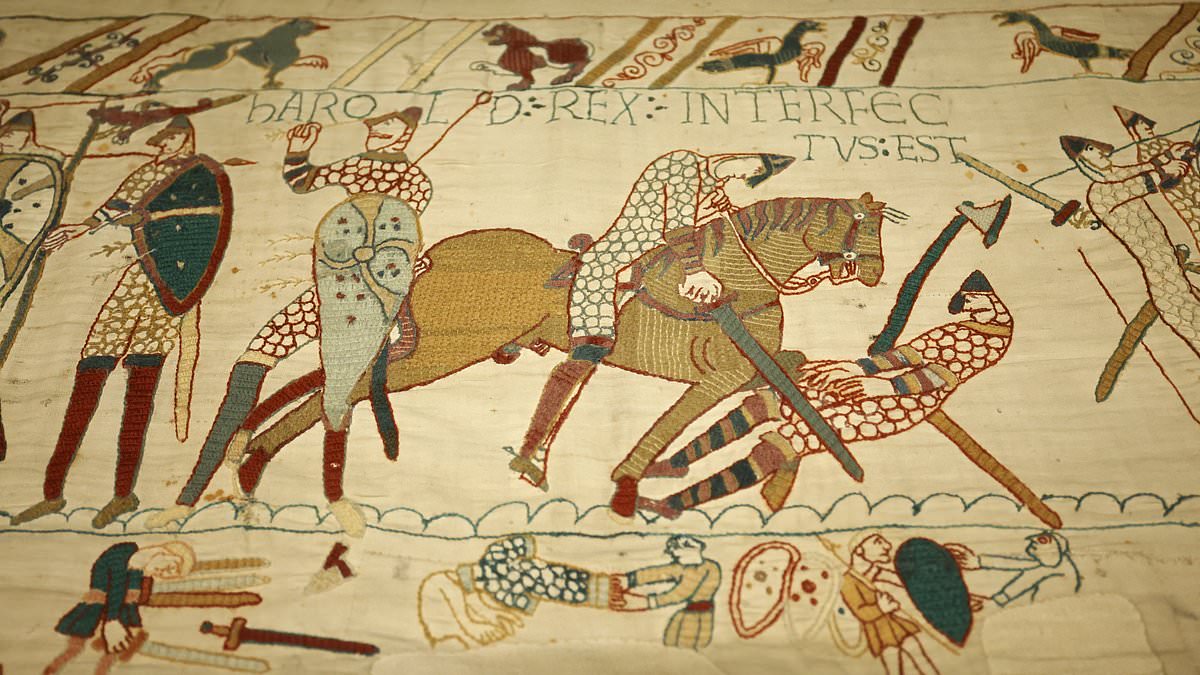
For the first time in almost 1,000 years, the Bayeux Tapestry is back on British soil for a special exhibition at the British Museum.The intricately worked 70-metre-long tapestry tells the epic story of William the Conqueror's bloody conquest of England in 1066.But amidst the battles, bloodshed and bodies, the Bayeux Tapestry still hides some intriguing mysteries.Surprisingly, those include exactly how many penises the ancient illustration depicts.Today, even basic facts like whether King Harold was really shot through the eye with an arrow have been called into question.And, according to the experts, some of these burning questions may never be fully answered.British Museum curator Professor Michael Lewis told the Daily Mail: 'The tapestry is interesting in terms of it being ambiguous in many ways.''It's hard getting behind the minds of 11th-century people through the objects, and you sometimes wonder if you bring in your own interpretation to these things.' For the first time in almost 1,000 years, the Bayeux Tapestry is back on British soil for a special exhibition at the British MuseumDoes the Bayeux Tapestry show a medieval sex scandal?One of the strangest lingering puzzles surrounding the Bayeux Tapestry is the identity of a woman who might have been caught up in a medieval sex scandal.While there are over 600 figures and around 200 horses depicted, there are just three women shown in the entire story – all of whom are in peril or distress.'You've got Queen Edith who's mourning the loss of her husband,' says Professor Lewis.'You've got a woman who's fleeing from her house that's being burned down, perhaps as a way of enticing the English into battle.'And you've got this mystic, mysterious figure, Aelfgyva, who we don't really know about.'What makes the figure of Aelfgyva so strange is that she is being caressed on the cheek beside a clergyman, while below, a nude male figure imitates the priest's pose.Historians believe this unusual arrangement might have been meant to implicate a sexual relationship between the two, but exactly who this woman is and why she was included in the tapestry remains a mystery. On the Bayeux Tapestry, a woman named Aelfgyva is caressed on the cheek beside a clergyman. Below them, a naked man appears in the decorative border Only three women are depicted in the main panel of the tapestry, all of whom are shown in some form of peril or distress The Bayeux Tapestry in numbers 9 linen panels used4 coloured dyes5 types of stitch627 figures featured6 women (3 in the main embroidery, 3 in the borders)737 animals23 trees (and 416 other plants)37 ships33 buildings93 or 94 penises Historians have puzzled over the image for centuries, with theories ranging from a forbidden affair to a plot designed to smear powerful figures connected to William the Conqueror.Professor Lewis believes that the mysterious woman might be Emma of Normandy, who married King Aethelred the Unready and then, following his death, King Cnut.She was also the mother of Edward the Confessor and the great-aunt of William the Conqueror.When Edward the Confessor died without an heir, William used the family tie as a justification for his claim to the English throne and for the invasion that secured it.However, there were rumours that Emma had an affair with the Bishop of Winchester during her first marriage.Professor Lewis said the inclusion of the scene might have been a subtle nod to the adultery – and may have even been stitched into the tapestry to cast doubt on William's claim to the throne.He says: 'You can see that they may have kind of changed things a little bit to try and get some of that different sort of messaging across as well, which I think is really fascinating.'Exactly how many penises are there? Experts still can't agree on how many penises are depicted in the Bayeux Tapestry after one academic claimed to have found a hidden 94th penis (pictured)While it might seem odd, the tapestry actually contains dozens of human and horse penises mixed among the scenes of battle.In some cases, these actually play an important symbolic role to demonstrate power or virility.William the Conqueror's horse, for example, has the largest penis in the entire tapestry, which is believed to be a way of demonstrating his dominance over the other men.But, bizarrely, academics still can't agree on just how many penises the Bayeux Tapestry contains.While Oxford academic Professor George Garnett counted 93 penises in 2018, only five of which belong to men, others have disagreed.Last year, historian Dr Christopher Monk claimed to have found a 94th hidden penis that had previously escaped notice.Professor Garnett still maintains that the suspected member is actually a dagger due to a yellow 'blob' on the end, but the debate still rages on.Professor Lewis described some of his fellow historians as 'obsessed with these 93 or 94 penises', but wouldn't weigh in on the debate. Experts believe the tapestry uses penises, especially those of horses, to demonstrate the virility and power of the Norman invaders He says: 'I don't really think about it too much, to be honest; it's sort of a strange aspect of tapestry studies. But the nudity is quite interesting in a general sense.'How do these [nude scenes] actually relate to the main narrative? Sometimes it doesn't make a lot of sense...so it's kind of a mystery sometimes what was in people's minds.'Was King Harold really shot in the eye?Perhaps the most famous scene in the entire Bayeux Tapestry depicts the moment that King Harold, leader of the Anglo-Saxon forces, is killed by an arrow to the eye.But did this famous event ever really happen?According to the experts, the answer is almost certainly not.This famous error comes from a section of the tapestry in which you can see a man pulling an arrow from his eye on the left, while on the right, you'll see a man being cut down by a Norman invader on a horse.Alongside the scene is the phrase 'Harold rex interfectus est', which translates to 'King Harold is killed'.The tapestry appears to show King Harold being hit in the eye by an arrow, but experts say this stitching was a later addition and that the figure was originally holding a spearProfessor Lewis claims the arrow stitching in the scene was 'certainly' added later.The Tapestry was conserved in 1982, at which point the backing fabric was taken off and the stitching studied carefully.This allowed curators to see the extent of restorations and how they changed the imagery.It seems that the first 'Harold' figure originally held a spear, but that this was lost over the years, leaving behind a row of holes that historians interpreted as an arrow.When the tapestry was later repaired in the 19th Century, an arrow was added, making it look like this figure was being struck in the eye.In reality, experts think the figure to the right is more likely to be King Harold, as more contemporary sources suggest that he was hacked down by Norman knights.However, while this question might never be truly settled, Professor Lewis says that the bloody violence in these scenes might tell us more about the people who made the tapestry than the people in it.Having been created by English women after King William's conquest, the slaughter of English men and women would have weighed heavily on the minds of the tapestry artists. Professor Michael Lewis, lead curator of the exhibition (left), describing the details to chair of the British Museum George Osborne and France's Culture Minister Catherine PégardProfessor Lewis says: 'I think what's really important about tapestries is that it's very difficult for the women who were creating the embroidery not to have those [deaths] in their minds as they're depicting these scenes.'Not only those of women, but also the killing and destruction of the men folk as well. I think people would have been very emotionally attached to those images that they're creating in the tapestry.'What happened to the final missing section?The final surviving scene of the Bayeux Tapestry depicts the Norman Victory at Hastings, with Anglo-Saxon soldiers dead or fleeing.However, the tapestry then abruptly ends in a section that has clearly been damaged.Historians think there was likely a final scene depicting King William's coronation at Westminster Abbey on Christmas Day 1066.No one knows where this final scene is now or why it was removed from the tapestry at some point in the last 1,000 years.And with no surviving evidence to help guide the way, there is no way of knowing what those final scenes might have revealed about King William's reign. A POTTED HISTORY OF THE BAYEUX TAPESTRY 1066: Between seven and twelve thousand Norman soldiers defeat an English army of a similar size at what is now Battle, East Sussex1476: The embroidered cloth depicting the battle is referred to for the first time in an inventory of Bayeux Cathedral1732–3: Antiquarian Smart Lethieullier writes the first detailed English account of the tapestry while living in Paris – but it is not published till 1767 1792: During the French Revolution, the precious artwork was declared public property and confiscated to be used as a covering for wagons – but it was saved by a lawyer who hid it in his home 1804: In a move dripping in symbolism, Napoleon – under the impression France was about to invade and conquer Britain – had the tapestry temporarily moved to Paris for display1870: The tapestry is removed from Bayeux once again during the Franco–Prussian War – but it is moved back two years later 1944: The Gestapo removed the tapestry to the Louvre in Paris – just days before the German withdrawal. A message from Heinrich Himmler – who coveted the cloth because it is a part of Germanic history – is believed to imply the Nazis planned to take it to Berlin 1945: It was returned to Bayeux, where it has been ever since
The Bayeux Tapestry's biggest remaining mysteries: The five key unanswered questions about the medieval artwork - including exactly how many penises it depicts
Full Article
Original Source
Read the full article at Dailymail →KhanList aggregates and links to publicly available news content. We do not host full articles from third-party sources. Always verify important information with original sources.