
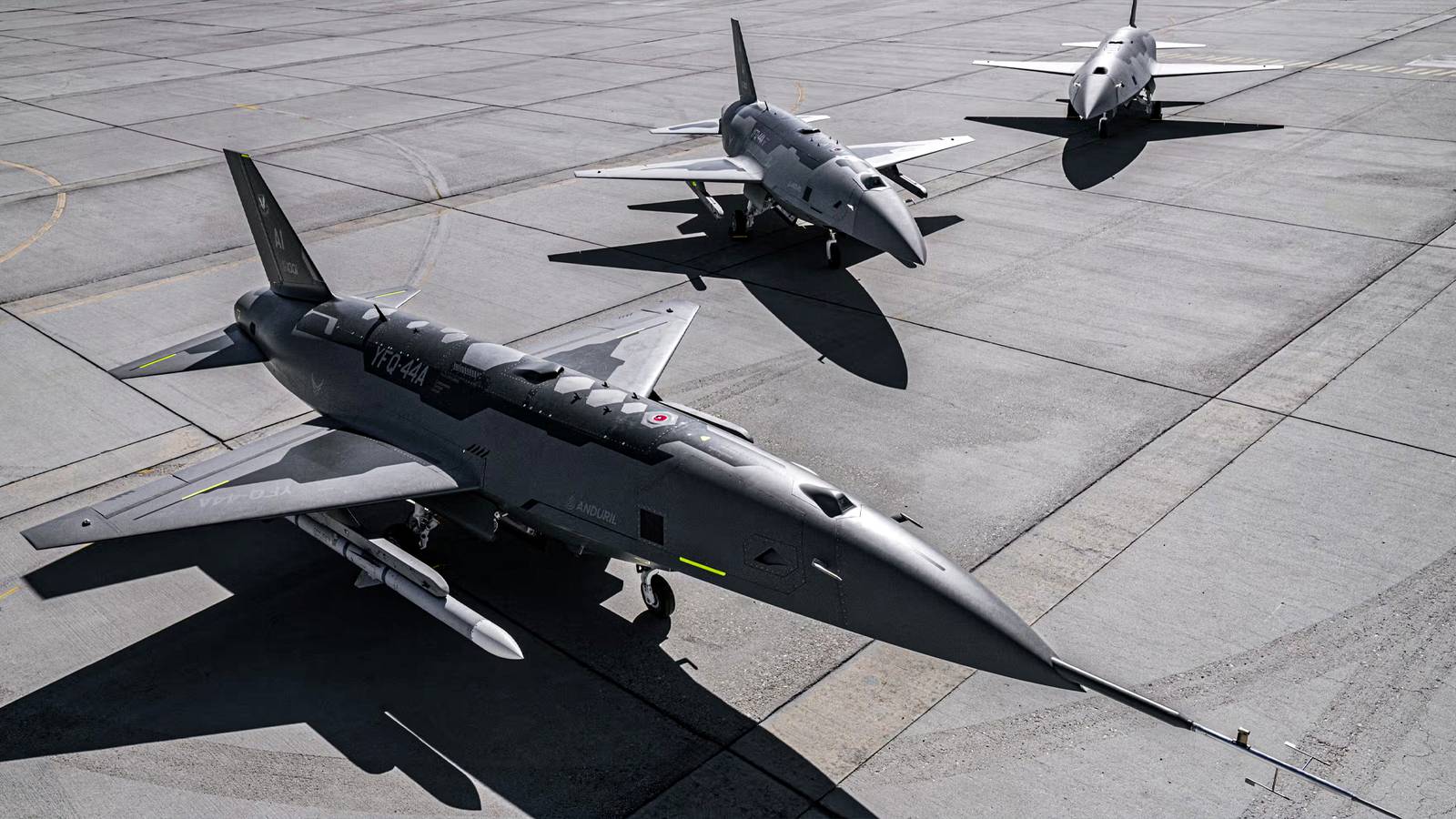
Published Sep 26, 2026, 10:00 AM EDT Luke Diaz is a freelance military writer with experience with active duty experience in the US Navy as well as defense and industrial engineering. He is a former Naval Flight Officer who performed tactical air control on the carrier-based E-2 Hawkeye. On September 3, Anduril Industries announced a major step forward in the development of the artificial intelligence brand that will power the US Air Force's future fleet of Collaborative Combat Aircraft. The defense startup is collaborating with a hypersonic aircraft startup known as Hermeus. The new drone builders will team up to produce Quarterhorse Mk 2, a reusable uncrewed aircraft aiming for Mach 5. Supersonic test flights are planned for 2027, Air and Space Forces Magazine reported. Next year, the Air Force also aims to down select a single primary autonomy provider for its first batch of collaborative combat aircraft. In traditional military programs, the Air Force buys a plane and its software as one locked package. For the CCA program, they are doing things differently. They are choosing the physical drone from one company, and buying the autonomous AI software independently of another. The short list of three finalists includes Anduril as well, giving the new defense contractor a chance to become a major player in the future fleet of Loyal Wingman drones. Through its Lattice for Mission Autonomy software, Anduril has positioned itself to potentially power the brain of the Air Force's entire future robotic fighter fleet. The Third Aircraft For Lattice Credit: Hermeus The Hermeus agreement matters less for what Quarterhorse does than for what it says about where Anduril is able to adapt its code for different hardware. Following Anduril's own Fury CCA and its recently announced Thunder tiltrotor drone, Quarterhorse is the third airframe to join the growing family of remote-piloted, semi-autonomous aircraft powered by Anduril AI software. Yet, that list could get much longer in the near future as America's drone force is rapidly ramping up to scale. Lattice is meant to let the aircraft respond to changing conditions in flight, coordinate with other assets, and carry out complex missions alongside human operators. Hermeus described the deal as the first large-scale integration of Anduril's autonomy software onto a third-party aircraft outside Fury, a milestone the company is using to argue Lattice can generalize beyond the fighter-like drone it was built for. According to Benzinga, Anduril's Lattice for Mission Autonomy will serve as the core software engine for mission planning and execution on the Quarterhorse Mk 2. The decision gives the company a third independent airframe carrying its autonomy stack outside its own Fury program. The choice also follows a major milestone in Lattice's progress. On July 15, an Anduril Fury drone performed the first-ever live missile launch by an American CCA. The Lattice software successfully received and processed target data from an outside source, analyzing and relaying it to a human commander to safely approve the shot, who commanded the drone to fire. This provided a real-world weapons test to finally prove the software works end-to-end. Credit: US Air Force Anduril built Lattice to be completely modular. It is designed to act as an open operating system that can be plugged into Anduril's own drones, General Atomics' drones, or any future models the military buys down the road. Yet, Lattice's reach extends well past any single aircraft. In March, the US Army already signed a ten-year procurement deal with Anduril for up to $20 billion. The contract folds more than 120 separate procurement actions into one framework built around Lattice as the backbone for its anti-missile and anti-drone Integrated Battle Command System, according to DefenseScoop. Army Colonel Tony Lindh, deputy acquisitions' director for the service's Joint Interagency Task Force 401, said the arrangement establishes a common technological backbone that will let warfighters and federal agents share data and coordinate responses more effectively. That software already will carry data integration with hundreds of existing joint and Army systems. It is separately being adapted to help fly a hypersonic demonstrator that has nothing to do with the Army at all. That is a lot of ground for one piece of software to cover before it ever touches the fighter-like drones the Air Force is buying in the hundreds. It still remains to be seen whether Lattice's institutional momentum in command and control translates into control over the aircraft themselves, and that depends on how the collaborative combat aircraft program will actually be built. A Fleet Number That Keeps Moving Credit: US Air Force The collaborative combat aircraft program, known as CCA, is still yet to settle on a final fleet size. Then Air Force Secretary Frank Kendall set the original cap in 2023, calling for at least 1,000 CCAs and potentially more across the life of the program, according to The War Zone. Officials later scaled that back to an initial run of 100 to 150 aircraft by the end of the decade, but the goal to eventually reach 1,000 is still a widely circulated figure. This summer, current Secretary Troy Meink told the Air and Space Forces Association's annual conference that the service now wants at least 500 CCAs fielded by 2032. Anduril makes one of just two airframes selected for this first wave of Loyal Wingman drones. Following the official announcement in June, the Air Force awarded engineering, manufacturing, and production contracts to General Atomics and Anduril for what are now designated the FQ-42A Vengeance and FQ-44A Fury. The small startup beat out three Legacy Prime contractors to take the second spot: Boeing, Lockheed Martin, and Northrop Grumman. After the program kicked off, the Netherlands became the first international partner to join the Air Force program earlier this year with plans to procure their own Fleet of CCAs. At the same time, the Navy is also pursuing a parallel Loyal Wingman effort with a lower price target near $15 million per aircraft. In 2025, it issued development contracts to Anduril, Boeing, General Atomics, and Northrop Grumman. Anduril has rapidly established itself at the ground level of what will be one of the most influential new technologies for the future of American Air power. Three Finalists: The Initial Split Credit: US Air Force The mission autonomy software, the part that actually decides how a drone behaves once it is airborne, was never tied to the airframe builders from the outset. To that end, Anduril entered a race against General Atomics, Lockheed Martin, Northrop Grumman, RTX subsidiary Collins Aerospace, and Shield AI. Three of those six, Anduril, Shield AI, and Collins Aerospace, received production options funding a first six-month performance period. The next step for the Air Force is to narrow the field to one or two contenders for a second six-month phase. It will end in a single primary autonomy provider for Increment One chosen by summer 2027. The goal is to deliberately keep the mission software decoupled from the airframe it flies on, making the future fleet of Loyal Wingman drones 'vendor-agnostic' on the software side of sustainment and upgrades. So far, Collins Aerospace's Sidekick software has already been paired with General Atomics' YFQ-42A. Meanwhile, Shield AI's Hivemind has been paired with Anduril's own YFQ-44A. However, Lattice is paired with Hivemind in order to make the Fury drone fully functional, and the drone even completed a successful transition between the two AI 'Directors' mid-flight for different mission segments during testing in Spring in what was dubbed a 'dual autonomy stack' demonstration. The underlying framework that makes this swapping possible is the Pentagon's broader push for modular open systems. This is an important part of the USAF's drive to future-proof every platform in its inventory, as it wants to avoid any 'vendor lock' which has driven up the cost of legacy airframes for decades. What Winning Would Actually Mean Credit: US Air Force If Lattice wins that down, the practical effect is close to what the original question was really asking. Anduril would supply the airframe for one of the two Increment One designs and the flight software for potentially both. That is on top of already owning the Army's next-gen counter-drone command backbone, and it may also claim a stake in the Navy's carrier-based Loyal Wingman competition, while it has already earned a foothold on the Hermeus hypersonic drone. Christian Gutierrez, senior vice president of Hivemind at Shield AI, said: “Mission autonomy is a foundational capability for future airpower. The Air Force’s approach enables faster innovation, rapid capability deployment, and greater operational advantage for the warfighter. We’re excited to continue our partnership with the Air Force to field collaborative autonomy and deliver these capabilities at scale.” Mark Shushnar, Anduril’s vice president for autonomous airpower, was quoted: “We have been refining, testing, and iterating on our production system, in parallel with aircraft development, for the past two years. We have already implemented our full rate production processes and tooling on prototype aircraft, identifying and addressing issues during prototyping to streamline the transition into production.” If Collins or Shield AI wins instead, the CCA fleet ends up genuinely split, with Anduril's own aircraft potentially flying on a rival's brain even as Lattice keeps expanding everywhere else in the US drone enterprise. Only the outcome puts Anduril's software directly in command of the airframe question the whole program was designed to answer. The Air Force built a hedge against either extreme, as Breaking Defense reported. Colonel Timothy Helfrich said the mission autonomy contract vehicle will keep all six vendors in a pool as a backup option. So the service retains the ability to order software licenses from a different company later, even after a primary provider is chosen. All the same, the company that wins the initial down select still gets first claim on the operational fleet the Air Force actually fields at scale.
The Software Deal That Could Put Anduril Inside Every CCA The Air Force Buys
Full Article
Original Source
Read the full article at Simpleflying →KhanList aggregates and links to publicly available news content. We do not host full articles from third-party sources. Always verify important information with original sources.