
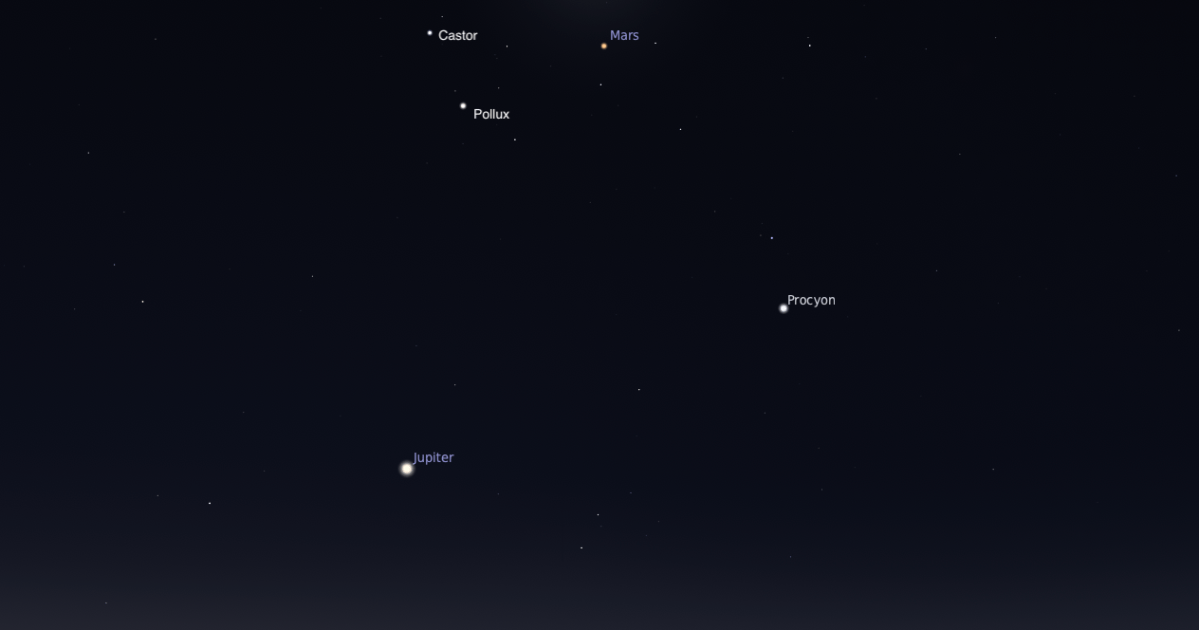
A delicate crescent Moon meets up with Mars in the constellation Gemini on September 6, visible in the early-morning hours before sunrise. Jupiter, closer to the horizon in Cancer, gets its chance to tango with our satellite two days later. Credit: Stellarium/USGS/Celestia/Clementine Friday, September 4Last Quarter Moon occurs at 3:51 A.M. EDT Have you heard of the “demon star,” Algol? This strange sun is actually two stars in a system known as an eclipsing binary. As the name would suggest, as they orbit, one star regularly passes in front of and eclipses the other from our point of view. This happens every 2.87 days — and when it does, we see the visible star suddenly and briefly dip from its usual brightness of magnitude 2.1 down to magnitude 3.4. That’s a change large enough to notice with the naked eye! The entire cycle takes less than half a day but, if you catch it just right, you can view Algol at both minimum and maximum magnitude in the same night. Tonight is one of those nights for many observers across the U.S. Algol should reach its minimum brightness at 9:50 P.M. EDT. The star rises in the northeast around 8 P.M. local daylight time, so at the moment of minimum, it will be above the horizon for those in the Eastern and Central time zones, and rising shortly after for those in the Mountain time zone. It takes about five hours for Algol to brighten, so even as it rises last in the Pacific time zone, it will still be close to minimum. Observers across the U.S. will be able to watch it increase in brightness over the course of the night, finally reaching its maximum magnitude once more around 3 A.M. EDT tomorrow morning. Located in the northern constellation Perseus, Algol — also known as Beta (β) Persei — will be roughly 30° below the right side of the W of Cassiopeia early in the evening as it’s rising. It’s about 9.4° south-southwest of brighter magnitude 1.8 Mirfak, Perseus’ alpha star, and Algol is the brightest star in southwestern Perseus. Sunrise: 6:30 A.M.Sunset: 7:27 P.M.Moonrise: 11:51 P.M.Moonset: 2:59 P.M.Moon Phase: Waning crescent (41%)*Times for sunrise, sunset, moonrise, and moonset are given in local time from 40° N 90° W. The Moon’s illumination is given at 10 P.M. local time from the same location. This diagram shows the positions of Saturn’s four brightest moons at midnight CDT on September 5. Titan will be northeast of the planet all through the early morning of the 6th, and visible northwest of the ringed world overnight on September 6/7. Credit: Stellarium/Oleg Pluton Saturday, September 5Titan, Saturn’s brightest moon, orbits its parent world with a period of about 16 days. You’ll find this moon passing near Saturn today and tomorrow, when it will be northeast and northwest of the ringed world, respectively. Now rising around 9 P.M. local daylight time and standing highest around 3 A.M. in the early-morning sky, Saturn is visible to the naked eye — it’s easy to find, too, as the brightest light in the region of southern Pisces and northern Cetus. By midnight, it’s already more than 30° high in the southeast, so late-night observers can get in on the action as well as early risers. By 3 A.M. the planet stands 50° high in the south. By midnight Central time on the 5th, Titan is less than an arcminute from Saturn, sitting just northeast of the planet. Several other, fainter moons cluster closer in — you’re most likely to spot 10th-magnitude Rhea, Tethys, and Dione. At midnight CDT, the latter lies alone to Saturn’s east (southeast of Titan), while the other two are west of the planet. Their positions change quickly, though, so they may be in different spots if you take a peek at a different time. Titan is moving westward, skimming north of the ringed world. By the time Saturn rises tomorrow evening, the 6th, in the Midwest, Titan will already be some 41” northwest of the planet, and continuing to pull away. On this day, Tethys lies east of Saturn, while Dione and Rhea are to the planet’s west, south of Titan. Sunrise: 6:31 A.M.Sunset: 7:25 P.M.Moonrise: —Moonset: 4:01 P.M.Moon Phase: Waning crescent (30%) Sunday, September 6The waning crescent Moon lies in Gemini today, not far from the 3rd-magnitude star Epsilon (ε) Geminorum, roughly around where western twin Castor’s knee would be. Mars is also in Gemini, closer to the midsection of the eastern twin, Pollux. You can catch the lovely celestial pairing early this morning: Mars rises around 2 A.M. local daylight time, and an hour before sunrise, the pair has reached some 40° high in the east, with Jupiter also visible to their lower left, in the constellation Cancer. Mars still appears pretty tiny in a telescope, just 5” across. It will slowly grow larger over the coming months as its distance from Earth decreases, but for now, surface detail is impossible to see. However, you can easily note its reddish color — compare that to, say, white-hued Castor and yellow-hued Pollux, the bright stars marking heads of the Twins. Closer to the horizon, brighter Jupiter is sitting in eastern Cancer about 7.2° east of M44, the Beehive Cluster. Through a telescope, the gas giant stretches an impressive 32” and is flanked by its Galilean moons. Early in the morning, Io and Callisto lie west of the world and Europa and Ganymede are to the east. Observers in the Central and Mountain time zones can try to catch Io disappearing into Jupiter’s long, dark shadow around 5:35 A.M. CDT, although the sky will be starting to brighten in the Midwest and the planet will be only a few degrees high in the Mountain time zone. Pacific Coast observers will see only the three other moons, as Io reappears right around sunrise in the Pacific time zone. The Moon passes 3° due north of Mars this afternoon at 2 P.M. EDT, shortly before our satellite reaches perigee, the closest point to Earth in its orbit, at 4:43 P.M. EDT. At that time, it will be 228,825 miles (368,258 kilometers) away. Sunrise: 6:32 A.M.Sunset: 7:24 P.M.Moonrise: 12:58 A.M.Moonset: 4:53 P.M.Moon Phase: Waning crescent (20%) Monday, September 7Venus has pulled away from the bright star Spica in Virgo, which it met in the sky last week, and tonight stands side by side with the star as they set together following sunset. An hour after the Sun disappears, the pair is just 3° high in the west, with some 4.7° separating them. You’ll need a horizon clear of trees and buildings to see them well — an observing site slightly above your surroundings, such as a hill or parking garage, will further aid your endeavors. They set around 8:45 P.M. local daylight time. Although Venus is quickly losing altitude, it is approaching greatest brilliancy, which it will reach next week. Through a telescope, Venus appears as a 34%-lit crescent that spans 33” — a slightly larger apparent size than Jupiter, despite the two planets’ physical size difference. Venus is only 0.5 astronomical unit from Earth, where 1 astronomical unit, or AU, is the average Earth-Sun distance of 93 million miles (150 million km). Jupiter, by contrast, is now 6.2 AU from Earth, so its much greater distance diminishes its apparent size in our sky. Sunrise: 6:33 A.M.Sunset: 7:22 P.M.Moonrise: 2:13 A.M.Moonset: 5:34 P.M.Moon Phase: Waning crescent (11%) The Moon, now in Cancer, sits close to bright Jupiter in the early-morning sky of September 8. Credit: Stellarium/USGS/Celestia/Clementine Tuesday, September 8The Moon has now skimmed through the morning sky over to Cancer, where it checks in on Jupiter — and you can check in on them both before dawn. The Moon rises around 3:30 A.M. local daylight time, with Jupiter following half an hour later. An hour before sunrise, the Moon is 20° high in the east, to the upper right of bright Jupiter in eastern Cancer. About 3.8° to the Moon’s right (west) is the Beehive Cluster, a lovely open cluster in central Cancer. Before the sky grows light, you might be able to make out its brighter stars with the naked eye, as the slim crescent Moon shouldn’t throw out too much light. Binoculars or any small scope will certainly show its many members. Jupiter shows off a wealth of detail in a telescope, including a light-and-dark banded atmosphere and four large, bright moons. Io is alone to the planet’s east, while Europa, Ganymede, and Callisto stretch out to the west. The Moon will pass 0.8° north of Jupiter at 2 P.M. EDT, during daylight across the U.S. Sunrise: 6:34 A.M.Sunset: 7:20 P.M.Moonrise: 3:30 A.M.Moonset: 6:08 P.M.Moon Phase: Waning crescent (5%) Wednesday, September 9The waning Moon has moved from Cancer to Leo and is nearing the bright star Regulus, which marks the Lion’s heart. Our satellite will pass 0.6° south of Regulus at 4 P.M. EDT this afternoon. An hour before sunrise this morning, Regulus is just 4° above the eastern horizon, with the Moon —just 4% lit as sunset quickly sweeps across the lunar nearside — still 4.5° to its west (upper right). In fact, this morning offers an excellent opportunity to trace out the line of the ecliptic in the sky. The ecliptic is defined as the plane of Earth’s orbit around the Sun. But because all the major planets in our solar system orbit close to the same plane, they appear to sit along a line in our sky: the ecliptic. The Moon’s orbit, while tilted some 5° to this plane, still largely carries our satellite mostly along this line, and several stars in the sky also happen to sit along the ecliptic as well. This morning, you can visualize the ecliptic by starting at Regulus, low in the eastern sky, and moving your gaze to the upper right. Along the way, you’ll encounter the Moon, Jupiter, and then Mars, all of which lie along the ecliptic and show off its orientation in the morning sky. Sunrise: 6:35 A.M.Sunset: 7:19 P.M.Moonrise: 4:45 A.M.Moonset: 6:35 P.M.Moon Phase: Waning crescent (1%) Uranus (marked by the red crosshairs) lies roughly midway between the bright star Aldebaran and the Pleiades star cluster. It is highest in the early-morning, and best visible an hour or so before dawn, while the sky is still dark. Credit: Stellarium Thursday, September 10Uranus reaches a stationary point at 2 P.M. EDT, coming to a halt amid the stars of Taurus the Bull. Rising around 10:40 P.M. local daylight time, the best time to view the ice giant is in the early morning, in the hour or so before dawn, when the sky is dark enough that the 5th-magnitude world can be picked up at nearly its highest point in the sky. In the hour before dawn, Uranus stands 70° high in the south, near the small V of stars that makes up the face of Taurus. If you’re facing south, that V will appear tilted on its side, opening toward the left, with the bright star Aldebaran along the left side. Look to the V’s upper right to find the Pleiades, an open cluster of stars also cataloged as M45. They are easy to see with the naked eye. Uranus is about halfway along a line drawn between Aldebaran and the Pleiades, just 1° to the upper right (west-northwest) of magnitude 4.9 Omega (ω) Tauri. If you center that star in binoculars or a telescope, the planet should be within view as well. Its tiny disk spans 4” and may appear grayish in color, like a “flat” star. Prior to today’s halt, Uranus was moving eastward, or prograde, against the background stars. After today, it will begin moving westward, or retrograde, across our sky. New Moon occurs tonight at 11:27 P.M. EDT. Sunrise: 6:36 A.M.Sunset: 7:17 P.M.Moonrise: 5:59 A.M.Moonset: 7:00 P.M.Moon Phase: New Friday, September 11With dark, moonless skies tonight, let’s go galaxy hunting. By 9 P.M. local daylight time, Pegasus is already high in the east, the Great Square easily giving away its location. The northern part of this constellation holds a group of five galaxies, the brightest of which is NGC 7331. Called the Deer Lick Group, you’ll find this gaggle of galaxies just 4.4° north of 3rd-magnitude Eta (η) Pegasi. NGC 7331 is the easiest to view, a stunning spiral galaxy glowing at magnitude 9.5. If your observing site is particularly dark, you might be able to spot it through binoculars. Any telescope will show it, with larger apertures offering ever more detail. It’s highly inclined to our line of sight, though not exactly edge on, allowing you to see into the center, toward the bright nucleus wrapped in fainter spiral arms. It stretches some 11’ long and 4’ wide. The four remaining galaxies in this group are sometimes called the “fleas” because they’re much smaller and fainter. They are NGC 7335 (magnitude 13.4), NGC 7340 (magnitude 14.9), NGC 7336 (magnitude 15.0), and NGC 7337 (magnitude 15.2). However, they’re not physically smaller than NGC 7331, but instead much farther away, hinting that this “group” isn’t really a true family, but just a chance superposition on the sky. Sunrise: 6:37 A.M.Sunset: 7:15 P.M.Moonrise: 7:09 A.M.Moonset: 7:24 P.M.Moon Phase: Waxing crescent (1%) Alison Klesman is senior editor of Astronomy magazine. She holds a Ph.D. in astronomy and has studied a variety of topics, from minor planets to supermassive black holes.
The Sky This Week from September 4 to 11: The Moon joins Jupiter and Mars
Full Article
Original Source
Read the full article at Astronomy →KhanList aggregates and links to publicly available news content. We do not host full articles from third-party sources. Always verify important information with original sources.