
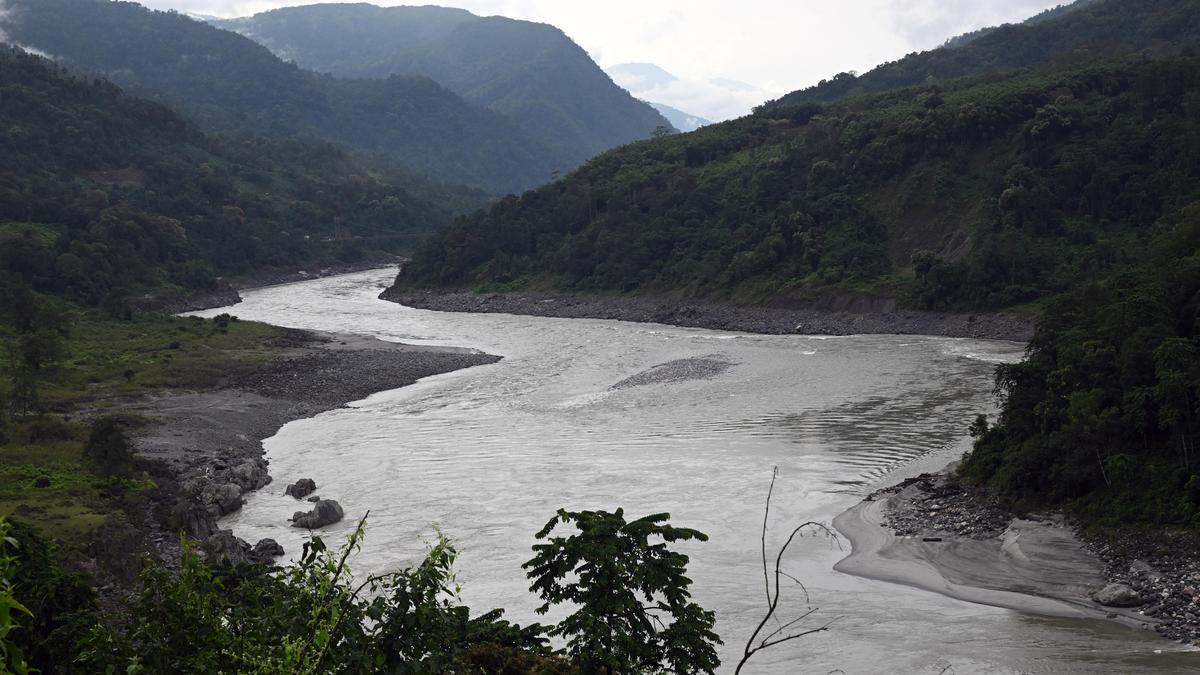
‘The key issue seems to be why the Himalayan countries have failed to establish a framework for sharing transboundary rivers’ | Photo Credit: THE HINDU/RITU RAJ KONWAR The 11,200 MW Siang Upper Multipurpose Project (SUMP) in Arunachal Pradesh has evolved from a decades-old hydropower proposal with less storage capacity into a project with significant strategic and national security implications, particularly in response to China’s decision to proceed with the 60 GW Medog hydropower project on the Yarlung Tsangpo in Tibet. The river flows into India as the Siang and subsequently the Brahmaputra. By 2020, NHPC Limited had intensified preliminary investigations. With a proposed capacity roughly three times that of the Three Gorges Dam, the project has raised concerns in the downstream countries, India and Bangladesh.India views SUMP as a potential strategic buffer against upstream hydrological risks. Its proposed 9.2 billion cubic metres of live storage capacity is expected to regulate excess flows during sudden releases and maintain downstream water availability during periods of reduced discharge.Despite the national security rationale, SUMP faces resistance from indigenous communities. The proposed reservoir could submerge an estimated 27 ancestral villages and displace over 1.5 lakh people, nearly 11% of Arunachal Pradesh’s population. The government’s initial response by deploying armed forces has also deepened tensions.Tribal land protection in northeast India rests on constitutional provisions and statutory safeguards, but their scope varies across States. The Sixth Schedule provides one of the strongest protections through Autonomous District Councils, which exercise legislative and administrative powers over land, customary laws and local governance. However, Arunachal Pradesh, which is not covered by the Sixth Schedule, relies partly on the Arunachal Pradesh Scheduled Tribes (Protection of Transfer of Land) Act, which restricts the transfer of tribal land to non-tribals while allowing government acquisition for public purposes. The key issue, however, is not merely the existence of legal protections but whether they can meaningfully safeguard community rights when large infrastructure projects are undertaken in the name of national security.For the local communities of Arunachal Pradesh, the mountains and valleys provide water, food, medicinal plants and other essential resources while sustaining cultural practices, customary laws and collective identity. The Siang River, revered as Anni (Mother), holds deep cultural and spiritual significance. The valley contains sacred sites, burial grounds and historical landscapes that sustain indigenous traditions and customary institutions. The financial compensation cannot adequately address the consequences of submerging ancestral villages. Their concerns are about losing their social networks, cultural continuity and ecological relationships, and becoming landless communities in unfamiliar areas — an extension of similar stories of existential crisis experienced now by tribal communities in Jharkhand, Madhya Pradesh and Great Nicobar. Published - November 27, 2026 12:56 am IST
The Siang dam — strategic ambition, ecological fallout
Full Article
Original Source
Read the full article at Thehindu →KhanList aggregates and links to publicly available news content. We do not host full articles from third-party sources. Always verify important information with original sources.