
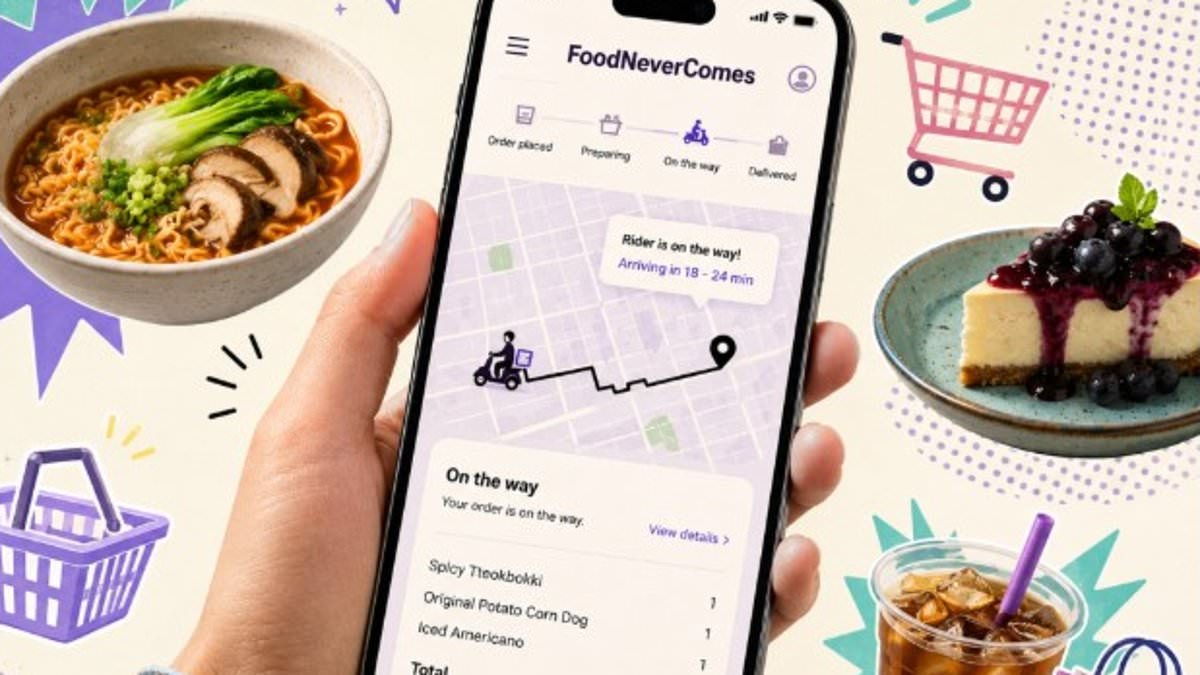
My online shopping basket is filling up nicely.So far, it contains a very stylish gabardine trench coat in size small, reduced from $159.99 to $74.99 – the website tells me there are only seven left, so I’m particularly pleased to have snagged it.Plus a pair of sleek, metal-effect, bluetooth earbuds, an absolute snip at $24.99 down from $79.99; and a foldaway compact drying rack for $28.99 – down 33 per cent.And, now, I’m umming and ah-ing over whether I can justify a luxury Cloud Rest Bolster Pet Bed – just $34.99 down from $79.99 – for my Jack Russell.But of course I can! Because when I read the tagline at the top of the website, it says ‘Every cart is on the house – checkout never charges you a cent’. Lo and behold, while my basket total is $134.97, it turns out I’ve been charged a grand total of $0.00.Perhaps even better, there’s no need to worry about shipping from the US, or any tiresome import taxes, or even waiting in for anything to arrive, because none of my carefully researched loot exists. Two 26-year-old software developers from Udaipur set up FoodNeverComes with the catchy tagline: ‘The food never comes – but the dopamine does’ Users can chose from 22 different national cuisines, 327 dishes, and 319 real recipes, complete with fake prices, a simulated checkout and watching the delivery wending its way to youI am shopping on online megastore FakeHaul, one of a rash of fake experience sites that have sprung up around the world this year.Known as ‘dopamine sites’, these platforms supposedly give the experience, the excitement – the dopamine hit or ‘intense feeling of reward’ that some people get from shopping – but without any of it being real. Or breaking the bank.Clothes, makeup, household goods, holidays, food orders even.So users can browse menus, read reviews, add endless items to their basket, place orders and even track couriers, but none of it exists, nothing ever arrives. It’s like a giant game of shops as a child. And it’s astonishingly popular.US-based FakeHaul has thousands of users. FoodNeverComes – a fake food ordering business – has more than two million. The newer TripNeverLeaves – for holidays that never happen – is already a hit.All of which, of course, sounds as if the world has gone completely mad. But according to experts, there is a proper attraction, a draw. Because the appeal of these fake consumer sites to their predominantly young users is that they get to enjoy the rituals of consumption, without the reality.Ravi Dhar, director of the Yale Center for Customer Insights, has called it ‘anticipatory utility’ or ‘the thrill in the chase’ – the pleasure of looking forward to consumption, which is much more powerful with items that capture the imagination – anything from a new pair of shoes or a holiday to a restaurant meal.Professor Anna Lembke, MD author of Dopamine Nation, says: ‘These so-called “dopamine” sites function like digital “near-beer” [alcohol-free beer] providing the high of drug-adjacent rewards without the reward itself.’So the ‘hit’ comes from the search, browsing, adding items to a basket and clicking ‘buy’, rather than the actual gabardine coat, Thai curry or dog bed.It all started in March, in Seoul, South Korea, with a fake food delivery site called FoodNeverArrives, set up by Seohyun Park, a 21-year-old mechanical engineering student. US-based FakeHaul has thousands of users. Known as ‘dopamine sites’, these platforms supposedly give the experience, the excitement but without any of it being realAs Park explained to the New York Times last week, it was intended as a ‘playful experiment’ – to see whether the feeling of consuming could be separated from the act itself, after noticing that she got more pleasure from reviewing menus, assessing the cost, calories and ordering a food delivery than she did from actually eating the food.Much to her surprise, it took off like a rocket.Today Park’s site gets at least 10,000 visitors a month who spend a lot of time discussing how much they love adding up the money they haven’t spent and the calories they haven’t eaten.It has shone a light on our increasingly uneasy relationship with both technology and rampant consumerism. It has also spawned much talk about dopamine, the chemical messenger produced by our brains that helps us feel pleasure and happiness and boosts everything from learning to lactation, mood to movement and sleep.It is, of course, the dopamine hit that Class A drug users are often chasing. But it can also be produced by exercise, sunlight, music and meditation. And according to an article published by the Harvard Medical School called Pathway to Pleasure, it is especially triggered by sex, shopping and the smell of cookies baking in the oven.Anyway. Within weeks of Park’s site hitting the news earlier this year, dopamine sites were popping up all over.In India, two 26-year-old software developers from Udaipur – Purvansh Parmar and Anshul Sharma – set up FoodNeverComes with the catchy tagline: ‘The food never comes – but the dopamine does.’Users can chose from 22 different national cuisines, 327 dishes, and 319 real recipes, complete with fake prices, a simulated checkout and watching the delivery wending its way to you. You even get a dummy AI-generated call from the site with updates on delivery difficulties.‘He’s outside your building but he can’t find your door’.Since its launch in June, the site has attracted more than 2.7 million visitors.More recently, Parmar and Sharma launched into travel with their second venture, TripNeverLeaves, which lets users plan a holiday – everything from destination, hotel, flight, seat and transfer, right down to an itinerary of activities – although, of course, their virtual plane never leaves the runway.This has already attracted more than 100,000 visitors.While some sites are just for fun, others aim to prompt self-reflection or to help break bad habits.Damta World, a South Korean site, encourages users to join three-minute simulated smoking breaks with live chats – as if you’ve popped out with some mates for a gossip and gasper. But, of course, you’re still at your computer – and not smoking. More recently, Parmar and Sharma launched TripNeverLeaves, which lets users plan a holiday – everything from destination, hotel, flight, seat and transferMeanwhile, FakeHaul was set up as a personal project by Jack Yang, a Microsoft developer concerned about consumerism.But here, Professor Lembke flags a danger.‘The intention is to help people reduce compulsive over-consumption, which might work for some people, but won’t reduce the overall time spent online – its own harm,’ she tells me.Of course, the idea of using fakes and placebos to help addiction is not new. Alcohol-free beers. Nicotine-free vapes.Back in 2025, and to help people wean themselves off phone addictions, a former Google and Facebook marketing executive called Eric Antonow, invented the Methaphone as bit of a joke.‘Opioid addicts have methadone, iPhone addicts need Methaphones,’ he said.His invention was a clear, phone-shaped sheet of acrylic you can reach for instead of your phone and tap to your heart’s content.So it didn’t buzz or light up or ping with notifications. You couldn’t check messages or email, or play games on it. It was just a slab of plastic that cost $25.T he first batch sold out instantly, then TikTok picked up on it and a video of someone pretending to scroll the translucent slab in San Francisco had 53 million views.But according to experts, none of these other approaches produce dopamine as efficiently as the shopping websites, giving rise to worries about them functioning as ‘gateway’ behaviour – normalising the feeling of online shopping, food delivery or social media.Or, as Professor Lembke puts it: ‘These sites might increase consumption in the long-run by stimulating addictive neural pathways and triggering craving.’Not forgetting that, fake products or not, users are still bombarded by adverts while they are online. And, while the sites are currently free to use, this may well change.But perhaps most importantly, and before we shut ourselves away for hours doing fake shopping, we should remember that there are plenty of other legal, more worthwhile and fun ways of getting your dopamine hit.So here’s a radical thought. Rather than wasting your time ordering a load of old rubbish you’ll never receive, or planning a holiday that will never happen, perhaps just bake some cookies. Or pop back to bed for an hour. Or maybe even do both.
The shopping websites that give you the full dopamine rush of ordering food, clothes and even holidays... The twist? You never actually spend a penny and it's all fake!
Full Article
Original Source
Read the full article at Dailymail →KhanList aggregates and links to publicly available news content. We do not host full articles from third-party sources. Always verify important information with original sources.