
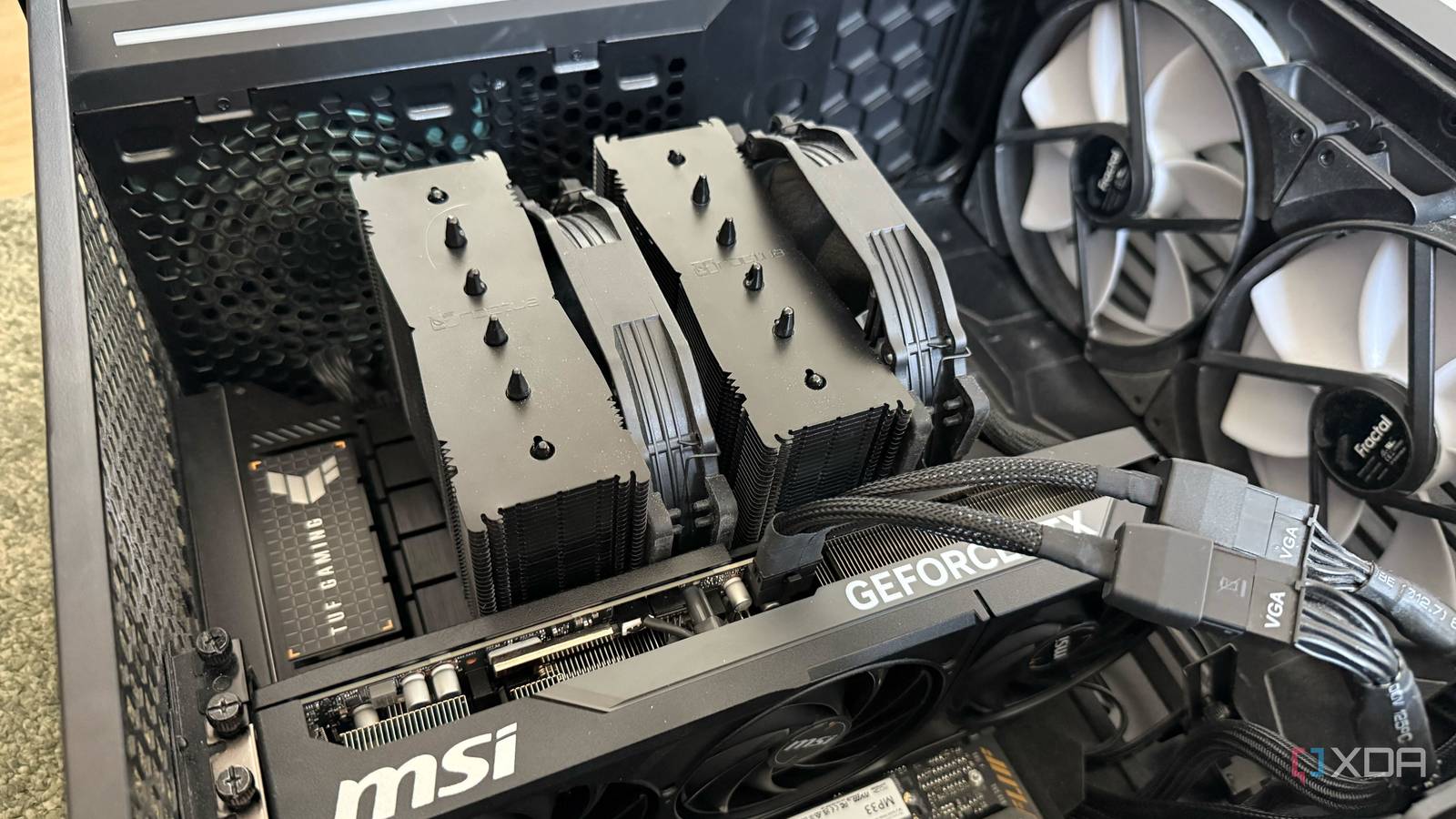
Published Sep 6, 2026, 4:30 PM EDT His love of PCs and their components was born out of trying to squeeze every ounce of performance out of the family computer. Tinkering with his own build at age 10 turned into building PCs for friends and family, fostering a passion that would ultimately take shape as a career path. Besides being the first call for tech support for those close to him, Ty is a computer science student, with his focus being cloud computing and networking. He also competed in semi-pro Counter-Strike for 8 years, making him intimately familiar with everything to do with peripherals. The RTX 5080 is a great GPU in a vacuum. It's got a decent VRAM buffer, enough raw raster capability to play games at 4K, and the ray tracing chops to turn the settings up a bit. It was my first and only purchase from the 50-series, and without any context, it's a well-performing GPU. Factor in the price I paid and the performance of the RX 9070 XT that was in my rig previously, and the picture starts to look a bit more grim. For the level of performance I was seeing at 4K from both cards, I was almost about to relegate it to my HTPC, but then I enabled Smooth Motion in the Nvidia App, and thanks in part to some borked AMD driver behavior, it managed to stay in my rig for good. The RTX 5080 is a fast gaming GPU, but it's not a good value I paid nearly half price for similar performance The price I paid for my 5080 in retrospect looks like a good deal, but it was expensive even then. I paid around $1,450 USD for a lightly used one on eBay, and at the time, that seemed like an adequate price given the circumstances. It earned me a decent discount over the retail offerings, but it wasn't like I had scored a massive deal. Now, cards of similar quality to my MSI one are going for well over $2,200 CAD, or $1,600 USD. This was a card that was supposed to retail for $1,000, mind you. Even at its retail price, I wouldn't consider the RTX 5080 a good deal. It has 16GB of VRAM, which seems a bit low for a card at this price-point, and given its uplift over the RTX 4080 can be anywhere from 5% to upwards of 20%, it doesn't seem to justify its high price, even if it does have an MSRP lower than its predecessor. Now, comparing it to the Red Team's flagship paints an even worse picture. You can currently buy an RX 9070 XT for just over half-price of what I paid for my RTX 5080, and for that, you get really strong 4K and 1440p gaming performance, with most benchmarks having it trade blows with the RTX 4080, which as we've established, has only marginal uplift over its new counterpart. XFX Swift AMD Radeon RX 9070 XT Smooth Motion works where MFG can't The setting that saved my RTX 5080 purchase I play most games with frame generation off, mostly because the RTX 5080 pushes out enough frames for me to be satisfied at 4K. However, there's one key exception to that, and it applies to my favorite game, Escape From Tarkov. My rig can usually push out around 100 FPS on average, but some maps in the game demand way more of it, and you also get serious degradation in performance during a gunfight regardless of location. Smooth Motion basically nullifies both of those concerns completely, and it can be applied to EFT, unlike MFG, which isn't supported currently. Smooth Motion is a type of frame generation, but it happens at the driver level instead of being integrated into the rendering pipeline of the game itself. Compared to MFG, it is prone to more visual artifacting and can only insert 1 generated frame between rendered frames instead of MFG's max of 5, but neither of those things matter in this scenario. Escape From Tarkov is almost the perfect use case for Smooth Motion, because it doubles framerate and the artifacts are only noticeable within the menus when scrolling quickly, at least in my experience. On Factory, a smaller, indoor map that doesn't demand much of the hardware, I average around 200 FPS with Smooth Motion off. With it on, that increases to the game's cap of 300. 1% lows actually decreased in the second test, but 0.1% lows increased significantly, likely due to the dynamic nature of testing in a live, online environment. The Customs map is where Smooth Motion really shows its chops, because it's a map that drops me below 100 FPS consistently in the more crowded areas. With Smooth Motion on, I saw my average jump a modest 36 FPS, but my 1% lows went from 92 to 123, which is what you really feel during gameplay. AMD has this feature, and they even shipped it first AFMF is the Red Team equivalent Smooth Motion is specific to Nvidia, but it's not the only driver-level frame generation method out there. AMD has one of their own called AFMF, and it actually released before Smooth Motion did. It also offers more control than Nvidia's single toggle, featuring different profiles and Vulkan support. I didn't swap GPUs specifically to use this setting, but I was aware of it when I was using my RX 9070 XT. It just never worked for me AFMF failed to hook onto certain games, among other AMD driver issues A feature I can't use is useless to me, unfortunately. Even after wiping my drivers clean and reinstalling my RX 9070 XT, I still couldn't get AFMF to hook onto EFT. This issue was compounded by driver timeouts that I had been experiencing for months, and it seemed to correlate with the Adrenalin software. Using the full-fat suite seemed to cause more timeouts than using the "minimal" driver install, and so to stop my system from completely locking up mid-session, I had to opt for the latter. Unfortunately, using the minimal install locks you out of a lot of features, with AFMF being one of those. Smooth Motion wins by DQ If it weren't for some weird driver behavior, I'd probably still be on my Radeon card. Despite being a little less performant, it was quieter and ran cooler, which I really appreciated. Unfortunately, Smooth Motion offers too big of an uplift over my regular performance. The RTX 5080 isn't a great value in a vacuum, but when compared to a card with misbehaving drivers, I'll take it.
The RTX 5080 was almost the most underwhelming GPU I've ever purchased, until this one setting saved it
Full Article
Original Source
Read the full article at Xda-developers →KhanList aggregates and links to publicly available news content. We do not host full articles from third-party sources. Always verify important information with original sources.