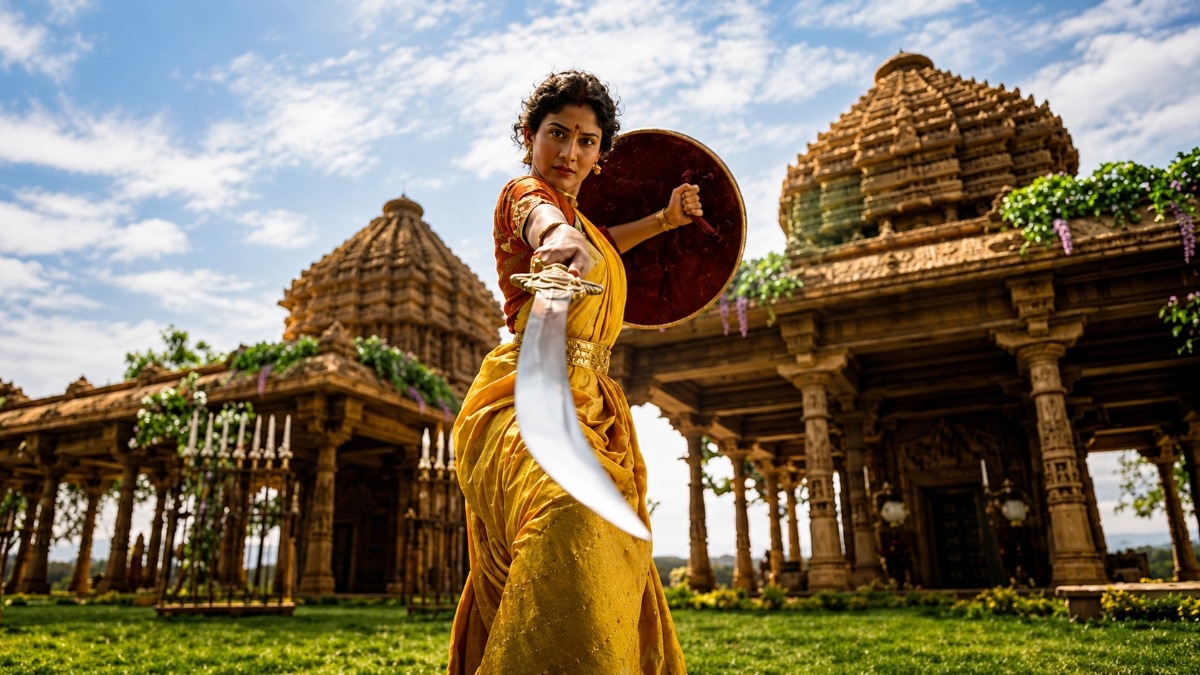
For decades, popular adaptations have celebrated Sita as the embodiment of grace, sacrifice and unwavering devotion. She has been remembered as the ideal wife, the keeper of dharma and the woman who endured exile, abduction and public scrutiny with extraordinary resilience. Her strength has almost always been defined by endurance.But Sita's story has never been that one-dimensional.And Nitesh Tiwari's Ramayana trailer has sparked discussions about Maa Sita and who she is. There's a lot happening in the Ramayana trailer. Ranbir Kapoor looks every bit the composed Lord Ram, while Yash's Raavan radiates menace in every frame. But if you look closely, in an almost blink-and-miss moment, Sai Pallavi's Sita gets one of the trailer's most intriguing shots.Clad in a yellow saree, she is seen wielding a curved sword and a round shield. The moment lasts barely a few seconds, but it has sparked an interesting conversation. Is Nitesh Tiwari's Ramayana preparing to revisit a side of Sita that mainstream cinema has largely overlooked? Not just Ram's wifeThe trailer doesn't tell us much, and a single shot is hardly enough to predict the film's interpretation. Yet the image of Sita carrying a sword suggests that Ramayana may be exploring her beyond the familiar "woman waiting to be rescued" narrative.It hints at a Sita with agency – a woman capable of making decisions, protecting herself and standing shoulder to shoulder with Ram, rather than simply behind him. That interpretation isn't entirely new. It has existed in literature for centuries. Sai Pallavi as Sita in Ramayana. The Sita we rarely talk aboutIn Valmiki's Ramayana, Sita is introduced as King Janaka's daughter, born from the Earth while he was ploughing a field. As an incarnation of Goddess Lakshmi, she is celebrated for her compassion, wisdom, resilience and steadfast commitment to dharma.But even within the epic, there are hints of extraordinary strength.One of the reasons Janaka announces the famous Swayamvar centred around Shiva's divine bow is because, according to folk tradition — recounted, among other places, in Amar Chitra Katha's retelling — Sita had effortlessly lifted the massive bow as a child while playing. Realising that his daughter possessed uncommon strength, Janaka declared that only someone capable of stringing the bow would be worthy of marrying her. Ram's feat, therefore, was not merely a display of masculinity—it was about finding someone who matched Sita's extraordinary abilities.The warrior princessThe warrior image of Sita becomes even more pronounced in other re-tellings of Ramayana.In the Adbhuta Ramayana, attributed to Valmiki, Sita transforms into Mahakali to defeat the thousand-headed Sahasra Ravan after Ram is rendered unconscious. It is one of the earliest texts to imagine Sita not merely as someone to be protected, but as the ultimate protector herself.A similar interpretation appears in Chitra Banerjee Divakaruni's 2019-novel The Forest of Enchantments, where Sita narrates her own story. Here, she is not just a devoted wife but also a healer, strategist and a woman deeply aware of the natural world.The novel also imagines a memorable scene between Sita and Queen Kaikeyi. A warrior queen herself who had once accompanied King Dashrath into battle as his charioteer and sword-fighter, Kaikeyi challenges Sita to a sword practice session. Watching the young princess's skill, strength and composure, Kaikeyi realises that Sita is not only worthy of Ram but also capable of facing every adversity that life might throw at her.It is a portrayal that shifts the conversation from Sita as someone who merely survives suffering to someone who actively shapes the world around her. Strength beyond the swordPerhaps that's the most fascinating part of Sita's legacy.Her strength was never defined solely by warfare. It lay equally in her intelligence, her knowledge of nature, her moral conviction and her ability to make difficult choices. She chose to accompany Ram into exile, overriding his objections, as Valmiki recounts in the Ayodhya Kanda. She questioned him when she disagreed. As Valmiki recounts in the Yuddha Kanda (sarga 104), before she walked into the fire to prove her purity in front of the army, Sita rebuked Ram for judging her the way an ordinary man judges an ordinary woman, despite everything he knew of her.And at the end of her journey, when Ram, under pressure from public doubt a second time, asked her to prove her purity once more before the court, Sita turned to her mother, the earth, instead — "My sacred birth of such a high degree, was not honoured by you" — as described in Valmiki's Ramayana, Uttara Kanda. The ground split open, and she descended into it, choosing an ending on her own terms over another public trial.These are some of the decisions that require as much courage as any battle.Seeing her journey, it is only best to describe Sita as a survivor. That instinct for survival wasn't new. In Raavan's Lanka, held captive in Ashok Vatika and surrounded by hostile rakshasis under his command, she trusted no man in that space — instead placing her faith in Trijata, a rakshasi among her own guards, who shielded her from the others' threats and comforted her with a dream foretelling Ram's victory.Her most sustained act of survival came after her second exile – pregnant, alone, and banished on the word of a citizenry she had never wronged. She found shelter in sage Valmiki's ashram and raised her twin sons, Luv and Kush, without Ram, without Lakshman, without the court that had once been hers.It was Valmiki who trained the boys, and – in one of the epic's more striking turns – taught them to recite his own verses on Ram's life, the very verses that eventually led father and sons to recognise each other. Sita's exile, in other words, produced the Ramayana's own telling. And when Ram finally asked her to return, she didn't. She asked the earth to take her back instead.Could Ramayana finally embrace this Sita?Whether Sai Pallavi's sword-wielding appearance as Sita is symbolic or a glimpse into a larger narrative remains to be seen. But the trailer has already achieved something important – it has reopened a conversation about who Sita really was.Not merely the ideal wife. Not just the woman waiting in Ashok Vatika.She was also a princess raised to be fearless, a woman whose strength inspired the conditions of her own Swayamvar, a healer who understood the rhythms of nature, a survivor who endured unimaginable loss, and, in several revered retellings, a warrior capable of defending herself and those she loved.If Nitesh Tiwari's Ramayana chooses to embrace that lesser-seen facet of Sita, it won't be reinventing mythology. It will simply be reminding audiences that the epic has always contained a far more layered heroine than popular culture has often given her credit for.- EndsPublished On: Jul 31, 2026 07:44 IST
The real Sita in Ramayana: Warrior, healer, survivor - not just the ideal wife
Full Article
Original Source
Read the full article at Indiatoday →KhanList aggregates and links to publicly available news content. We do not host full articles from third-party sources. Always verify important information with original sources.