
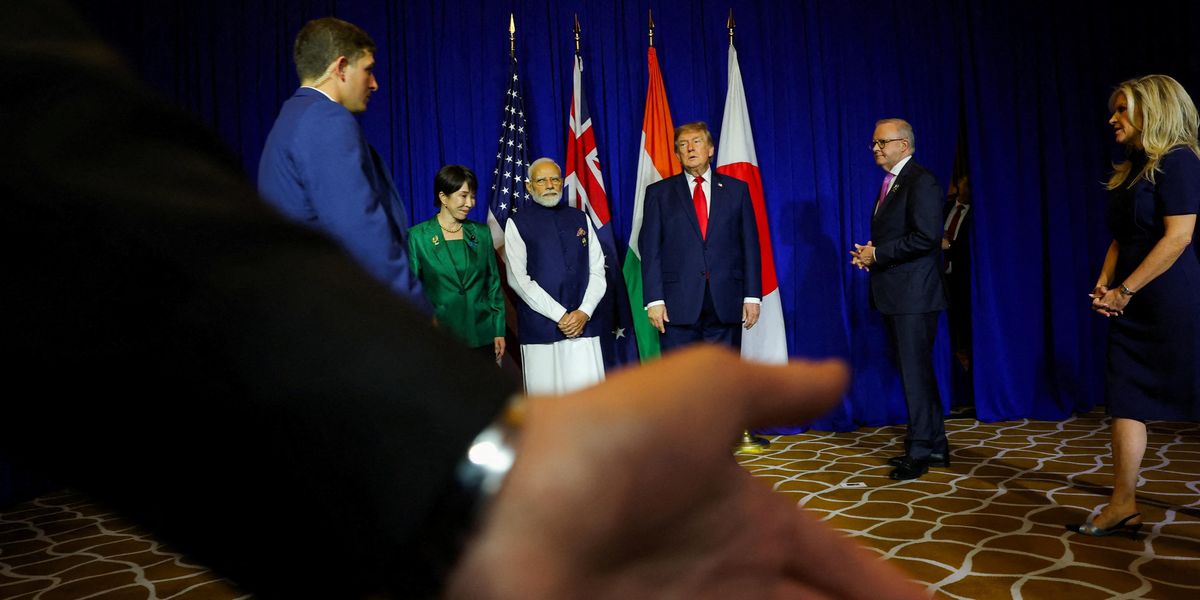
Last week the leaders of the Quad (Quadrilateral Security Dialogue )— comprised of Australia, India, Japan, and the United States — met in the Philippines for the first time in two years. President Donald Trump was in Manila for less than 24 hours with a jam-packed schedule, including his participation in the main event, which was the ASEAN Summit, as well as a bilateral engagement with President Ferdinand Marcos and the Quad summit itself. Perhaps because of this busy itinerary, the Quad was given extremely short shrift, with Trump scheduled to participate for a mere 55 minutes total.But that was only part of the problem. Since the Quad’s last summit in 2024 during President Joe Biden’s administration, the strategic bloc’s members have grown increasingly frustrated with the lack of formal meetings. India is particularly aggrieved because Trump refused to travel to New Delhi when it hosted the Quad last year. Indeed, India still believes that it is the rightful next host of the Quad, even though this year is supposed to be Australia’s turn. Trump’s decision to combine the Quad with the ASEAN summit, and to have the Philippines become the first third-party nation to host a Quad summit, has potentially caused otherwise avoidable diplomatic protocol frictions between New Delhi and Canberra. Moreover, America’s bilateral relationships with each of the Quad members has soured since Trump’s return to the White House. He has strained relations with India by imposing steep tariffs, demanding a trade deal, and resetting ties with Pakistan after Indian Prime Minister Narendra Modi declined to nominate him for the Nobel Peace Prize. Japan has faced tariffs, demands to dramatically increase defense spending, and criticism for not helping to reopen the Strait of Hormuz as part of his war against Iran. Australia has similarly faced tariffs and pressure to increase defense spending. Canberra was also kept in the dark about Washington’s decision to counter-blockade Iran, and Trump criticized its refusal to participate in his war. Meanwhile, during the summit this week, Trump, who prides himself on building personal relationships with foreign leaders, frustrated at least one of them while on stage. Trump’s decision to hold an impromptu press conference, in effect cutting further into the already short Quad time, prompted Modi to ask “Shall we move?” Both Australian Prime Minister Anthony Albanese and Japanese Prime Minister Sanae Takaichi also stood silently and looked uncomfortable while Trump took questions.Beyond the awkward atmospherics and limited time spent on Quad matters, the strategic bloc failed to achieve any meaningful policy deliverables. Perhaps the summit’s most significant security announcement concerned the Indo-Pacific Maritime Surveillance Collaboration, an initiative designed to improve maritime domain awareness and information sharing. Under the initiative, the Quad members pledged to deploy their P-8 and P-3C maritime patrol aircraft in a joint exercise in 2027. But the announcement was hardly groundbreaking and in truth is a repackaging of ongoing cooperation. Rather than conducting a standalone Quad exercise, the four nations will integrate their activities into Sea Dragon 2027, an established U.S.-led multinational anti-submarine warfare exercise in which Quad members have previously participated.Another major announcement was the launch of the Quad Business Leaders’ Forum. In truth, this is also repackaged from previous Quad initiatives. During Biden’s administration, all members in May 2022 agreed to convene a business and investment forum, and the following year, they formally launched the Quad Investors Network (QUIN) to bring together investors and executives from all four countries, leading to the Quad Investment and Technology Dialogue with then-Secretary of Commerce Gina Raimondo present. In September 2024, at the Wilmington summit, the QUIN highlighted ten strategic investments and partnerships. Similarly, the Cable Connectivity and Resilience nor Enhanced Quad Cybersecurity Cooperation initiatives simply build upon Biden-era agreements as well. Even the Super Intelligence Accelerator initiative has strong antecedents in the Biden administration, when the Quad established joint research initiatives, worked on safeguards, and pledged funding. By contrast, Trump’s AI program seems more focused on deployment, but does not specifically pledge to do anything new beyond that.Trump’s decision to fly to Shenzhen immediately after the Quad summit to meet with Russian President Vladimir Putin and Chinese President Xi Jinping — two authoritarian leaders whose governments stand in opposition to the democratic values underpinning the Quad — further reinforced the perception that he does not necessarily prioritize cooperation with U.S. allies and partners over engagement with America’s rivals. This strikes at the very heart of the Quad and is likely to cause rising anxiety.While Trump’s participation in the Quad has certainly kept it alive for now, the grouping is on life support. It is abundantly clear that he and his administration are simply rebranding past initiatives and framing them as progress, and they do not take the Quad seriously — particularly when compared to great power relationships. Trump has also made no attempt to repair strained bilateral ties with each of the members, and his personal relationships with their leaders appear to be worsening. If current trends persist over Trump’s last two years in office, the Quad is likely to become far more symbolic than substantive — an international box-checking exercise rather than a forum for policy achievements — which will only redound to the benefit of Russia and China and diminish the value of the strategic bloc to the rest of the world.
The Quad is on life support and Trump is holding the plug
Full Article
Original Source
Read the full article at Responsiblestatecraft →KhanList aggregates and links to publicly available news content. We do not host full articles from third-party sources. Always verify important information with original sources.