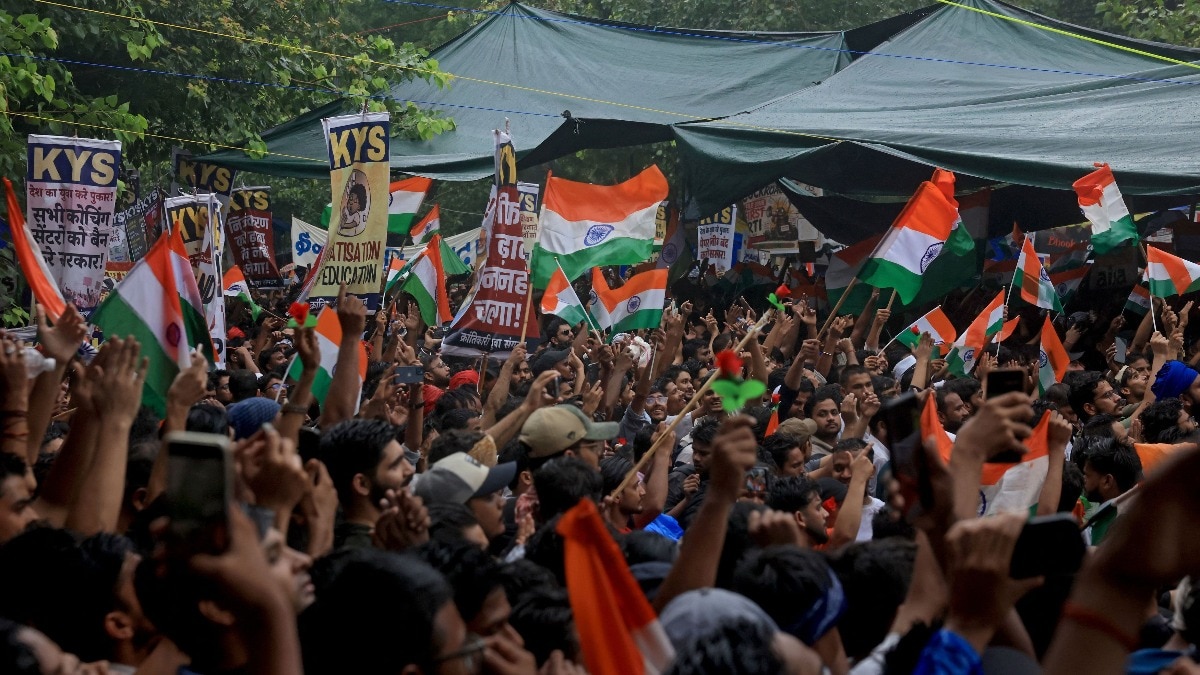
For many Gen Zers, the road to the Jantar Mantar protest began with a family argument.Many Gen Zers had to protest at home before joining the CJP march. (Photo: Reuters)Before many Gen Z protesters could make their way to Jantar Mantar for the Cockroach Janta Party (CJP) protest, they first had to stage a protest of their own - at home.Thousands of students and young people from across the country gathered in Delhi on July 20 for the CJP's Sansad Chalo march, organised to demand reforms in the education system. The day ended in chaos as police used lathicharge and tear gas to disperse protesters who had come within metres of Parliament, leaving scores from both sides injured. A glimpse of crowd from the march towards the parliament on July 20. (Photo: Reuters) The first hurdle wasn't the police barricades but worried parents. Many of them found themselves making emotional appeals and defending their decision at home to join the protest.Before heading out to "save the nation", they had to answer whether it's safe to go out where network connectivity is zero, tear gas shells are flying, lathis are raining, and whether their academics are taken care of. "I had to argue with my parents for two hours," said 19-year-old Anika Rao, a college student from a GK-1. "They kept saying 'Why do you have to go? Let others go. What if something happens? Don't you have an exam coming up?' I told them that if people like us don't participate, who will?!"Another protester, 18-year-old Rohan Kapoor, a DU student, told India Today Digital, "My father is a corporate executive. He said protests are for those who have no other options. But I have been around folks who have instilled this thought in me that silence is a choice, and a bad one. It took me explaining the issue for an hour before he agreed, with the condition that I return before dark and stay in a group," he said. "When I told my mother I was heading to Jantar Mantar for the protest, she was almost in tears. It was all, 'Why are you going?' and 'Swear on me that you won't go,' followed by a lot more emotional drama and concerns about getting serious injuries," says Vansh Rai*, a 27-year-old footwear design student from Noida."She even said, 'What if a lathi hits you on the head? It could leave you with a life-changing injury,'" he recalled. When he refused to change his mind and left for the protest anyway, his mother turned to what he jokingly calls the "ultimate weapon" - calling his father."While I was on the way, I received a threatening call from my father," he recalls. But it wasn't enough to change his plans."I understand they're worried about my safety, and the scenes were actually pretty frightening too. But with everything that's unfolding in the country, I wanted to be part of challenging it. Our education system can't be this broken. When the online movement turned into an offline protest, I didn't want to miss the chance to actually be part of trying to bring about some change," he says.Shreya Bhowmick, a 24-year-old finance professional, was not allowed to attend the protest because her parents feared a stampede or a lathicharge - both of which eventually took place. Rapid Action Force (RAF) personnel fire tear gas shells to disperse CJP supporters during the protest. (Photo: AFP) For Guneet Sharma*, a 22-year-old from Delhi, the concern at home wasn't just about physical safety. His mother was equally worried about what would happen if he was detained by the police or got entangled in legal proceedings."'What if the police detains you? What if you get caught up in court cases and litigation?' she kept asking me," he recalls. "She was convinced something would go wrong."But Guneet had already made up his mind. "I just told her, 'Jo hoga, sabke saath hoga. Dekh lenge.' (Whatever happens, we'll all face it together. We'll deal with it.)"Social media is also full of videos of youngsters negotiating, arguing, and pleading for permission to attend. While visuals from the CJP protests have taken over timelines, these pre-protest moments have become a story of their own.In one now-viral video, a father can be heard scolding his daughter, saying, "Nahi jaana toh nahi jaana" ("If I said you're not going, then you're not going"), after she expresses her wish to attend the protest. Her mother adds, "Ek nahi jayega toh kya fark pad jayega?" ("What difference will it make if one person doesn't go?").Lavanya, who goes by the Instagram username @cigarette_ki.dabbi, eventually couldn't make it to the protest. Later, she clarified that her parents' decision stemmed from concerns about her safety."I want to clarify that my father was just concerned about me and my health. He does not support any political party; he was only denying permission because of safety. So please stop spreading hate and understand a parent's POV," she later wrote in a comment.But for many, this protest-before-the-protest flopped."I feel absolutely ashamed, living so close to Delhi and not being able to attend the protest (because being financially dependent on parents means needing approval, and that I couldn't get because it's unsafe). I'll forever have this guilt," wrote Pavika Pandey, a content creator, on Instagram. Screenshot from Instagram. Expecting resistance from home, many youngsters kept their protest plans a secret. Several arrived with their faces fully covered - not just to avoid being caught on police cameras, but also to make sure their parents didn't accidentally discover they were at the protest through social media or news coverage.For many, the reason was also contrasting political ideologies.While some shared their stories through Reels on Instagram, others turned to Reddit to talk about similar battles playing out at home."Guys, my dad found out I was going to go to the 20th July protest, and he threatened to lock me in my room for the whole day," wrote one user on the r/IndianTeenagers subreddit.But this isn't something only Gen Z is dealing with. Parents being protective about their children attending protests is nothing new. Conversations with our Gen X and Millennial colleagues revealed that they, too, were met with the same resistance whenever they wanted to attend rallies or demonstrations.The issues may have changed over the years, but the conversations at home have remained more or less the same - concerns about safety, emotional persuasion, and, sometimes, a flat-out "no."Having said that, there were contrasting scenes at the protest site too. While many youngsters struggled to convince their parents to let them attend, several parents turned up at the protest themselves, and many even brought their children along.Meanwhile, the CJP has said the protest at Delhi's Jantar Mantar will continue. On Tuesday morning, protesters began gathering at the site again.As protests continue to rage, Prime Minister Narendra Modi described the alleged NEET paper leak as a "ghor paap" (grave sin), saying that 13 accused had been arrested so far. He called for strict action against those responsible and urged states to work together to prevent such leaks in the future.Congress leader Rahul Gandhi, meanwhile, condemned the police lathicharge on students during Monday's CJP protest, calling it "un-Indian". He also visited Delhi's RML Hospital to meet the injured students. Union Health Minister JP Nadda also visited the hospital to review the situation.(With inputs from Anand Singh)*Some names have been changed on request.- EndsPublished By: Medha ChawlaPublished On: Jul 21, 2026 14:31 IST
The protest before the CJP protest: Gen Z's fight for permission at home
Full Article
Original Source
Read the full article at Indiatoday →KhanList aggregates and links to publicly available news content. We do not host full articles from third-party sources. Always verify important information with original sources.