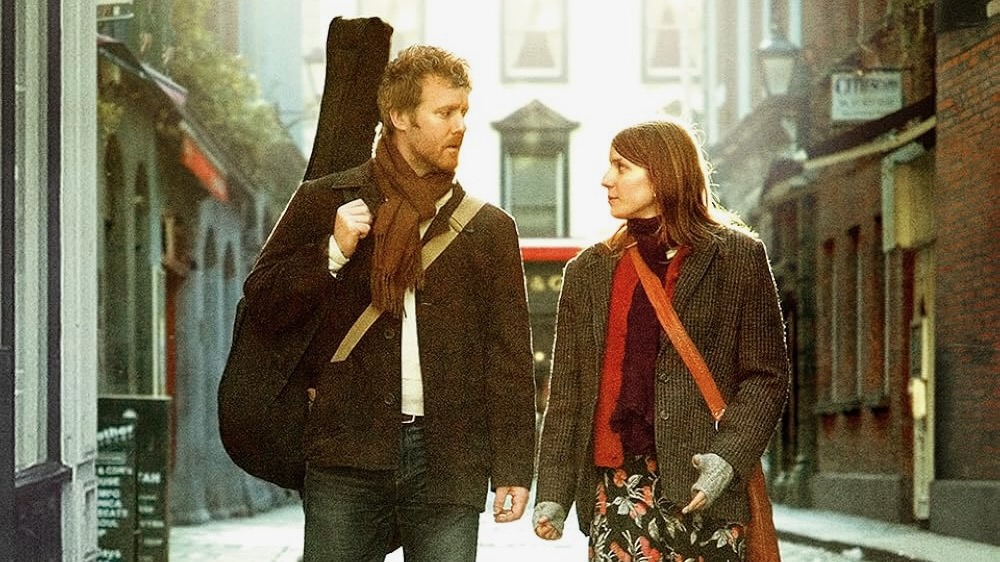
This article was originally published in 2017 for the 10th anniversary of Once (the film). It has been republished in memory of Glen Hansard, who passed away this week at the age of 56. It’s 2011, and Glen Hansard is worried. His breakout film, Once, is about to open as an Off-Broadway musical at the New York Theatre Workshop in Manhattan’s East Village. Sure, the movie brought him and his co-star Marketa Irglova a level of fame in America neither could have ever dreamed of — the duo had, at that point, played two sold-out shows as The Swell Season at Radio City Music Hall, won an Oscar, and garnered two Grammy nods — but they both, Hansard especially, were anxious about how their delicate, incredibly low-budget indie film would transfer to the stage. “What if these guys fuck up?” Hansard reminisces. “What if they turn it into some nonsense?” So one night in late autumn, Hansard decides to take the leads of the musical to his favorite Manhattan bar, an unassuming, dimly lit Irish pub on a quiet block on 5th Street called The Scratcher. He has his friends, including renowned Irish singer-songwriters Mark Geary and the late Fergus O’Farrell, meet him there as bartender Brendan O’Shea promptly locks the doors. After a few whiskeys at the bar, the musical’s co-stars, Steve Kazee and Cristin Milioti, were led to the back of the bar alongside all of the other musicians, who had readied their acoustic guitars, tambourines, and other assorted instruments and began to play. Throughout the course of each traditional or modern Irish folk song, certain musicians would join in and sing — everyone was expected to participate. After a few tunes, it was now Kazee’s turn. A self-described Irish folk superfan, Kazee, who was gearing up to play Hansard’s “Guy” character, began to strum the opening chords to Van Morrison’s classic track “Into the Mystic”. “Oh my god, I was fucking terrified!” he remembers. “It was almost like this weird hazing, but more of an indoctrination into that world. It was like, ‘Alright, if you’re going to be doing this, know the roots of it; know that this is what it’s about.’” “I remember just beaming the whole night,” Cristin Milioti adds, recalling her performance of an a capella song she had written. “It was so, so beautiful and the music was gorgeous. I remember walking out when the sun came up and feeling on top of the world.” They had passed the test. Soon after, this iteration of Once hit the stage at the New York Theatre Workshop for a critically acclaimed one-month run and was quickly moved to Broadway, where it became one of the most successful musicals in recent memory, eventually winning eight Tony Awards in 2012 and a Grammy in 2013. The musical, written by acclaimed Irish playwright Enda Walsh, gave Once, then a cult classic of sorts, a second life. Though Glen Hansard and Marketa Irglova had been playing some of the world’s most important stages for years, their music was introduced to a different audience entirely — hell, the aforementioned O’Farrell song “Gold”, an inclusion on the Once Soundtrack originally recorded by little-known Irish band Interference, was being performed onstage at the Tony Awards, complete with choreography and about a dozen voices. So, how did we get here? Hansard’s band The Frames was playing midsize rooms across America — Chicago’s Metro and New York’s Bowery Ballroom, for instance — but they surely weren’t hitting No. 7 on the Billboard Top 200 Albums Chart like the Once Soundtrack did on March 15, 2008. To understand the Once phenomenon, we need to dig deep in the film’s origin story, which now dates back a full 10 years since its release. It’s a narrative as absurd as it is unlikely; a low-res, quickly shot, extremely independent Irish film that only hit dozens of art house movie theaters became ingrained in American popular culture on the backs of two extremely talented musicians with little to no acting experience and a director who never gave up. “I’ve got it!” screamed John Carney as he ran down the stairs of his house in Dublin toward his girlfriend in 2005. Carney, then a struggling filmmaker a few years removed from On the Edge (one of Cillian Murphy’s first movies), felt as if he’d finally cracked something, though it was unknown what that was. “It was one of those moments with this script,” he says over the phone. “With this idea, with this story, I felt like I had finally managed to crack a story that would have universal appeal no matter which way you did it.” That original screenplay was simply a page-long outline of the story, beginning with a musician meeting a woman on Dublin’s Grafton Street, a pedestrian walkway famous for its many busking artists, and ending with the unnamed female character receiving a piano at the end. The film was set to star Cillian Murphy, fresh off of his portrayal of Scarecrow in Christopher Nolan’s Batman Begins, and would include Glen Hansard and Damien Rice (among others) as its musical advisors, helping Carney develop the busker character while also writing new songs for the soundtrack.
The Oral History of Once
Full Article
Original Source
Read the full article at Consequence →KhanList aggregates and links to publicly available news content. We do not host full articles from third-party sources. Always verify important information with original sources.