
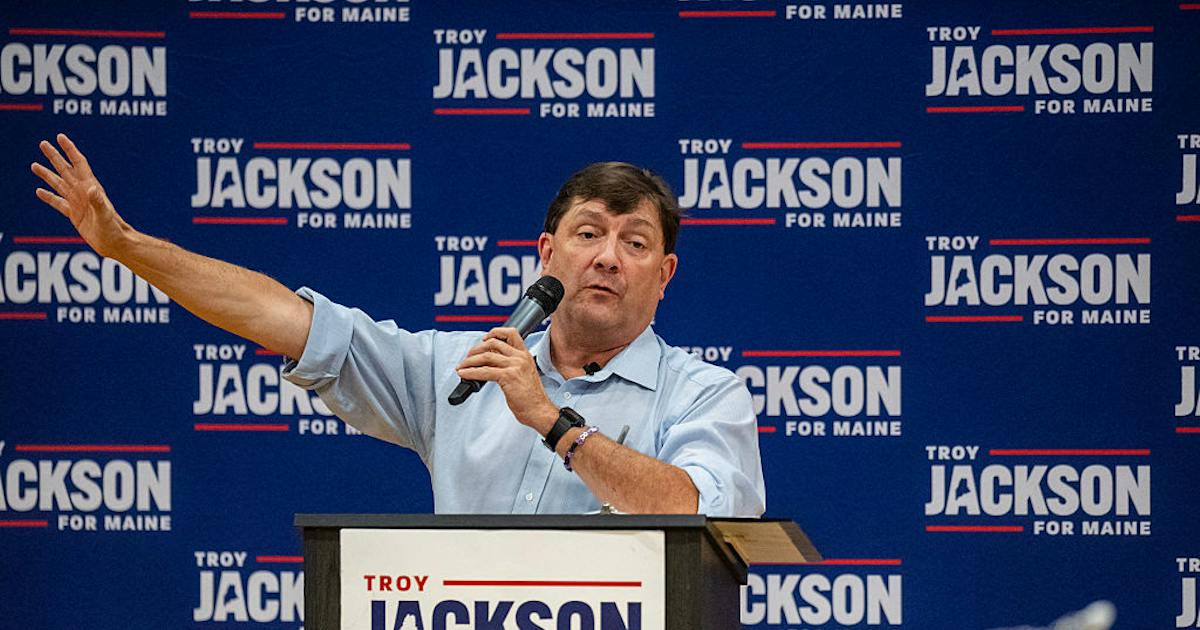
You’re reading The TNR Blue Book. Get daily scoops, strategy, and developments inside the liberal ideas factory delivered right to your inbox. Sign up for free.Inside WashingtonThe new “hot” issue: Home heating bills spiking due to the Iran warAs autumn begins and temperatures start to dip across the Northeast, many Americans who rely on heating oil to warm their homes are facing massive price increases due to the war in Iran. Democrats have started talking about utility costs on the campaign trail, and voters facing a cold and expensive winter seem to be listening.Some of the cycle’s most watched elections are in states where heating oil keeps houses warm in the wintertime: Maine, Alaska, and Pennsylvania. Democratic candidates in these states are already running on the high cost of heating as winter approaches. On Tuesday, the House Majority PAC released an ad slamming Paul LePage, the Republican candidate running against Democrat Matt Dunlap in Maine’s 2nd congressional district. “LePage supports a foreign war that’s sending gas and oil prices in Maine through the roof,” the ad says.Dunlap hammered that point in a statement to The New Republic, writing that “Mainers are already being forced to choose between heating their homes, buying groceries, and paying for health care.” Meanwhile, he said, “Paul LePage supports the Iran war that’s raising prices and refuses to challenge his party bosses in Washington.”Maine Senate candidate Troy Jackson’s campaign tied heating oil prices to Senator Susan Collins in a statement to The New Republic: “Susan Collins has spent decades selling out Mainers by supporting an agenda that raises their energy costs, dismantling programs aimed at lowering prices, signing off on Trump’s war that’s jacking up the cost of heating oil as Mainers schedule their tank fill-ups for winter,” said campaign spokesperson Cheyenne Gallivan.In Alaska, Senate candidate Mary Peltola echoed that sentiment, releasing a statement tying her opponent to the cost of home heating. “A dozen times Dan Sullivan has voted to continue the war in Iran. A dozen times Dan Sullivan has voted to jack up our prices. Sullivan’s fuel price hikes affect everyone—from our smallest fishing boat in the ocean, to families heating their homes through winter,” the statement reads.Earlier this month, the price of oil topped $100 per barrel for the first time since July, and estimates from the National Energy Assistance Directors Association, or NEADA, project that U.S. households will spend on average nearly 9 percent more than last year—an extra $82—to heat their homes this winter. The figure is even higher for households that rely on heating oil, though; NEADA estimates that households using heating oil could pay $707 more than they did last winter to stay warm.In New York, the cost of heating oil has shot up 66 percent from last year’s price. Across the Northeast, some homeowners are already making tough decisions about how they plan to heat their homes. Experts stressed that utility costs have already been higher than usual, and the Iran war has only added to that burden.The increased cost of energy comes as the war in Iran nears its seven-month mark. This week, Senate Democrats are planning to push another vote curbing Trump’s war-making power to the floor, hoping to get Republicans on record in their support for the expensive and devastating conflict. In previous war powers votes, Republican Senators Susan Collins of Maine, Lisa Murkowski of Alaska, and Rand Paul of Kentucky have voted with Democrats to oppose the war. Retiring Senator Thom Tillis of North Carolina has said that he would support the resolution this time, after voting against it previously.Aside from trying to halt the war in Iran, some Democrats are pushing to strengthen energy assistance programs that help the lowest-income and most vulnerable Americans, like the Low Income Home Energy Assistance Program, or LIHEAP. “Last year was Vermont’s coldest winter in almost two decades, and the weather will only continue to get more extreme—in red and blue states alike,” said Vermont Senator Peter Welch. “Yet the Trump administration has threatened to eliminate LIHEAP—not just once, but six times.” On Thursday, Senator Kirsten Gillibrand of New York sent a letter to RFK Jr. requesting that the Department of Health and Human Services release LIHEAP funding to the states earlier, “in light of the alarming rise in global oil prices prompted by this administration’s war in Iran.”In the early days of the Trump administration, DOGE fired the entire staff responsible for LIHEAP. “Making sure that there is a federal workforce that is able to administer the LIHEAP program and release the funds at least on time is definitely super important,” said Rachel Jacobson, the lead researcher on state climate policy at the Center on Budget and Policy Priorities. Meanwhile, she explained, states could put into place moratoria on utility shutoffs, preventing utilities from cutting off energy to residents who can’t afford it during the coldest months of the year.While it could be an expensive winter for some in the Northeast and beyond, Sandeep Vaheesan, legal director at the Open Markets Institute, cautiously suggested there could be a bright side. “One sort of positive feature of the moment is energy costs have been politicized,” he said. “Will the public and political interest be sustained and be enough to activate elected officials? I don’t think the affordability crisis is going away, so I’m cautiously optimistic.”—Emma JanssenOutside WashingtonReaction continues to ProPublica’s blockbuster report published Tuesday morning. GOP Senator Susan Collins of Maine, the ProPublica team revealed, was being investigated by the FBI over surprisingly detailed and specific pay-to-play allegations when the Trump administration gutted the anti-corruption arm of the Justice Department, shuttering an investigation that was rapidly widening to include other members of Congress. Democrat Troy Jackson, who faces Collins in November, quickly issued a statement Tuesday calling Collins’s actions “corruption of the highest order” and saying that Maine residents “deserve answers.” Collins’s team, meanwhile, has called the ProPublica story “categorically false.” The final line of ProPublica’s Tuesday piece implicated another senator, as well: the late Lindsey Graham. As of Wednesday morning there has been no reaction from the campaign of Darline Graham Nordone—Graham’s sister, appointed to replace him, who is now defending the seat against Democratic challenger Annie Andrews. At Spotlight PA, Stephen Caruso lays out possible scenarios for Democrats to flip Pennsylvania’s state Senate, after decades of GOP control. “Pennsylvania Democrats have their best shot in recent memory,” writes Caruso, “at winning a vaunted trifecta—meaning control of the governorship and both legislative chambers.” Democrats Eileen Hartnett Albillar, Mark Pinsley, Chris Thomas, and Brian Wrightson are challenging Republican incumbents in the 6th, 16th, 24th, and 40th districts, respectively, and the limited polling available suggests some of these may be close. “The latter two races,” Caruso notes, “have been defined by the ongoing data center debate.”—Heather Souvaine HornThe Ideas FactoryOpen Markets Institute isn’t loving the Paramount–Warner Bros. merger settlement, in which Paramount agreed to various niceties in exchange for state attorneys general dropping the suit to block the company’s acquisition of Warner Bros. “It is increasingly obvious,” OMI executive director Barry Lynn said in an aggressive statement on the organization’s website, “that many top political leaders and officials are either beholden to corporate monopolies, or feel unable to stand up to their power.” Lynn singles out California Governor Gavin Newsom, Democratic gubernatorial nominee Xavier Becerra, and Los Angeles Mayor Karen Bass for particular censure, alleging they pressured California Attorney General Rob Bonta to settle. As is traditional ahead of state visits like the one Washington will see this week, several think tanks and outlets have published ideas and recommendations for better U.S.-China relations in the lead-up to Chinese President Xi Jinping’s White House visit on Thursday. Here’s a particularly interesting one: At the Carnegie Endowment for International Peace, visiting researcher Lucy Luo last week tackled the question of what an AI crisis “hotline”—as some have recommended to deal with the risk of rogue AI agents—would need to look like in order to be effective. Prior U.S.-China hotlines “repeatedly failed in moments of need,” Luo notes. For this one to work, she writes, it should be text-based, would need to “establish different lines for routine communication and emergencies,” as well as “thresholds” for hotline use, and would need to “design for AI.” Have a read.—Heather Souvaine HornIn ClosingPolitical Trivia Question of the DayTrump’s threat to “annihilate” Iran brings to mind the 1953 CIA-backed coup that installed the Shah (who in turn was deposed in 1979 by the revolution that ushered in the current government). Who was the CIA operative long credited with orchestrating the coup? (Sign up for The TNR Blue Book to find the answer in tomorrow’s newsletter.)—Michael TomaskyYou’re reading The TNR Blue Book. Get daily scoops, strategy, and developments inside the liberal ideas factory delivered right to your inbox. Sign up for free.Inside WashingtonHow do you stop election tampering before it happens?A potential crisis was averted last week when the Supreme Court blocked President Trump’s plan to restrict mail-in voting. But election integrity experts and lawmakers are still lying awake at night worrying about threats on the ground: physical intimidation at polling places, ballots seized, and postelection insurrection.On Friday, a coalition led by the NAACP filed a lawsuit asking for a court order to prevent the Trump administration from deploying federal agents to the polls “in a manner that unlawfully intimidates voters or anyone urging or aiding voters.” The coalition, which includes a number of labor unions, is concerned that Immigration and Customs Enforcement or National Guard presence at the polls could discourage naturalized citizens or Hispanic voters from voting.But that’s not the only scenario worrying people. “We have no idea what Trump will do next because his entire presidency this time and last time has been totally unpredictable and chaotic,” said Jane Kleeb, the vice chair of the Democratic National Committee and president of the Association of State Democratic Committees, or ASDC. “What I am really worried about is the possibility of a law enforcement warrant to seize election materials and ballots,” said Shelby Wayment, a staff attorney at UCLA Law’s Safeguarding Democracy Project. The group recently released a guide for judges if they do receive a request for a warrant to seize election materials. The government has attempted to do similar seizures before—the FBI seized 2020 voting records in Fulton County, Georgia, and the Department of Justice has attempted to get warrants for 2024 voting records in Wayne County, Michigan.Wayment is particularly concerned that this could happen in states like California (where tabulating the vote notoriously takes a long time) or in counties that are critical to determining who ultimately takes control of the House. “If the chain of custody is disrupted” by having ballots seized, Wayment explained, “you don’t really have clear evidence of who has handled those ballots, where those have been.” Even though Trump’s plan to restrict mail-in ballots was blocked, advocates are looking at other aspects of the March executive order that established that plan. In that same executive order, Trump instructed the federal government to create lists of citizens in each state and send the lists to the state election officials. The idea behind the citizenship lists, explained Aria Branch of Elias Law Group, would be to force states to purge voters who aren’t on those lists, no matter that the lists could be incorrect. Litigation is ongoing to prevent this, but Branch is still concerned. “I don’t think that we are out of the woods on that issue at all,” she said.Democratic lawmakers, election officials, and civil society groups have been collaborating in the lead-up to November. On September 14, the ASDC launched the New Battlefield Project to protect the midterms across all 50 states. The project is threefold—training up to 10,000 volunteers to be poll watchers, pushing voters to vote as early as possible, and establishing the Democracy Defense Network, a group of analysts who monitor election disinformation and scare tactics and inform state parties about what they’re seeing.“What keeps me up at night is the idea that all of the insurrectionists [Trump] pardoned would be summoned to get their buddies and go outside of polling locations and drop-box locations to intimidate voters,” said Kleeb. To counteract that threat, the ASDC will train volunteers to show up at polling places and peacefully observe, gathering any information necessary for lawsuits if something goes wrong. The New Battlefield Project is also funding “Election Protection Directors” in 20 states that didn’t have the resources to hire anyone for the role. These directors will coordinate with the DNC if anything goes awry in their state’s elections, assemble teams of lawyers, and help coordinate the poll-watching volunteers.Last week, Representatives Analilia Mejia, Emanuel Cleaver, Emily Randall, and Suhas Subramanyam introduced a resolution affirming the House’s commitment to enforcing the Fourteenth and Fifteenth Amendments and protecting voting rights. “Congress must act before the next election is upon us,” Mejia wrote in a statement to The New Republic. She pointed to the John R. Lewis Voting Rights Act, though that legislation is unlikely to be passed anytime soon. “Congress has a constitutional responsibility to oversee elections, and we are derelict in our duties,” Mejia said.Her co-sponsor, Subramanyam, is looking ahead to what could happen after the election. “I’m concerned that after the election, when Democrats win the majority, at least in the House, the president will call into question the results of the election and try to make that a mainstream Republican viewpoint,” he told The New Republic. He worries that there could be another January 6–style insurrection. If that happens, he explained, “certainly we’ll appeal to the courts to make sure that they implement the results of any election.” But if Republicans and the administration don’t back down, he said, “people will need to take to the streets.” Branch agrees that November 3 won’t be the end of things. “Election Day is sort of the beginning of this,” she said. “We also have to get the election certified, and then we have to get our members seated.”—Emma JanssenOutside WashingtonPlaying with fire: “Only eight of 160 utility companies that operate in fire-prone areas of Texas” have complied so far with a 2025 law requiring them to submit wildfire mitigation plans, The Texas Tribune reports. GOP state Representative Ken King, who spearheaded the 2025 law, is displeased. But there’s some interesting context to this news item that might not be immediately apparent to readers outside the state.Focusing on electrical utilities has been a relatively popular GOP response to wildfires in recent years. GOP Senate candidate Ken Paxton, for example, as state attorney general, sued the electrical company believed to be responsible for the Smokehouse Creek fire. Any talk of how climate change is increasing wildfire risk, by contrast, is off the agenda. (Bizarrely, Paxton actually suggested ESG—a.k.a. “environmental, social, and governance” business practices—might have led to the fires.) The 2025 wildfire mitigation law known as H.B. 145, though, was actually one of a trio of laws passed in response to the deadly 2024 Panhandle wildfires. The other fires burning around the time of the Smokehouse Creek fire are believed to have been caused not by a utility company but by private lines supplying an oil field. Accordingly, H.B. 143 and 144, which King also spearheaded, gave the state (especially via the Texas Railroad Commission, which regulates the oil industry) more regulatory oversight over oil and gas field electrical equipment. Anything involving the oil industry in Texas is, obviously, a little more politically sensitive. (Even King in 2024 prefaced these proposals by telling the Tribune he would “never do anything to damage the oil and gas industry in our state.”) Right now, fossil fuels are a white-hot issue in the fight for Texas’s vital Senate seat. Paxton, a lifelong fossil fuel champion, has accused Democrat James Talarico of having “dedicated his career to trying to destroy the oil and gas industry.” Talarico, who has previously backed emissions-reductions targets and whose campaign materials cite wildfires as one of the dangers associated with climate change, has taken pains in recent weeks to emphasize his support for a fossil fuel–inclusive, “all of the above” energy policy (a position that gives climate activists nightmares).Meanwhile, the race for a spot on the body newly tasked with inspecting oil field electrical equipment—the Texas Railroad Commission—has garnered national attention, after Republican candidate Bo French’s racist tweets prompted “shocked, shocked!” responses from state Republicans who cannot possibly have been surprised by this. Karl Rove even took to The Wall Street Journal to declare his allegiance to Democrat Jon Rosenthal instead.Elsewhere:Record diesel prices are hammering the agriculture and trucking industries. NPR talks to fourth-generation farmer John Boyd Jr. in Virginia, and highlights the plight of Black farmers at risk of losing their farms. MPR News in Minnesota features the perspective of truckers who may “fill up 200 to 240 gallons at a time”—an act that now costs “more than $1,200.” Republicans are getting visibly nervous, and have proposed a diesel export ban and more.—Heather Souvaine HornThe Ideas FactoryWednesday at 5 p.m., the Brookings Institution, America’s Rural Future, West Virginia University’s Reed School of Media and Communications, and the American Enterprise Institute co-host an event at West Virginia University about the loss of local news and its impact on rural communities. Speakers include Mayor Amy Shuler Goodwin of Charleston, West Virginia, and Rebuild Local News director of policy Matt Pearce.Tuesday at 11 a.m., the Center for American Progress hosts a conversation with Senator Tammy Duckworth on “the evolving challenges posed by the People’s Republic of China, as well as opportunities for strategic engagement within the bilateral relationship.” CAP senior vice president Damian Murphy will offer opening remarks, and senior fellow Jonathan Fritz will join Duckworth onstage for the discussion.In case you missed it: The Progressive Policy Institute last week released an intriguing report profiling Democratic candidates who have succeeded in working-class districts. A rather pointed quote from the interview Robin Johnson, the report’s co-author, did with Vox for the release: The successful candidates, Johnson said, “are from a variety of backgrounds … and we want to contrast that with the consultants who tried to make the perfect Frankenstein candidate out of [former Maine Senate candidate Graham] Platner. These people are out there—you don’t need to create it. They’re out there.”—Heather Souvaine HornIn Closing: Four Questions ForDustin Gouker, journalist covering gambling and prediction marketsQ: Who are you, and what are you working on right now?A: I am a longtime journalist who currently self-publishes two newsletters: The Closing Line, which focuses on gambling, and The Event Horizon, which focuses on prediction markets. I am trying to figure what’s next for prediction markets and for me. It’s easy not to look past the next newsletter, given the aggressive news cycles these days.Q: What is the most common misconception you regularly see about how prediction markets operate?A: I think too many people see prediction markets as a binary thing that is good or bad, and gambling or not gambling. There is a lot of good in prediction markets, but it’s accompanied by some nonsense. And while betting parlays and sports sides are pretty clearly gambling, there are markets that are legitimately useful from a price discovery and economic value standpoint. I don’t think prediction markets should be pigeonholed.Q: Is internal enforcement enough for keeping prediction markets in check, or would you like to see more regulation?A: I am afraid of what will happen if there’s not more regulation of prediction markets. Don’t get me wrong, there is definitely regulation, and much of it is good. But some of that regulation doesn’t treat prediction markets as gambling products, and I don’t think there are enough guardrails in some areas.Q: What keeps you going in these stressful times?A: I have always been a writer, and the task of writing and publishing two newsletters pretty much every day is something I can fall back on. I am blessed that I get to work for myself and do something I love and that other people value.Interview by Grace SegersPolitical Trivia Question of the DaySince it’s U.N. week, a rare question on international rather than U.S. politics. The first two secretaries-general of the U.N. were both from Scandinavia. Can you name them and the countries they came from? (Sign up for The TNR Blue Book to find the answer in tomorrow’s newsletter.)You’re reading The TNR Blue Book. Get daily scoops, strategy, and developments inside the liberal ideas factory delivered right to your inbox. Sign up for free.Inside WashingtonThe surprising issue dividing Senate Dems right nowWhile Americans worry about sky-high gas prices and AI safety, the Senate has its sights trained on something entirely different—the world of college sports. Though it might seem like an odd focus for the upper chamber in the last few weeks before the October recess, a bill is sparking substantive disagreements over antitrust policy, racial justice in sports, and workers’ rights. The bill dividing Democrats is the Protect College Sports Act, which the Senate voted to advance on Thursday. The bill attempts to regulate the lucrative world of college sports by setting a cap on payments to athletes, placing a five-year limit on playing eligibility, and giving the National Collegiate Athletic Association, or NCAA, an antitrust exemption. Supporters of the bill say that it will bring order to the world of college sports, setting rules on how athletes can use the transfer portal, stopping a “spending spiral” by schools, and putting an end to lawsuits on these issues.The bill easily passed the vote to consider it, with 77 votes for it and just 22 against it; 19 Senate Democrats voted against the bill alongside three Republicans, moving them closer to a final vote on the legislation. “I think the bill is necessary, and it’s not a perfect bill,” said Michigan Senator Gary Peters, who voted for it. “I don’t think we’d ever be able to come up with a perfect bill.”Senator Chris Coons of Delaware, an outspoken Democratic supporter of the bill, agreed that the bill does more good than harm. “On balance, this is a compromise that secures a lot of significant benefits and protections for college athletes,” he told The New Republic on Thursday. When asked what he thought about his colleagues who were concerned about the antitrust exemption, he mumbled wryly: “Good for them.”Anti-monopoly advocates worry that the antitrust exemption takes power away from student athletes, who in recent years have benefited from competition between schools trying to woo them onto their teams with cash deals. In 2025, the settlement of a 2020 lawsuit gave Division I schools the right to pay players directly. But before student athletes gained the right to make money from their work on the court or field, coaches and athletic directors took home the most cash. “The players were getting pennies on the dollar,” said Sandeep Vaheesan, the legal director at the anti-monopoly organization Open Markets Institute. “Even though they were the ones really generating all this money.” Vaheesan, along with lawmakers like Senator Chris Murphy of Connecticut, are concerned that this legislation could reverse these recent financial wins for student athletes. “I think we’re going to rue the day we gave an antitrust exemption this big to the colleges,” Murphy said. “It’s going to result in a huge cost increase for consumers and for folks who follow college sports on TV.”Asked why he thought the bill was passing with the support of some of his fellow Senate Democrats, Murphy said: “The Power Five schools have a lot of influence. They’ve spent millions and millions of dollars on lobbying.”Coons argued that the bill isn’t too deferential to the interests of colleges. “They did not get the definition of college athletes as never being employees, which was one of the top asks of the conferences and colleges,” he said. “That was a concession to those of us who are strong supporters of organized labor and want to retain the possibility to organize.”Meanwhile, all five of the Senate’s Black members—Republican Tim Scott and Democrats Cory Booker, Raphael Warnock, Lisa Blunt Rochester, and Angela Alsobrooks—opposed the bill. The NAACP’s president and chief executive strongly opposes the legislation. “Sharecropping is over,” he said on a media call this week. “We should not ask athletes, particularly Black athletes, to generate revenue on the football field or basketball court and then share in none of the revenue.”“It does raise concerns about how committed members of the Senate, including Senate Democrats, are to the well-being and welfare of workers,” Vaheesan said.—Emma JanssenOutside WashingtonSurging gas prices are dominating headlines this week, particularly across the Midwest. In Michigan, gas prices jumped 22 cents from Wednesday to Thursday, drawing worryingly close to $5 a gallon, with further hikes predicted. (Average prices in Minnesota rose 14 cents in the same 24-hour period. In Cincinnati, Ohio, prices jumped 25 cents overnight between Tuesday and Wednesday.) At the Detroit Free Press on Thursday, Frank Witsil reported new calculations from Brown University professor Jeff Colgan estimating that since the start of Trump’s war on Iran, American households have paid on average $826 more on gas than they would have without the conflict. Susan Tompor of the same paper reported a troubling new trend of free gas and free groceries scams. “This summer,” writes Tompor, “the Better Business Bureau Scam Tracker page received reports from consumers who complained that they received postcards claiming they qualified for valuable gas and grocery gift cards and vouchers,” from the mysteriously named “AAPP”—which can look like “AARP” if people are reading quickly. Those who followed the instructions “complained that they lost money once they paid a $5 processing fee. Some consumers saw additional unauthorized charges of $46 or more being taken out of their accounts.” Analysts predict that prices will remain high for months to come—with record diesel prices rapidly affecting the rest of the economy via their impact on trucking and farming.In case you missed it: Arizona Republicans are pushing ahead with subpoenas for Governor Katie Hobbs, state Attorney General Kris Mayes, their staff, and others over events from 2022 that The Arizona Republic first reported in 2024. Specifically: The state’s Department of Child Safety, per Axios reporter Jeremy Duda’s retelling of the somewhat tangled tale, “granted a previously rejected rate hike to Sunshine Residential Homes after the group home provider gave $400,000 to Hobbs’s inauguration fund and the Arizona Democratic Party.” Mayes’s office concluded a two-year investigation last month finding no “evidence of the necessary quid pro quo to support a bribery charge,” per the final memo. But GOP State Senator Jake Hoffman says the investigation was phony and incomplete, and now the hearing at which Hobbs and others will be compelled to testify is scheduled, Duda reports, for “eight days before early voting begins and five weeks before the election.” Hobbs and her running mate, former GOP Mesa Mayor John Giles, have consistently led Republicans Andy Biggs and running mate Sine Kerr in recent polls, but the margins have varied widely from poll to poll. While the Cook Political Report moved the race from “toss-up” to “lean Democrat” in July, their race summary still rates Hobbs “the most endangered Democratic incumbent.”—Heather Souvaine HornThe Ideas FactoryThe Center for Biological Diversity is suing the Trump administration “for withholding public records detailing the efforts of politically appointed industry insiders at the Environmental Protection Agency to reapprove the dangerous, drift-prone pesticide dicamba,” according to the org’s press release. Dicamba is typically applied to crops that have been genetically modified to resist it, so that it kills the weeds but not the crops. But it also has a habit of “drifting” from its initial area of application and killing other crops, as well as wildlife. Plus it’s repeatedly been linked to increased risk of cancer in humans. “If you’ve done nothing wrong, then you have no reason to withhold public documents,” CBD’s environmental health science director Nathan Donley said in the press release. CBD was also part of a coalition of groups that sued the Trump administration in February, challenging the initial reapproval.Friday at 1 p.m., a webcast at the Center for Strategic and International Studies asks: “Is U.S. Economic Diplomacy Up to Speed?” The question may feel bleakly comical against the backdrop of Trump tariffs, the economic shocks of the Iran war, and speculation that Canada might join the EU just to piss Trump off. But Enoh T. Ebong, Allison Lombardo, and Jonathan Gandomi, according to CSIS’s event summary, will focus on a broader, more process-oriented issue: whether the State Department is ready to participate in a new era of negotiations over “critical minerals supply chains … technology standards,” and more. “While the State Department’s role has expanded significantly,” the organization’s event summary states, “its internal structures have not kept pace, leaving expertise fragmented across nearly 20 agencies without strong coordination.”—Heather Souvaine HornIn ClosingGood Week/Bad WeekGood Week: MacklemoreSure, the middling rapper got booted from his supporting slot on Ed Sheeran’s tour because of his pro-Palestinian statement during a performance at New Jersey’s MetLife Stadium—that’s bad news for him financially. But his righteous stance is being applauded worldwide, and other Sheeran opening acts followed suit. Plus, when was the last time everyone was talking about Macklemore? (Never.)Bad Week: Ed SheeranWe knew his music was an abomination. Now we know that his politics are too. Booting an artist from your tour because he said “Free Palestine” does not make you “apolitical”; it makes you an explicit opponent of Palestine’s self-determination, and a craven lickspittle of the corporate entertainment complex.—Ryan KearneyPolitical Trivia Question of the DayWith Texas on our minds: Three speakers of the House in the twentieth century, all Democrats, hailed from Texas. Who were they? One is really hard—he was speaker for just one term. One was speaker for nearly two decades. The third’s tenure ended in (ginned-up) scandal. (Sign up for The TNR Blue Book to find the answer in Tuesday’s newsletter.)You’re reading The TNR Blue Book. Get daily scoops, strategy, and developments inside the liberal ideas factory delivered right to your inbox. Sign up for free.Inside WashingtonThe issue pitting Senate Dems against some Democratic candidatesSenate Democrats lost a battle on Tuesday when the Senate Ag Committee voted to advance the GOP’s proposed Farm Bill without the SNAP protections Democrats have been pushing for. But while sitting Dems might be frustrated, a different group might be breathing a sigh of relief: For Democratic and independent candidates in agriculture-heavy states, this means their Republican opponents might stop hitting them over the Farm Bill. Wednesday’s committee meeting came after the committee failed to advance the legislation to the Senate in August. Democrats have been withholding votes from the once-bipartisan bill in an effort to delay rollbacks to SNAP that were set in last year’s One Big Beautiful Bill Act, or OBBBA. OBBBA’s policy forcing states to pay more for the administrative costs of SNAP takes effect October 1 of this year. Another measure, which forces states to pay for more of the cost of SNAP benefits based on their error rates, will take effect on October 1, 2027.Experts say these policies are already hurting states and SNAP recipients. Five million Americans have lost access to SNAP since OBBBA was signed last July, according to the Center on Budget and Policy Priorities, or CBPP. “We’ve been seeing some states taking some pretty extreme steps to try to lower their error rates very quickly,” said Katie Bergh, a senior policy analyst at the CBPP, “and those steps are making it much harder for eligible families to access the help they need to afford groceries.”Senate Democrats have pushed for an extension, to allow states to take more time to fix their error rates and prepare to pay more for the program. In August, committee Chairman Senator John Boozman gave Democrats part of what they wanted—a one-year extension of the error-rate change. But Dems say that’s not enough and that it comes with a poisonous addition that would actually raise some states’ SNAP costs in 2031. Jonathan Coppess, a professor of ag policy at the University of Illinois and former federal agriculture official, said that Boozman’s concession on the error rate shows that even some Republicans think the SNAP cuts are bad policy. “It certainly is some recognition by the committee that there’s a problem with what they enacted last year” in the OBBBA, he said.While Democrats on the Senate Ag Committee are united in their opposition to this version of the Farm Bill, not every Democrat wants to see them blocking the legislation. In Iowa, for example, Republican House and Senate candidates have been hitting Democrats on their resistance to the Farm Bill. GOP Representative Zach Nunn, who is running against State Senator Sarah Trone Garriott in Iowa’s 3rd congressional district, complained about “partisan games” this week and said that “it is completely unacceptable to hold the Farm Bill hostage.”After the bill failed to pass committee in August, Josh Turek, the Democratic Senate candidate in Iowa, posted on X that “Democrats in the Senate failed [Iowa farmers] by letting perfect be the enemy of the good.” He promised that, if elected, he would pass the Farm Bill. Dan Osborn, an independent running for Senate in Nebraska, told The New Republic in a statement that he would vote for the bill if elected. “Senate Democrats are hurting everyone, especially our farmers, by holding up the Farm Bill,” he said. “As always, they’re looking past the middle of the country, working only for the coasts, and using Nebraskans’ lives as a political football.”Bergh, however, pushed back against the common trope of farmers versus SNAP recipients. “We hear a lot from farm state lawmakers about how a Farm Bill needs to deliver for rural America, but SNAP is how about one in seven rural households put food on the table,” she said. “Their needs should really be front and center in a Farm Bill conversation.”—Emma JanssenOutside WashingtonMost of the backlash against data centers has focused on energy and water consumption, as well as noise and water pollution. But now there’s another reason to worry: The data center boom “will create a ‘tsunami’ of discarded electronics, putting the world on a course to triple its annual generation of toxic e-waste in the next 25 years,” and could “fill enough shipping containers to encircle the globe six times,” The Guardian reports. E-waste “typically contains toxics like lead, mercury, cadmium and forever chemicals, as well as valuable metals that are challenging to reclaim,” the paper’s Erin McCormick writes. The predictions about data centers turbocharging the e-waste problem come from a new report by environmental group Basel Action Network.“The average Maine household has paid an average of $4,300 more for goods and services since President Donald Trump began his second term,” the Maine Morning Star announces, based on recent analysis from the Maine Center for Economic Policy. Susan Collins probably isn’t thrilled with this headline. The long-standing GOP senator, currently polling a couple points behind Democrat Troy Jackson, has been trying to distance herself from the president in recent weeks.—Heather Souvaine HornThe Ideas FactoryAt the Center for American Progress, Weadé James, Paige Shoemaker DeMio, and Olivia O’Connell release a report on “5 Evidence-Based Strategies to Improve U.S. K-12 Math Achievement,” following news that international tests show America’s 2025 average math score at an “all-time low,” significantly lagging behind those of other rich countries. The report emphasizes standard-setting, “high-quality instructional materials,” and investments in “teacher preparation,” alongside other recommendations. The authors also point to Massachusetts and Alabama as examples of states that have implemented policies significantly boosting average test scores.As home insurance costs continue to rise, Public Citizen releases the results of a survey sent to state and territorial insurance commissioners: “Only 28 percent of responding offices said they support publication of homeowners insurance data at the ZIP-code level,” the watchdog reports. The reason this data is important, Public Citizen’s press release suggests, is in part to be able to figure out how much of the increase in prices is being driven by the climate crisis, and how much is being driven by profiteering and “regulatory capture.”—Heather Souvaine HornIn ClosingPolitical Trivia Question of the DayOn the subject of stupid things said by vice presidents: What fairly recent vice president once said, “If we don’t succeed, we run the risk of failure,” and famously misspelled potato on a school visit? (Sign up for The TNR Blue Book to find the answer in tomorrow’s newsletter.)You’re reading The TNR Blue Book. Get daily scoops, strategy, and developments inside the liberal ideas factory delivered right to your inbox. Sign up for free.Inside WashingtonThe conversation around regulating artificial intelligence has rapidly become so wide-reaching that on Tuesday, Bernie Sanders, Steve Bannon, and Ashley Judd all wound up at the same conference dedicated to tackling the technology’s risks. But while the event showed that there’s a real hunger to take on AI oligarchs, it’s still not clear how that will translate into concrete action.The “Pro-Human Assembly,” hosted by the nonprofit Future of Life Institute at the Marriott Marquis in downtown Washington, D.C., brought together AI industry researchers, policymakers, and civil society organization leaders in a particularly fraught moment, following a week of dire warnings about AI risks and alarming disclosures about recent safety incidents.House members’ short speeches opening the conference illustrated just how divided Congress is on the right approach to regulating AI. Representative Greg Casar delivered the most stirring remarks, garnering multiple rounds of applause. “The answer is simple,” he said of the solution to AI threats. “We ban AI systems that are too powerful for humans to control.” The room applauded vigorously. That comment previewed legislation that he and Senator Bernie Sanders are set to release next week, which would ban the development of artificial superintelligence. Casar also directly called out Leading the Future, the AI industry-funded PAC that has spent millions to elect candidates it thinks will advance its agenda for relatively loose federal regulations on AI. Later in the afternoon, Sanders joined Casar’s criticism, directly addressing the CEOs of AI companies: “If you believe in democracy, if you believe that the people have the right to determine their future, stop pouring hundreds of millions of dollars into super PACs,” he said. Later in the day, Leading the Future’s most prominent victim, Alex Bores, spoke to the crowd. Bores championed state-level AI regulations during his time in New York’s Assembly, and Leading the Future spent millions to defeat his bid for Congress earlier this year.In his speech, Sanders presented his familiar anti-oligarchy messaging. “Virtually all of the decisions regarding the development of AI have been made by a handful of the richest people in the world,” he said, “whose chief goal is to achieve even more wealth and more power than they already have, no matter what the impact their work has on ordinary people.” Sanders used the opportunity to plug his American AI Sovereign Wealth Fund Act, which would distribute the wealth of AI companies and give the public a role in their management, and his call for a data center moratorium alongside Representative Alexandria Ocasio-Cortez.Representative Lori Trahan, who recently has positioned herself as a leader on AI, outlined a more moderate position. Much of her speech focused on the philosophical concerns of AI development—at one point, she quoted Hannah Arendt; at another, she called human beings “ends in ourselves.” Only toward the end did she mention her bipartisan legislation on AI, introduced with GOP Representative Jay Obernolte, and she was careful to frame it as a small incremental step that should be easy for everyone to get on board with. “We need a long sequence of small correct decisions, and we need to start making them today,” she said. “So let me tell you one Congress could make.” Trahan pitched her legislation as a commonsense regulation that won’t overly stifle AI companies. Leading the Future hasn’t endorsed Trahan and Obernolte’s bill, but said in August that the lawmakers “deserve particular credit” for their bipartisanship. On Monday, Obernolte met with OpenAI chief global affairs officer Chris Lehane. According to Obernolte, Lehane “was actually asking how he could be helpful.”Steve Bannon, the media executive and former strategist for President Donald Trump, sounded a lot like Senator Sanders in the opening line of his address: “American citizens are not going to be supplicants to the oligarchs.” Bannon acknowledged that the two appeared to be odd bedfellows, but said that he and Sanders are “trying to rise above our partisanship.” But while the two men’s willingness to appear back-to-back on the same stage could signal a new coalition of the populist left and right, other parts of Bannon’s speech suggested that it might not be that simple. Sanders, for example, implored President Trump to strike a deal with Chinese President Xi Jinping to slow AI development. Bannon, by contrast, took a far less conciliatory tone. “We should quarantine every aspect of the ecosystem of artificial intelligence away from the Chinese Communist Party,” he told the crowd, calling for the U.S. to stop training Chinese students in tech and to kick Chinese-owned companies out of the country. Those moments made the hope of a horseshoe-shaped coalition feel less possible, and created a rather awkward silence in the room. Ultimately, the conference gave a hint of the messaging Americans are likely to hear for the rest of 2026 and beyond—a populist approach to tackling AI companies, the importance of bipartisan cooperation, and the corrupting influence of money in politics. What Congress might do legislatively, though, remains unclear.—Emma JanssenOutside WashingtonMore bad news on affordability: A report from United Way of the Greater Capital Region finds that “nearly half of New York households are struggling to make ends meet despite earning incomes above the federal poverty line,” Spectrum News 1’s Noah Love reports. That may sound extreme, but it’s in line with what a Brookings Institution report this summer estimated regarding households across the nation. New York Governor Kathy Hochul is on an affordability blitz this week, announcing that the state’s energy rebate checks to an estimated 8.1 million households will be sent September 21. On Tuesday, she announced an “all-of-government push” to enroll some 2.5 million households on a utilities discount program that her administration expanded eligibility for in January. While polls consistently show Hochul leading her Republican opponent, Bruce Blakeman, she’s not a wildly popular figure to have at the top of the ticket, and there are several competitive House races in New York where Dems could use a bump. As Politico’s Nick Reisman put it last week: “Success would enable the governor to reverse the perception—stoked by former House Speaker Nancy Pelosi four years ago—that her 2022 campaign’s weak showing against Republican Lee Zeldin kept the House in GOP hands.”—Heather Souvaine HornOutside WashingtonThe Center for American Progress releases a report on “The Long Game on Energy Affordability.” Energy efficiency, writes its author, Frederick Bell, is what will reduce people’s energy bills in the long term. Right now, the Iran war and other developments have created what Bell calls an “affordability trap: The public’s demand for immediate relief can entice policymakers to reduce or eliminate investments that keep energy bills lower over time in order to find savings today.”In case you missed it: Data for Progress released a new poll this week with the striking finding that “voters blame Republicans for rising gas prices by a 30-point margin.” That includes 36 percent of Republicans blaming their own party for the spike.—Heather Souvaine HornIn ClosingBook of the Week: End Times Fascism: And the Fight for the Living WorldBy Naomi Klein and Astra TaylorTHE GIST: Klein and Taylor first coined “end times fascism” in The Guardian last April, in one of the shrewdest pieces to emerge from the chaos of the early months of the second Trump administration. “The forces we are up against have made peace with mass death,” they wrote. “They are treasonous to this world and its human and non-human inhabitants.” The piece referred to billionaires, Christian fundamentalists, and ethnonationalists working together on behalf of the same sinister ends. In End Times Fascism, Klein and Taylor elucidate the threat posed by this coalition and also explain how to fight back. PRAISE: The environmentalist and author Bill McKibben has said that End Times Fascism “will be a playbook for how a lot of progressives respond to the fix we find ourselves in.”CRUISING THE INDEX: Like almost all of Klein and Taylor’s work, End Times Fascism is not mere polemic—it mixes history, theory, and reportage in novel and trenchant ways. The book covers Sam Altman, Donald Trump, Benjamin Netanyahu, and Elon Musk, as well as doomsday preppers, “great replacement” neo-Nazis, and billionaires with persecution complexes. Although rooted in the (bad) last couple of years, its scope is wider, encompassing the rise of Nazism and World War II, race, reconstruction, and the Civil Rights Movement in the United States, and the wider state of global fascism.TNR’S QUICK CRITICAL ASSESSMENT: End Times Fascism sings with its authors’ intellect and experience as two of the most wide-ranging writers on the left. (Disclosure: Taylor is also a TNR contributor.) But the best thing about the book isn’t its persuasive diagnosis of all that ails this moment but its roadmap for how to get us out of this mess, which is both clear-eyed and surprisingly joyful. “End times fascism’s war on earthly life calls on us to develop a more inclusive and expansive form of universalism than the one developed in the twentieth century,” they write. Amen.—Alex ShephardPolitical Trivia Question of the DaySpeaking of the Federal Reserve, historians of the Fed generally agree that this chairman was the worst Fed chair of all time. Who was he, and why is his reputation so low? (Sign up for The TNR Blue Book to find the answer in tomorrow’s newsletter.)
The New “Hot” Issue: Home Heating Bills Spiking Due to the Iran War
Full Article
Original Source
Read the full article at Newrepublic →KhanList aggregates and links to publicly available news content. We do not host full articles from third-party sources. Always verify important information with original sources.