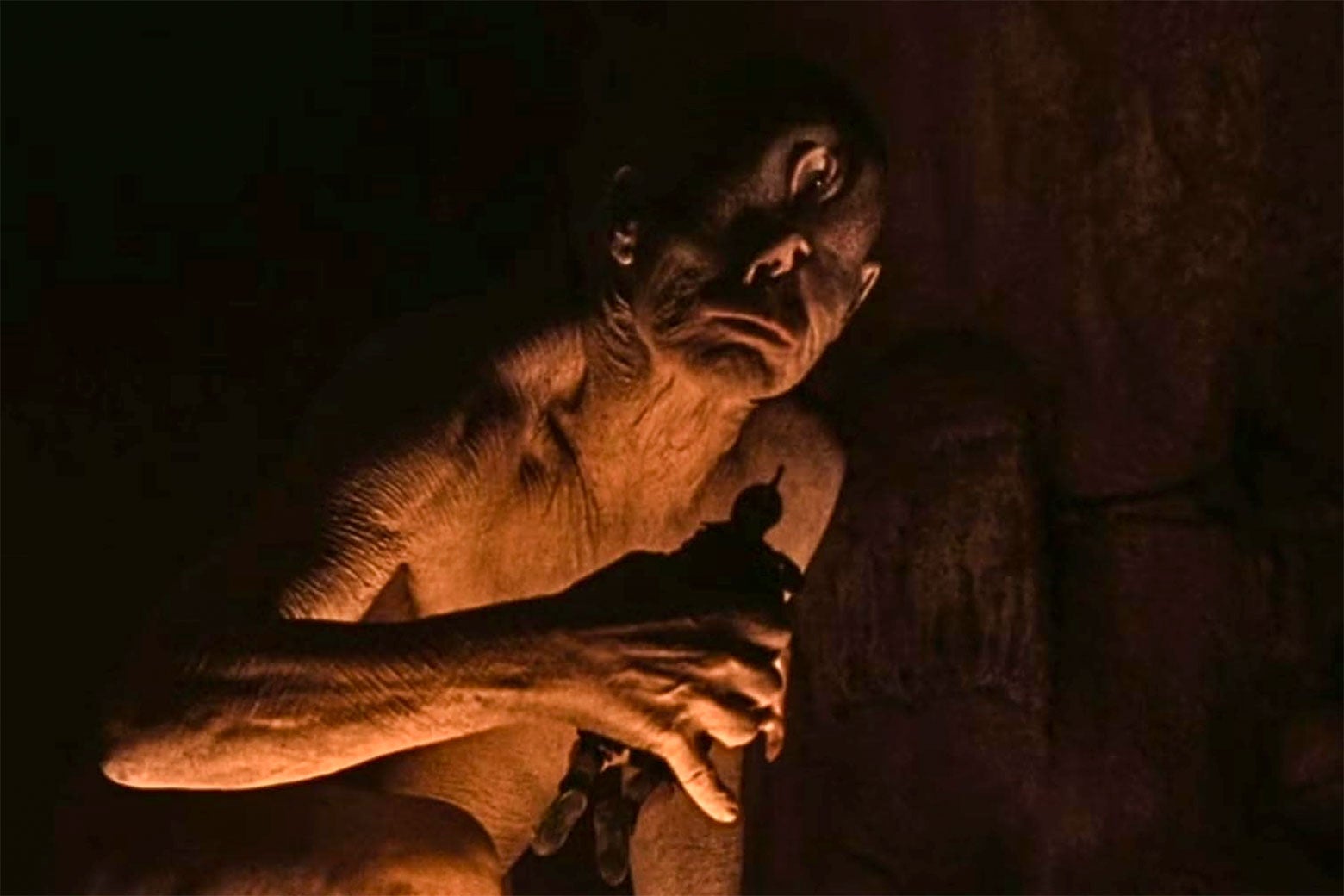
Movies As the pitiful, terrifying Cyclops, the great Bill Irwin reimagines one of the story’s most famous characters. By Enter your email to receive alerts for this author. Sign in or create an account to better manage your email preferences. Unsubscribe from email alerts Are you sure you want to unsubscribe from email alerts for Sam Adams? July 25, 20265:50 AM Bill Irwin as the Cyclops in The Odyssey. Universal Pictures Sign up for the Slatest to get the most insightful analysis, criticism, and advice out there, delivered to your inbox daily. A week after the release of The Odyssey, the movie has been so highly lauded and exhaustively dissected that it’s hard to imagine that any aspect of Christopher Nolan’s blockbuster epic remains overlooked or underpraised. And yet there’s one performance that isn’t getting its due, in part because some people don’t see it as a performance at all. After the opening-weekend dust had settled, Variety published a ranked list of what it called “every performance in Christopher Nolan’s film,” and while that’s obviously a bit of headline hyperbole—what, no mention of “Third Trojan” or “Old Man at Coastal Village”?—the article does touch on most of the major and even some of the minor parts. (Frankly, I barely remember anything about Logan Marshall-Green’s Melanthius, and I’ve seen the movie twice.) And although you can certainly argue with some of the list’s placements—Tom Holland’s Telemachus, I think, gets an especially unfair rap—my main quarrel is the total omission of one of The Odyssey’s most inspired and important characterizations: Bill Irwin’s Cyclops. Odysseus’ encounter with the Cyclops is one of the Odyssey’s key episodes, first alluded to by Zeus himself in the opening stanzas of Homer’s poem, and considered important enough to get an entire book to itself: Book 9, whose title Emily Wilson translates as “A Pirate in a Shepherd’s Cave.” Homer’s original story is quite different from the one that’s passed into popular recollection. His Cyclops, named Polyphemus, is a monster, but an articulate and even reasonable one, at least as far as man-eating descendants of the gods go. Sure, he traps Odysseus and his men in his cave and proceeds to rip them apart and swallow them two at a time. But he’s civil enough to share Odysseus’ wine around the fire and takes enough of a liking to the hero that he promises to eat him last. Homer’s Odysseus repays the Cyclops’ brief mercy with trickery and vengeance. He drives a hot wooden spear into the giant’s single eye and rushes out of the cave while it’s still gushing blood. Poor Polyphemus cries to the other Cyclopes for help—in this version of the tale, the “cyclopean people” have a kind of loose society, although they prefer to keep to themselves—but because Odysseus has cunningly told him that his name is “Noman” (or, in other translations, “Nobody”), when Polyphemus screams that he has been wounded by “no man,” his one-eyed neighbors think he’s the object of divine vengeance and opt to keep out of it. That might have been the end of the episode, except that Odysseus is so pleased with his own trick that he can’t resist a final boast as his ship pulls away. “If any mortal asks you how your eye was mutilated and made blind,” he calls out, “say that Odysseus, the city-sacker, Laertes’ son, who lives in Ithaca, destroyed your sight.” Irwin at the premiere of The Odyssey. Dia Dipasupil/Getty Images Odysseus’ spite costs him dearly. Polyphemus’ father is the sea god Poseidon, and because Odysseus has given him everything but his home address, he knows exactly whom to turn his father’s wrath toward. Needless to say, pissing off the god of the sea has bad results for Odysseus’ ocean-bound voyage home, and though Homer doesn’t exactly blame him for his fate, he underlines the violence of his hero’s actions, dwelling for several lines on the precise sound the Cyclops’ eyeball makes as it sizzles. It’s a stretch to say we’re meant to feel bad for Polyphemus—Homer is equally explicit about the way he tears Odysseus’ men apart and slurps down their innards—but at the very least Poseidon’s yearslong campaign to put him in a watery grave doesn’t seem entirely out of line. Irwin’s version of the Cyclops is much more alien than Homer’s, stranger and more mysterious. He never speaks to Odysseus or his men, and when he finally does cry out to his father, the words are nearly impossible to make out (although, to be fair, unintelligible dialogue is not that much of a rarity in a Christopher Nolan movie). He’s an unreasoning brute, chomping off men’s heads with such indifference he might as well be eating a lollipop. And yet, as Irwin plays him, he’s also a melancholy, even pitiable figure, a solitary outcast who’s just happy making cheese in his cave until Odysseus and his men push their way in. After all, he seems pretty good to the sheep. Irwin is an acclaimed stage actor, a Tony winner for the 2005 revival of Who’s Afraid of Virginia Woolf? (playing George to Kathleen Turner’s Martha) and perhaps the world’s leading performer of Samuel Beckett. He’s also Sesame Street’s Mr. Noodle, the most visible manifestation of his lifelong mastery of clowning. None of that makes a scrawny 76-year-old the obvious choice to play a towering fairy-tale ogre. But that’s precisely why Irwin’s performance, and Nolan’s decision to cast him in the part, is so inspired. Irwin’s Cyclops isn’t as muscled as Matt Damon’s Odysseus and his battle-hardened soldiers, and he’s not as hostile and warlike as the faceless Laestrygonians, who burst out of the mist with their swords ready for blood. He’s an ancient being, lumbering and saggy—and yet still powerful enough to rip a man to pieces without a second thought. Irwin’s Cyclops is devouring Odysseus’ crew not because he’s malicious. He’s doing it because they wandered into his home. And he doesn’t even seem to enjoy it that much: The first time he takes a bite, he winces like a child who’s just been fed a new vegetable, and lets a stray limb fall from the corner of his mouth. He seems barely aware that he’s tearing into a living thing, because he’s so much farther up the food chain that humans are both literally and figuratively beneath his notice. When the Cyclops finally calls out in pain, one of Odysseus’ men expresses shock that the creature has never once spoken to them. Odysseus responds, “Do you talk to ants?” Perhaps the lack of dialogue is why Irwin’s performance has been overlooked—James Ortiz, the puppeteer who did the voice of Project Hail Mary’s Rocky, has been floated as a potential Best Supporting Actor nominee, despite the fact that he never appears onscreen—or maybe it’s because the performance isn’t his alone. Since Bill Irwin isn’t actually 60 feet tall and Nolan famously favors practical effects, there are some shots in which the character is represented only by a giant hand poking out from the side of the frame, and others where he’s played by what amounts to a giant puppet. And because Nolan and Irwin have yet to reveal in detail how the sequence was filmed, it’s sometimes not clear what you’re looking at: Is that twisted-sideways nose and single eye atop the Cyclops’ face actually Irwin’s, and if so, how did it get there? (Nolan’s movies always use some digital effects, but he tends to reserve them for places where they won’t be noticed, and to do the big showstoppers for real.) Still, if you’ve ever seen Irwin perform, especially onstage, you know that he uses his whole body as a carefully tuned instrument, and the Cyclops’ entrancingly odd body language seems cut from precisely the same cloth, especially since Irwin is also responsible for the Cyclops puppet’s movement. Even when Nolan cast him as the sardonic robot sidekick TARS in Interstellar, Irwin, who manipulated TARS’ chassis on set while delivering his lines, managed to bring emotion and character to a 200-pound pile of metal blocks. In Nolan’s Odyssey, the Cyclops encounter is the first time we get a glimpse of the true Odysseus—not the hero whose deeds are already passing into legend but the sly, resourceful leader who is also ruthless, impetuous, and cruel. There’s no reason for him to fire a final arrow into the Cyclops’ already useless eye as he and his men flee the cave, and the movie doesn’t even try to give us one. It’s petty and rash, carelessly endangering the lives of his surviving crew with what amounts to a touchdown dance. And it feels especially heartless because Irwin has made one of myth’s great monsters into a sympathetic figure. When the blinded Cyclops flails about on his back, he feels more like a wounded baby than a defeated enemy. We’ll learn much more about Odysseus’ supposed heroism as The Odyssey goes on, how much of what has gone down in history as a glorious victory was actually more like a treacherous slaughter. But it starts with the Cyclops, a terrifying abomination who turns out to be a sad-eyed hermit. Read more in Slate about The Odyssey. Get the best of culture Get the best of movies, TV, books, music, and more. The Oscars Christopher Nolan The Odyssey
The Most Overlooked Performance in The Odyssey Is Also the One That Towers Over All the Rest
Full Article
Original Source
Read the full article at Slate →KhanList aggregates and links to publicly available news content. We do not host full articles from third-party sources. Always verify important information with original sources.