
For most of its history, Pakistan’s geopolitical value has risen and fallen with other countries’ emergencies. The Mecca Pact may be its most serious attempt yet to break that cycle. On Aug. 31, Pakistan, Saudi Arabia, and Turkey established a secretariat in Saudi Arabia for the Mecca Defence Agreement. The first secretary-general comes from Pakistan for a three-year term. The agreement builds on the Saudi-Pakistani agreement signed in September 2025, locking a decades-old informal security arrangement into a mutual defense pact. Turkey’s inclusion in August 2026 transformed it into a NATO-style collective security arrangement. The three states also outlined cooperation in air defense, drones, electronic warfare, and joint defense production. The pact thus represents more than a new alliance: connecting Saudi financial resources and Gulf influence, Turkish defense industrial capacity and NATO experience, and Pakistan’s large military, nuclear status, and longstanding regional security ties. While institution-building is still at an early stage, it appears to support Pakistan’s pursuit of durable strategic leverage in the region. Its first test came within weeks. On Oct. 5, the pact’s collective-defense commitments were activated amid escalating Houthi missile and drone attacks on Saudi Arabia. A senior Pakistani military official has also mentioned that Pakistani jets are used in strikes against the Houthis. If confirmed, this would mark a reversal of Pakistan’s refusal to join the Yemen war in 2015.The pact may face credibility gaps from limited interoperability and divergent threat perceptions. However, in middle-power contexts, complementary expertise and a division of labor can be equally important for credibility. Rapid institutionalization can also help address weaknesses by defusing the risks of alliance entrapment and competing regional blocs. Establishing a permanent secretariat is an important first step. While institutionalization can enhance the pact’s credibility, it also helps advance Pakistan’s longstanding ambition to anchor itself in a vital standing regional security architecture, giving the agreement a substantive foundation beyond political symbolism.Pakistan has benefited from U.S. policies in the Middle East and South Asia, especially during recent conflicts and geopolitical realignments. The May 2025 India-Pakistan crisis renewed Washington’s strategic attention to Pakistan, as the United States got directly involved in ceasefire efforts and President Donald Trump subsequently hosted Pakistan’s army chief, Field Marshal Asim Munir, at the White House. The war with Iran has widened that opening, given Pakistan’s unique relationships with both Washington and Tehran. Islamabad has emerged as a key intermediary between the two sides and played a crucial role in the preliminary ceasefire and negotiating framework in June 2026. Moreover, Iranian attacks on Gulf states, Israeli attacks on Qatar, and disruptions to energy flows through the Strait of Hormuz have increased demand among Gulf states for additional deterrence and military cooperation, making Pakistan’s longstanding security relationships in the region more valuable. Islamabad has tried to convert this attention into economic benefits, including a request for $10 billion in U.S.-backed exchange stabilization support. While this underscores Pakistan’s continuing economic vulnerability and external dependence, that very weakness also gives it stronger incentives to cultivate long-term bargaining leverage from comparative advantage in military capabilities.What Pakistan intends to buy with this newfound vitality remains to be seen. Pakistan is now seeking to translate its recent diplomatic access and military role into institutions and relationships that can survive them. Instead of short-term material gains, Islamabad is investing in standing defense commitments, mutual consultation, and defense-industrial cooperation to retain a pivotal place in regional security after a shift either in Washington’s attention or in Gulf countries’ threat perception. Whether the country succeeds will depend on how the agreements and the institutional foundation supporting them can generate continuous and meaningful cooperation in the long run.Pakistan’s Recurring Strategic WindowsPakistan has carried periodic geopolitical weight when major powers needed its engagement. The United States relied on Islamabad to broker the 1971 U.S.-Chinese rapprochement, fight the Soviets in Afghanistan, back the “Global War on Terror,” and — most recently — manage tensions with Iran. Pakistan utilized these strategic windows to access resources and weapons and raise its international standing. However, that leverage languished once the crises passed. Islamabad is trying to break that cycle and place itself as an indispensable hub in the region’s long-term security architecture.This cycle has deep roots. During the Soviet-Afghan War, Pakistan became the crucial link for American and Saudi support to the Afghan mujahedeen, gaining enormous resources and strategic importance. After the Soviet withdrawal, U.S. assistance fell sharply as Washington’s focus shifted toward Pakistan’s nuclear program. Following 9/11, Pakistan again became central to U.S. operations in Afghanistan and received substantial security and economic benefits. However, the partnership remained largely transactional, and as mistrust deepened and the United States withdrew from Afghanistan, Pakistan’s place in Washington’s strategic calculus faded.The current opening is broader because it is not driven by one conflict or one patron. Pakistan has found fresh room to maneuver at the intersection of several developments, including uncertainty about U.S. security commitments in the Gulf, Saudi Arabia’s search for increased deterrence, Turkey’s effort to expand its defense-industrial and political reach, and Washington’s need for intermediaries who can communicate with Tehran. The Iran war has made these trends more visible, especially as missile and drone attacks across the Gulf and disruptions to shipping through the Strait of Hormuz have reinforced interests in regional security arrangements. Turkey’s expanding defense industry has also made Ankara a major supplier of drones, armored systems, and joint production opportunities.While both Saudi Arabia and Turkey are important to this emerging dynamic, Pakistan occupies a different niche, making it a natural leader in this process. The country has been involved in a crucial mediation role with Iran, including efforts to restart the U.S.-Iran talks, while maintaining close ties with all regional and major power actors. It was able to keep the relationship with Tehran functional as well, despite deepening its security partnership with Riyadh. This demonstrates diplomatic assets that Pakistan now possesses and their usefulness to actors that have difficulty talking to one another. This unusually rich access gives Pakistan an opportunity to seal a more permanent place in the emerging regional security order.Toward a Lasting Foothold in the Regional Security Architecture The Saudi-Pakistani defense relationship has a long history. Pakistani troops served in the country in the 1970s and 1980s, and the two militaries have maintained ties for decades. The 1982 protocol provided an earlier framework for military cooperation. Pakistani forces also helped protect Saudi territory during the 1990 to 1991 Gulf crisis. In turn, Riyadh repeatedly provided Islamabad with oil facilities, loans, and financial support during economic distress. Although Saudi financing gives Riyadh leverage over Islamabad, Pakistan’s ability to supply military personnel, training, and air defense helps offset that asymmetry.On Sept. 17, 2025, they formalized the relationship by signing the defense agreement, although many of its operational details remain undisclosed. Its nuclear implications have generated wide speculation since neither side has announced a Pakistani nuclear guarantee. However, the ambiguity can allow Riyadh to signal a hedge against the Iranian nuclear program without an explicit arrangement and Islamabad to accrue returns without accepting a defined obligation. The nuclear question also looks different after the United States signed a Section 123 civil nuclear cooperation agreement with the Saudi government on July 22. This may indicate greater U.S. flexibility toward Saudi nuclear ambitions to counterbalance the risk of an Iranian nuclear breakout.The agreement’s conventional significance is also substantial, as it gives a durable expression to ad hoc arrangements and extends peacetime cooperation to wartime commitments. Pakistan’s key motivation is to leverage its conventional military strength to compensate for its economic vulnerability, while deepening ties with major Middle Eastern partners. The country has long monetized military capacity abroad, including through U.N. peacekeeping, but in this case it seeks to turn military power into a standing role in regional security. Saudi Arabia adds money, political weight, and a central position in Gulf security. Pakistan and Turkey already cooperate on naval platforms and conduct combined exercises. Turkey brings capabilities Pakistan and Saudi Arabia lack, including a large and experienced NATO military and growing expertise in drones, naval platforms, electronic warfare, and missile-related technologies.Pakistan has deployed a substantial combat-capable force to Saudi Arabia — roughly 8,000 troops, about 16 JF-17 fighter jets, two drone squadrons, and a Chinese-made HQ-9 air-defense system. The total could rise up to 80,000 if Riyadh invokes the full scope of the agreement. On October 5, the three states formally moved to the “practical implementation” of their collective-defense commitments, authorizing measures to provide agreed military forces and capabilities and ensure their rapid deployment to the Kingdom. Two days later, Pakistan Air Force jets were reportedly taking part in strikes to degrade Houthi missile and drone threats. Islamabad denied the claim and said only that Pakistani forces were in the kingdom in “multiple capabilities.” Turkey has also agreed to send technical and defensive support to help Saudi Arabia fight the Houthis. The progression to an activated deployment and support mechanism shows that the pact is evolving from a political commitment into a credible regional military architecture.Pakistan has a strong incentive to turn this trend into a standing, broader security architecture in which its role becomes both central and lasting. The Aug. 31 decision to create a secretariat matters for that reason. Rotating leadership and a fixed seat can allow the organization to outlast the signatory governments’ immediate priorities. A standing secretariat lowers the transaction costs of each subsequent round of cooperation and of planning cycles that would otherwise require fresh political authorization. It also creates constituencies inside each defense establishment whose professional interests are tied to the arrangement’s continuation. Its longer-term significance, however, will depend on whether the secretariat continues to remain active and functional, combined planning and exercises take place without fresh authorization from all three capitals, and defense cooperation leads to concrete contracts and combined production.Why a Constrained Arrangement May Still WorkThe pact faces concerns over credibility gaps in interoperability and threat perception, or over the “all-patrons, all-clients paradox.” In a major power–protégé relationship, interoperability and a shared threat perception are canonical measures of credibility and alliance commitments. However, among middle powers, particularly in a South-South context, the equation can be different. As confidence in vertical extended deterrence by a major-power patron declines, and in the absence of the full-spectrum capabilities of any single middle power, the value of a defense pact may lie primarily in complementary capabilities and a division of labor. Such arrangements may not be effective in every conflict, but by expanding the pool of joint resources and filling gaps in one another’s capabilities, they can help strengthen collective deterrence. Through institutionalization and regularized exchanges, interoperability may improve over time, while convergence in threat perceptions may also gradually increase.A discouraging fact is that the past regional record has been poor. The Arab League’s 1950 Joint Defence Treaty, the Peninsula Shield Force, and the Islamic Military Counter Terrorism Coalition failed to produce durable multilateral capacity or impact. What distinguishes the Mecca pact, however, is that it is neither driven by a single conflict — such as the Arab-Israeli conflict shaping the Arab League’s collective defense arrangements — nor crowded by competing Arab powers with conflicting regional interests. Pakistan’s role as a form of informal leader and interlocutor can be particularly important in this context.Pakistan’s history with Saudi Arabia does not indicate automatic alignment. In 2015, Pakistan declined to join the Saudi-led intervention in Yemen, despite Saudi request and economic support. The pact, however, has changed that dynamic. In 2026, Islamabad sent combat-ready forces and assets to Saudi Arabia while simultaneously serving as the principal mediator between Washington and Tehran and easing Iranian trade through overland routes across their shared border. American critics questioned Pakistan’s suitability as a mediator after reports of Pakistan sheltering Iranian military aircraft. Pakistan’s relationship with Iran is also constrained by domestic sectarian sensitivities and a need to avoid being pulled too deeply into Gulf rivalries. The new agreement does not erase these constraints, and it does not need to. The pact can produce a calibrated behavior by Pakistan, with a force present enough to satisfy the commitment and postured conservatively enough to avoid upsetting the Iranian relationship. Reports of Pakistani involvement in airstrikes in Yemen, followed by officials describing the role as defensive and affirming no deployment of ground forces, and a public denial of involvement in the strikes, all suggest what a calibrated response may look like. The durability of the arrangement may depend on retaining that flexibility for Pakistan.There can be additional constraints. The attack-on-one-attack-on-all formula can be difficult to interpret in an Indian-Pakistani contingency, where Riyadh faces strong incentives for restraint given its economic and strategic ties with New Delhi. However, the pact does not require members to enter a war automatically or at a similar scale. If Pakistan requests assistance, the possibility of Saudi or Turkish support could complicate Indian calculations. The support could take forms short of direct combat, including arms, air defense, intelligence, logistics, training, or diplomatic coordination. Nevertheless, an India-Pakistan war would be a hard test. Even if Riyadh and Ankara avoid direct fighting, the pact would still matter if it could generate meaningful military, logistical, intelligence, or diplomatic support. In their absence, the claim that Pakistan had secured a durable strategic position would be much weaker.Ankara’s participation also raises unresolved questions about how NATO obligations and restrictions on American defense technology would intersect with trilateral defense cooperation. The constraint is more relevant to joint defense production. Turkey’s defense industry is integrated with NATO and continues to use U.S.-origin technology in important systems. U.S. export control rules generally require authorization before controlled defense articles or technical data can be retransferred to third parties, limiting technologies Ankara can share. This may force trilateral production to rely on domestically developed components, or cooperation may take place in systems over which Turkey and Pakistan possess greater control.The pact has produced reactions from surrounding powers. An Iranian parliamentarian warned two days after the signing that an attack originating from the territory of any of the three would draw a response without qualification. However, these constraints narrow the range of cooperation the pact can realistically institutionalize, but they do not render the arrangement ineffective. They would matter less if the arrangement works as a framework for sustained security cooperation. For Pakistan, its value lies in institutionalizing a broader role in supplying military personnel, supporting training and defense production, contributing to collective deterrence, and serving as an intermediary across competing regional relationships.The India Problem, and Pakistan’s Different AnswerThis move is partly Pakistan’s answer to India’s strategic outreach and influence. Islamabad cannot match India’s economic weight or growing partnerships across the Gulf, Africa, and Asia. Pakistan, however, can offer something that many stakeholders in the Middle East would highly value. It has a nuclear-armed military that Gulf governments know well, and it can open channels to Washington, Beijing, Riyadh, Tehran, and Ankara simultaneously. While U.S. security guarantees still matter, they carry less certainty than before. Pakistan is positioning itself to fill that space as an additional supplier to governments and leverage that centrality in its competition with India.This is a clever approach to asymmetry instead of trying to compete with India everywhere. India’s relations with the Gulf have expanded beyond energy cooperation. India participates in a Strategic Partnership Council with Saudi Arabia, a strategic dialogue with the Gulf Cooperation Council, and in the India-Middle East-Europe Economic Corridor. Its ties with the United Arab Emirates have expanded into investment, technology, logistics, and defense cooperation. These relationships rest on the scale of India’s economy, market, diaspora, and growing international weight, which Pakistan cannot reproduce.Pakistan’s strategy thus concentrates on comparative assets it can leverage. Security is a domain in which it offers battle-tested capabilities valuable to the Gulf states. Pakistan’s operational performance against India during the 2025 confrontation generated acclaim, bringing its tactical capabilities into international focus. It is better positioned in the Gulf to train forces, provide officers and advisers, participate in exercises, contribute to air and missile defense coordination, cooperate on defense production, and serve as a mediator with several powers at once.India is an important reference point for any Pakistani long-term strategy. New Delhi will closely assess the expansion of Pakistani military reach in important regions. Saudi Arabia and Turkey have their own substantial relationships with India and strong incentives to preserve them. While signing the agreement with Pakistan in 2025, Saudi officials emphasized that Riyadh also intended to continue developing its relationship with New Delhi. Pakistan’s objective can thus be limited to ensuring that India’s expanding economic and diplomatic influence does not leave Pakistan without options and strategically peripheral to the Gulf.What This Means for WashingtonThe pact’s significance for the United States is not trivial. U.S. governments prefer partners to share the burden of managing their own security. A network of allies and non-NATO partners for strengthening deterrence, expanding air and maritime capability, and redistributing security burdens could serve that objective. Pakistan and Turkey both have long experience operating American systems and working with Western armed forces, although they have diversified their partnerships. Saudi Arabia remains deeply tied to U.S. weapons, training, and security cooperation. None has an interest in replacing the United States with a different security order. From that standpoint, the pact does not offer an alternative to the U.S.-led security arrangement. It would function as an additional layer within it, allowing regional states to arrange capabilities that Washington is reluctant to supply. If the reports of Pakistani aircrafts taking part in air strikes in Yemen are accurate, then Pakistan would be taking on a mission that U.S. forces carried out themselves in 2024 and 2025.However, burden-sharing can change the strategic autonomy of partner states. The network that can supplement American power offers its members more room to maneuver without Washington. Combined defense production can reduce dependence on U.S. suppliers. New mechanisms for political coordination can allow regional powers to prioritize policies without Washington’s involvement. Pakistan’s relationships with China and Iran mean that the value it offers to U.S. partners is partly derived from its nonexclusive alignment with the United States. For Washington, its partners may increasingly coordinate more independently, but that coordination should be compatible with U.S. interests in continued access, interoperability, technology protection, and escalation management.The emerging regional security network built around Pakistan could remain embedded in an order that Washington can still largely shape. But such arrangements remain favorable to U.S. interests only if Washington actively tends to them. By doing so, the United States could gain an additional and less expensive layer of regional deterrence. If it dismisses these arrangements or mistakes them for a strategic break with Washington, Islamabad will have strong incentives to offer the same strategic value elsewhere. There are other eager buyers, and the recent institutionalization with Pakistan at its center makes its offer more competitive.That is Pakistan’s current moment. It is still learning how to use temporary geopolitical demand to build relationships and institutions that outlast the demand. For Pakistan, the test of the Mecca pact will be whether it can secure a durable central place in Gulf security planning after the ongoing crises subside. For the United States, the test will be whether it can accommodate a greater autonomy of its allies and partners in the Middle East and South Asia, while continuing to shape the regional order in which that autonomy develops and is exercised.Muhib Rahman is a postdoctoral fellow at Perry World House at the University of Pennsylvania and an incoming assistant professor at the School of International Service at American University. His scholarly work and public-facing works have appeared across a wide range of academic journals and media outlets.Nazmus Sakib is a lecturer at the University of Kentucky. His research and commentary have appeared in numerous scholarly journals and press platforms. Image: The White House via Wikimedia Commons
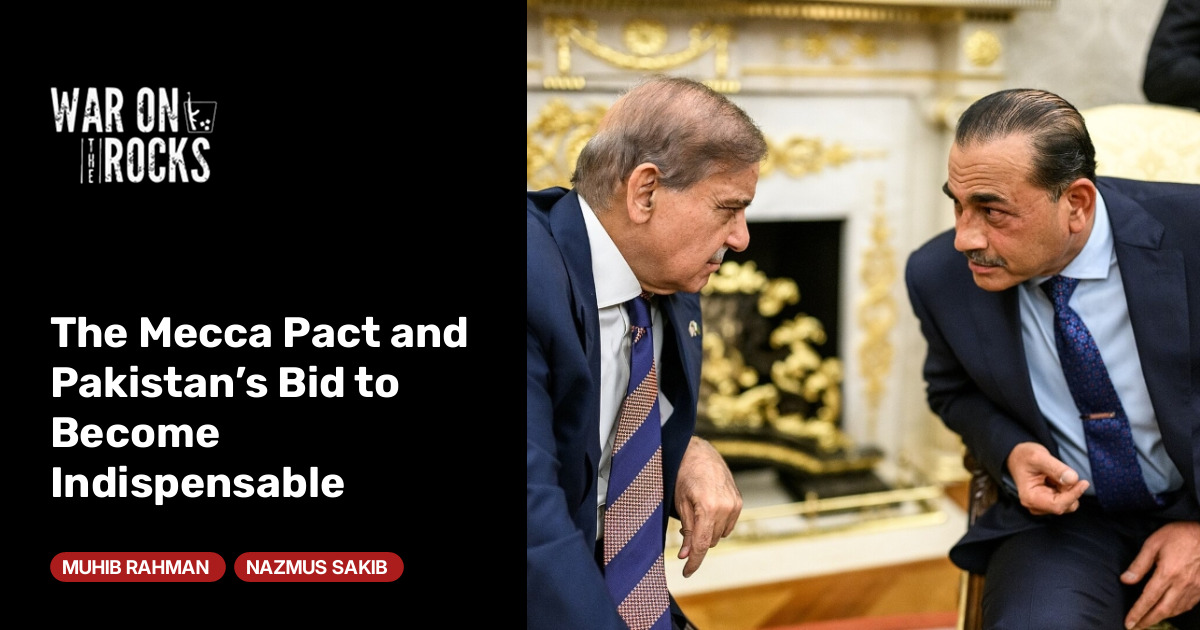
The Mecca Pact and Pakistan’s Bid to Become Indispensable
Full Article
Original Source
Read the full article at Warontherocks →KhanList aggregates and links to publicly available news content. We do not host full articles from third-party sources. Always verify important information with original sources.