
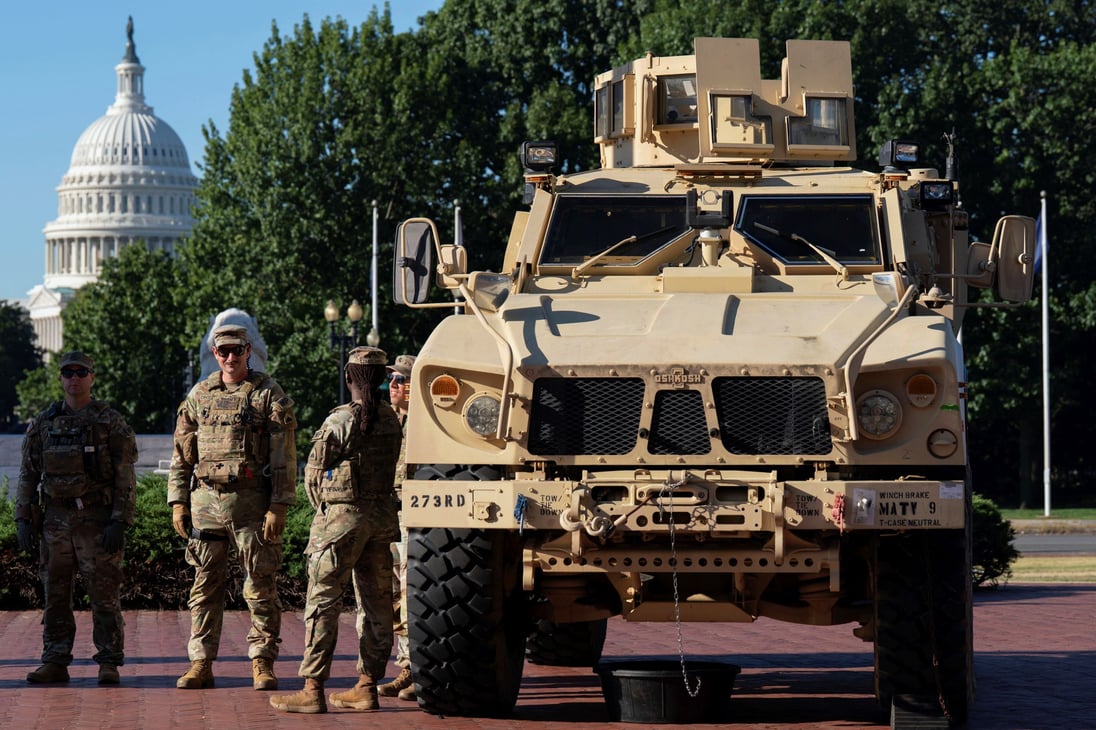
In the 13 months since their deployment, patrolling troops have become a part of daily life in the District, with constant patrols and units stationed in metro stations and public spaces.WASHINGTON (CN) — A D.C. Circuit panel on Wednesday appeared likely to uphold a federal court order to end the deployment of National Guard troops in the nation’s capital that first began over a year ago last August.The three-judge panel heard arguments for the first time since a federal judge ruled in November 2025 the deployment was clearly an unlawful activation of troops for non-military, crime-deterrence missions without any request from D.C. Mayor Muriel Bowser.U.S. District Judge Jia Cobb, a Joe Biden appointee, stayed her order until Dec. 11 pending the government’s appeal, which it quickly did. A stay panel dominated by Donald Trump appointees extended the stay throughout the appeal on Dec. 17, 2025, allowing the deployment to continue.Mitchell Reich, of the Office of the Attorney General for D.C., argued that the National Guard’s deployment has gone well beyond the president’s purported mission of clamping down on crime and has since become an effort to normalize military troops on the streets of an American city.“For over a year, thousands of National Guard troops have been patrolling the streets of the District of Columbia, detaining suspects, assisting in the execution of warrants and otherwise enforcing the law," Reich said.“In order to justify this extraordinary and indefinite deployment of military power in an American city, defendants would need to identify some statute or constitutional provision that authorizes is. But as to both the D.C. guard and the out-of-state guard units patrolling the District, they have failed to do so.”Reich highlighted how in recent weeks National Guard troops have been seen staging outside an elementary school in the city and stationed around ballot drop boxes, raising both safety concerns for young children and voter intimidation concerns with the midterm elections.Following the latter incident, National Guard officials stated that units are directed not to monitor or secure polling locations and would address any further incidents.Reich argued that such instances have negatively impacted public faith in the Metropolitan Police Department and made it more difficult for local law enforcement to do their jobs, while also making vulnerable residents fearful of going about their daily lives, resulting in diminished economic activity in the city.He urged the merits panel — made up of U.S. Circuit judges Cornelia Pillard and Bradley Garcia, an Obama and Biden appointee respective, and Senior U.S. Circuit Judge Judith Rogers, a Bill Clinton appointee — to affirm Cobb’s injunction and allow her to grant the city summary judgment.Justice Department attorney Eric McArthur argued Wednesday that the National Guard’s mission has been “striking success” and was clearly within the president’s authority under the D.C. Militia Code to order out any portion of the National Guard for any duties he deems proper.McArthur rejected Cobb’s determination that the president needed the D.C. mayor’s request before acting, as such requests under Section 103 of the D.C. Code are only meant to address specific crises.“There has to be a mob, a riot, or some similar body of men gathered to break the law,” McArthur said. “So that’s a very narrow provision that’s specifically focused on riot suppression. It wouldn’t authorize any of these other things, it wouldn’t authorize pandemic relief, it wouldn’t authorize drug interdiction, it wouldn’t authorize help with demonstrations and inaugurations.”Rogers noted that the government’s theory granted the president broad authority despite the fact Congress has primary authority over D.C. under the Constitution.“It can’t be that the president says crime is out of control, so he can just call out the guard and do whatever he wants,” Rogers said. “Under Article I, Congress is in charge of the District of Columbia, and as part of the president’s budget, he includes requests by the city for law enforcement and Congress may appropriate money in accordance with that.”In the 13 months since the deployment, the National Guard has become a part of daily life in the district, with small patrols between three and six troops stationed throughout the city in federal parks, metro stations and residential areas, regularly armed with handguns and assault rifles.The mobilization has been extended through the remainder of Trump’s term.A May 28 report by the Niskanen Center found that the deployment resulted in a 24% reduction in opportunistic property offenses, but concluded that it failed to address the worst types of crime in the city and at an exorbitant price tag.The center found the average daily cost per Guard member in D.C. was $607, totaling approximately $185 million in just the first five months of the deployment.“Property crime deterrence through visible uniformed presence in public spaces is real,” the center wrote. “But violence in D.C.’s most disadvantaged neighborhoods required something more targeted, more sustained and more strategically aligned with the actual geography of harm.”Subscribe to our free newslettersOur weekly newsletter Closing Arguments offers the latest about ongoing trials, major litigation and rulings in courthouses around the U.S. and the world, while the monthly Under the Lights dishes the legal dirt from Hollywood, sports, Big Tech and the arts.Additional Reads
DC urges appeals court to end yearlong National Guard deployment in capital
Full Article
Original Source
Read the full article at Courthousenews →KhanList aggregates and links to publicly available news content. We do not host full articles from third-party sources. Always verify important information with original sources.